Currently, I write police procedural novels with the stories taking place in Hollywood during the early 1960s; a period when I was a street cop there. I've moved to Mexico to be closer to my hobby of studying Mexican history. My friend and fellow author, Professor Michael Hogan, is my mentor.
I am planning to write a three-part epic story that takes place in the mid-nineteenth century. What has inspired me was hearing about Los Ninos Heroes, martyrs of the Battle of Chapultepec. Also, my father was born in Concordia, Mexico and knowing his family history is an added incentive.
View all posts by jesswaid →
Here’s a blogpost kindly shared by the folks at Radio Free Kaslo, a fun, funky Canadian radio program. I’m a fan of the show, and am happy to have given them access to my jazz collection, which apparently is going to be featured in future shows as well.
Today’s Radio Free Kaslo broadcast (Friday, April 12, 2013), features the stunning insights of marketing guru to the stars (and all-around Big Personality) Blair Enns…
… an interview that includes tough, probing questions (like “have you ever caught a fish in Kootenay Lake, and if so, how big?”) with Liberal candidate for the British Columbia legislature Greg Garbula…
… and music from Emmy Lou Harris & Rodney Crowell’s new album…
…as well as a soulful tune from the great Billie Holiday…
… the latter pulled from the extensive Jazz collection of author Jess Waid (The Mike Montego Series and the forthcoming He Blew Blue Jazz). Many thanks to Jess!
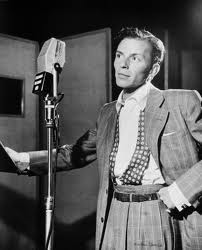
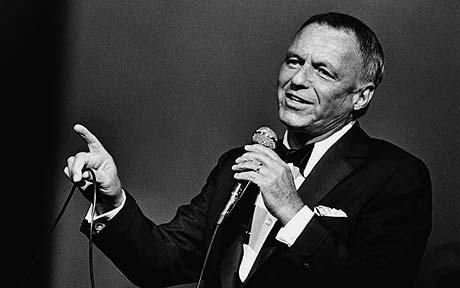
I never actually met Sinatra, but I did experience a “drive-by” exchange. While leaving Hollywood High School one afternoon with a gorgeous blonde classmate, I got the “evil eye” from Ol’ Blue Eyes. He was heading west on Selma at Highland Avenue driving a ’54 gray T-bird convertible. I guess he might’ve been jealous. Eat your heart out, Frankie baby.
Francis Albert “Frank” Sinatra, (b. December 12, 1915, d. May 14, 1998) was an American singer and film actor. Beginning his musical career in the swing era with Harry James and Tommy Dorsey, Sinatra found unprecedented success as a solo artist from the early to mid-1940s after being signed to Columbia Records in 1943. Being the idol of the “bobby soxers”, he released his first album, The Voice of Frank Sinatra in 1946. His professional career had stalled by the 1950s, but it was reborn in 1953 after he won the Academy Award for Best Supporting Actor for his performance in From Here to Eternity.
He signed with Capitol Records in 1953 and released several critically lauded albums (such as In the Wee Small Hours, Songs for Swingin’ Lovers!, Come Fly with Me, Only the Lonely and Nice ‘n’ Easy). Sinatra left Capitol to found his own record label, Reprise Records in 1961 (finding success with albums such as Ring-a-Ding-Ding!, Sinatra at the Sands and Francis Albert Sinatra & Antonio Carlos Jobim), toured internationally, was a founding member of the Rat Pack and fraternized with celebrities and statesmen, including John F. Kennedy. Sinatra turned 50 in 1965, recorded the retrospective September of My Years, starred in the Emmy-winning television special Frank Sinatra: A Man and His Music, and scored hits with “Strangers in the Night” and “My Way”.
With sales of his music dwindling and after appearing in several poorly received films, Sinatra retired for the first time in 1971. Two years later, however, he came out of retirement and in 1973 recorded several albums, scoring a Top 40 hit with “(Theme From) New York, New York” in 1980. Using his Las Vegas shows as a home base, he toured both within the United States and internationally, until a short time before his death in 1998.
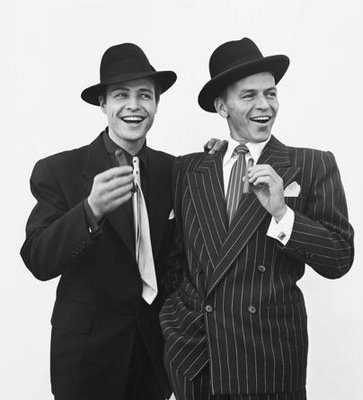
Sinatra with Marlon Brando in Guys & Dolls
Sinatra also forged a highly successful career as a film actor. After winning Best Supporting Actor in 1953, he also garnered a nomination for Best Actor for The Man with the Golden Arm, and critical acclaim for his performance in The Manchurian Candidate. He also starred in such musicals as High Society, Pal Joey, Guys and Dolls and On the Town. Sinatra was honored at the Kennedy Center Honors in 1983 and was awarded the Presidential Medal of Freedom by Ronald Reagan in 1985 and the Congressional Gold Medal in 1997. Sinatra was also the recipient of eleven Grammy Awards, including the Grammy Trustees Award, Grammy Legend Award and the Grammy Lifetime Achievement Award.
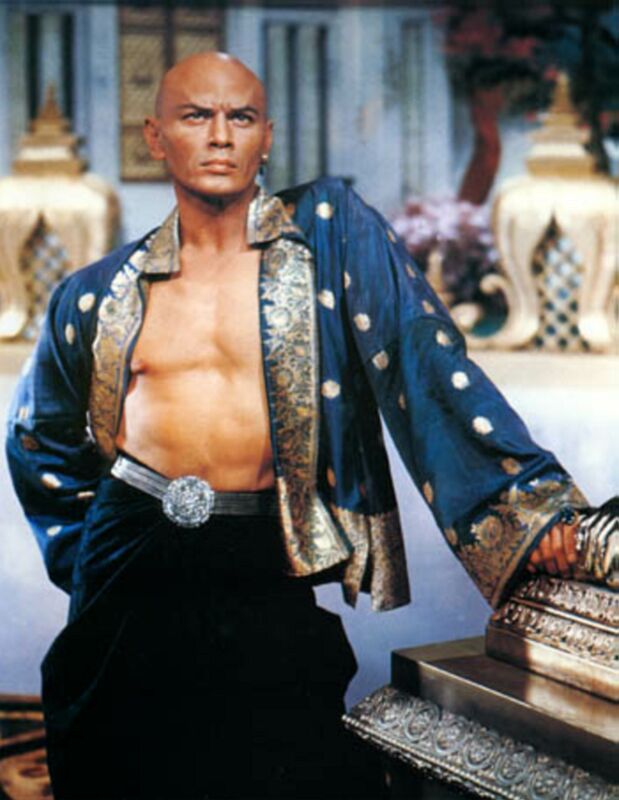
Yul Brynner (b. July 11, 1920, d. October 10, 1985) was a Russian-born American stage and film actor. He was best known for his portrayal of the King of Siam in the Rodgers and Hammerstein musical The King and I, for which he won two Tony Awards and an Academy Award for the film version; he played the role 4,625 times on stage. He is also remembered as Rameses II in the 1956 Cecil B. DeMille blockbuster The Ten Commandments, General Bounine in the 1956 film Anastasia, and Chris Adams in The Magnificent Seven. Brynner was noted for his distinctive voice and for his shaved head, which he maintained as a personal trademark long after adopting it in 1951 for his role in The King and I. Earlier, he was a model and television director, and later a photographer and the author of two books.
Yul Brynner was born Yuliy Borisovich Briner in 1920. He exaggerated his background and early life for the press, claiming that he was born Taidje Khan of part-Mongol parentage, on the Russian island of Sakhalin. In reality, he was born at home in a four-story residence at 15 Aleutskaya Street, Vladivostok, in the Far East Russian Republic (present-day Primorsky Krai, Russia). He also occasionally referred to himself as Julius Briner, Jules Bryner, or Youl Bryner. A 1989 biography by his son, Rock Brynner, clarified these issues.
During World War II, Brynner worked as a French-speaking radio announcer and commentator for the U.S. Office of War Information, broadcasting propaganda to occupied France. At the same time, he studied acting in Connecticut with the Russian teacher Michael Chekhov. Brynner’s first Broadway performance was a small part in Shakespeare’s Twelfth Night in December 1941. Brynner found little acting work during the next few years, but among other acting stints, he co-starred in a 1946 production of Lute Song with Mary Martin. He also did some modeling work and was photographed nude by George Platt Lynes.
Brynner married his first wife, actress Virginia Gilmore, in 1944, and soon after began working as a director at the new CBS television studios, directing Studio One, among other shows. In 1949, he made his film debut in Port of New York, his only film with his natural head of hair. The next year, at the urging of Martin, he auditioned for Rodgers and Hammerstein’s new musical in New York. He recalled that, as he was finding success as a director on television, he was reluctant to go back on the stage. Once he read the script, however, he was fascinated by the character of the King and was eager to do the project.
His best-known role remains that of King Mongkut of Siam in The King and I in which he played 4,625 times on stage over the span of his career. He appeared in the original 1951 production and later touring productions as well as a 1977 Broadway revival, a London Production in 1979 and another Broadway revival in 1985. He won Tony Award for both the first and the last of these Broadway productions. He also appeared in the 1956 film version, for which he won an Academy Award as Best Actor and in a short-lived TV version (Anna and the King) on CBS in 1972. Brynner is one of only nine people who have won both a Tony Award and an Academy Award for the same role. His connection to the story and the role of King Mongkut is so deep that he was mentioned in the song “One Night in Bangkok” from the 1984 musical Chess whose second act is set in Bangkok.
In 1951 Brynner shaved his head for his role in The King and I. Following the huge success of the Broadway production and subsequent film, Brynner continued to shave his head for the rest of his life, though he would sometimes wear a wig for certain roles. Brynner’s shaved head was unusual at the time, and his striking appearance helped to give him an iconic appeal. Some fans shaved off their hair to emulate him, and a shaved head was often referred to as the “Yul Brynner look.”
Brynner made an immediate impact upon launching his mainstream film career in 1956 and quickly gained superstar status after appearing not only in The King and I that year but also in starring roles in The Ten Commandments, and Anastasia with Ingrid Bergman. Brynner, at 5’10”, was reportedly concerned about being overshadowed by co-star Charlton Heston’s height and physical presence in The Ten Commandments and prepared his impressive physique seen in the film with an intensive weight-lifting program.
He appeared in more than 40 other films over the next two decades, including the epic Solomon and Sheba (1959), The Magnificent Seven (1960), Taras Bulba (1962) and Kings of the Sun (1963). He co-starred with Marlon Brando in Morituri (1965), Katharine Hepburn in The Madwoman of Chaillot (1969) and Lee J. Cobb in a film version of The Brothers Karamazov (1958). He played the titular role of The Ultimate Warrior (1975) and starred with Barbara Bouchet in Death Rage (1976). Among his final feature film appearances were in Michael Crichton’s Westworld (1973) and its sequel Futureworld (1976). Brynner also appeared in drag (as a torch singer) in an unbilled role in the Peter Sellers comedy The Magic Christian (1969).
In addition to his work as a director and performer, Brynner was an active photographer and wrote two books. His daughter Victoria put together Yul Brynner: Photographer (ISBN 0-8109-3144-3) a collection of his photographs of family, friends, and fellow actors, as well as those he took while serving as a UN special consultant on refugees. Brynner wrote Bring Forth the Children: A Journey to the Forgotten People of Europe and the Middle East (1960), with photographs by himself and Magnum photographer Inge Morath, and also The Yul Brynner Cookbook: Food Fit for the King and You.
A student of music from childhood, Brynner was an accomplished guitarist. In his early period in Europe he often played and sang gypsy songs in Parisian nightclubs with Aliosha Dimitrievitch. He sang some of those same songs in the film The Brothers Karamazov. In 1967 he and Dimitrievitch released a record album The Gypsy and I: Yul Brynner Sings Gypsy Songs (Vanguard VSD 79265).
Brynner married four times. The first three ended in divorce. He fathered three children and adopted two.
He and his first wife, actress Virginia Gilmore (1944–1960), had one child, Rock Yul Brynner, born on December 23, 1946. His father nicknamed him “Rock” when he was six years old in honor of boxer Rocky Graziano. Rock is a historian, novelist, and university history lecturer at Marist College in Poughkeepsie, New York and Western Connecticut State University in Danbury, Connecticut. In 2006, Rock wrote a book about his father and his family history titled Empire and Odyssey: The Brynners in Far East Russia and Beyond. Rock regularly returns to Vladivostok, the city of his father’s birth, for the “Pacific Meridian” Film Festival. Yul Brynner had a long affair with Marlene Dietrich, who was 19 years his senior, during the first production of The King and I.
Brynner’s daughter Lark Brynner was born out of wedlock in 1959 and raised by her mother, Frankie Tilden, who was 20 years old when Lark was born. Brynner supported her financially. His second wife, from 1960 to 1967, Doris Kleiner, was a Chilean model whom he married on the set during shooting of The Magnificent Seven in 1960. They had one child, Victoria Brynner (born November 1962), whose godmother was Audrey Hepburn.
His third wife, Jacqueline Thion de la Chaume (1971–1981), was a French socialite, the widow of Philippe de Croisset (he was the son of French playwright Francis de Croisset and a publishing executive). Brynner and Jacqueline adopted two Vietnamese children: Mia (1974) and Melody (1975). The first house that he ever owned was the Manoir de Criqueboeuf, a sixteenth-century manor house that he and Jacqueline purchased. His 1980 announcement that he would continue in the role of the King for another long tour and Broadway run, together with his affairs with female fans and his neglect of his wife and children, broke up their marriage.
At the age of 63, he married his fourth wife, Kathy Lee, a 24-year-old ballerina from a small town in Malaysia whom he had met in a production of The King and I in which she had a small dancing role. They remained married for the last 2 years (1983–1985) of Brynner’s life.
Brynner, a Swiss citizen, was naturalized as a US citizen, but in June 1965, he renounced his US citizenship at the US Embassy in Berne, Switzerland for tax reasons. He had lost his tax exemption as an American resident abroad by working too long in the U.S. and would have been bankrupted by his tax and penalty debt.
Brynner began smoking heavily at age 12, and his promotional photos almost always showed him with a cigarette in his hand, but he quit in 1971. In September 1983, Brynner found a lump on his vocal cords. In Los Angeles, only hours before his 4,000th performance in The King and I, he received the test results. His throat would be fine, but he had inoperable lung cancer. Brynner and the national tour of the musical were forced to take a few months off while he underwent radiation therapy, which hurt his throat and made it impossible for him to sing or speak easily. The tour then resumed.
In January 1985, nine months before his death, the tour reached New York for a farewell Broadway run. Aware he was dying, Brynner gave an interview on Good Morning America discussing the dangers of smoking and expressing his desire to make an anti-smoking commercial. The Broadway production of The King and I ran from January 7 to June 30 of that year, with Mary Beth Peil as Anna. His last performance marked the 4,625th time he had played the role of the King. Meanwhile, Brynner and the American Cancer Society created a public service announcement using a clip from the Good Morning America interview. Brynner died of lung cancer on October 10, 1985 in New York City on the same day as his Battle of Neretva co-star Orson Welles. Only a few days after his death, the public service announcement was showing on all the major U.S. television networks and was shown in many other countries around the world. He looked directly into the camera for 30 seconds, “His distinctive voice uttering one last haunting plea: ‘Now that I’m gone, I tell you: Don’t smoke. Whatever you do, just don’t smoke.’”
His remains are interred in France on the grounds of the Saint-Michel-de-Bois-Aubry Russian Orthodox monastery near Luzé between Tours and Poitiers.
On September 28, 2012, an eight-foot-tall statue was inaugurated at Yul Brynner Park, in front of the home where he was born at Aleutskaya St. No. 15 in Vladivostok, Russia. Created by local sculptor Alexei Bokiy, the monument was carved in granite from China. The grounds for the park were donated by the city of Vladivostok, which also paid additional costs. Vladivostok Mayor Igor Pushkariov, U.S. Consul General Sylvia Curran, and Rock Brynner participated in the ceremony, along with hundreds of city residents.
Brynner has a star on the Hollywood Walk of Fame at 6162 Hollywood Blvd.
The cottage at his childhood country home, at Sidimi near Vladivostok, is now a family museum.
In 1952, he received the Tony Award for Best Featured Actor in a Musical for his portrayal of the King of Siam in The King and I.
He won the 1956 Academy Award for Best Actor for the same role in the film version of The King and I, and made the “Top 10 Stars of the Year” list in both 1957 and 1958.
In 1985, he received a Special Tony Award honoring his 4,525 performances in The King and I.
Hollywood High School, my alma mater, is a Los Angeles Unified School District high school located at the intersection of North Highland Avenue and West Sunset Boulevard in the Hollywood district of Los Angeles, California.
In September 1903, a two-room school was opened on the second floor of an empty storeroom at the Masonic Temple on Highland Avenue, north of Hollywood Boulevard (then Prospect Avenue). Hollywood was incorporated as a municipality in November 1903. The Hollywood High Organ Opus 481 was a gift from the class of 1924. After suffering severe water damage from the Northridge earthquake in 1994, it was restored in 2002. The campus was listed on the National Register of Historic Places on January 4, 2012.
The school’s mascot was derived from the 1921 Rudolph Valentino film of the same name, The Sheik.
In 2002, artist Eloy Torrez painted a mural of 13 famous entertainers, titled “Portrait of Hollywood,” across the entire east wall of the school’s auditorium. From left to right, the entertainers displayed are Dorothy Dandridge, Dolores del Rio, Brandy Norwood, Selena, Lana Turner, Laurence Fishbourne, Cantinflas, Carol Burnett, Cher, Ricky Nelson, Bruce Lee, Rudolph Valentino, and Judy Garland. In 2007, Torrez added a 50-foot (15 m) tall mural of John Ritter, who died four years earlier, on the connecting portion of the building’s north wall] All but two of the entertainers, Lee and Valentino, were students at Hollywood High School. The artist said the mural is a celebration of a diverse ethnic range of actors and entertainers.
Hollywood High has been the filming location for movies, television shows, and other productions, including the following:
Made
Nancy Drew
Neon Maniacs
Penn & Teller: Bullshit! (Season 5, episode 1, “Obesity”)
Tony Hawk’s American Wasteland
Victorious
Notable alumni (includes year of graduation)
Arthur Alber, 1912, Los Angeles City Council member
Anthony Anderson, 1988, actor/comedian/writer
John Archer, 1933, actor
Meredith Baxter, 1965, actress
Mary Kay Bergman, 1978, actress
Vincent Bugliosi, 1952, attorney/author
Carol Burnett
Carol Burnett, 1951, actress/comedian
Valerie Bertinelli, 1978, actress
Diana Canova, 1971, actress/singer
Keith Carradine, 1966, actor
Robert Carradine, 1971, actor
Adriana Caselotti, 1934, actress/singer
Henry P. Caulfield, Jr., 1931, political scientist/college professor
“If I hadn’t become an actor, I might have become Public Enemy Number One.”
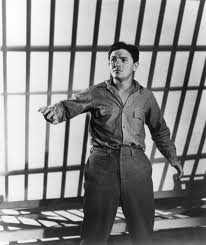
John Garfield (March 4, 1913 – May 21, 1952) was an American actor adept at playing brooding, rebellious, working-class characters. He grew up in poverty in Depression-era New York City and in the early 1930s became an important member of the Group Theater. In 1937, he moved to Hollywood, eventually becoming one of Warner Bros.’ major stars. Called to testify before the U.S. Congressional House Committee on Un-American Activities (HUAC), he denied Communist affiliation and refused to “name names,” effectively ending his film career. Some have claimed that the stress of this incident led to his premature death at 39 from a heart attack. (Rumors abounded that he “died in the saddle.”)
Garfield is acknowledged as a predecessor of such Method actors as Montgomery Clift, Marlon Brando, and James Dean.
Garfield was born Jacob Garfinkle in a small apartment on Rivington Street in Manhattan’s Lower East Side, to David and Hannah Garfinkle, Russian Jewish immigrants, and grew up in the heart of the Yiddish Theater District. In early infancy a middle name—Julius—was added, and for the rest of his life those who knew him well called him Julie. His father, a clothes presser and part-time cantor, struggled to make a living and to provide even marginal comfort for his small family. When Garfield was five, his brother Max was born and their mother never fully recovered from what was described as a “difficult” pregnancy. She died two years later and the young boys were sent to live with various relatives, all poor, scattered across the boroughs of Brooklyn, Queens and the Bronx. Several of these relatives lived in tenements in a section of East Brooklyn called Brownsville and there Garfield lived in one house and slept in another. At school he was judged a poor reader and speller, deficits that were aggravated by irregular attendance. He would later say of his time on the streets there, that he learned “all the meanness, all the toughness it’s possible for kids to acquire.”
His father remarried and moved to the West Bronx where Garfield joined a series of gangs. Much later he would recall: “Every street had its own gang. That’s the way it was in poor sections… the old safety in numbers.” He soon became gang leader. It was at this time people started to notice his ability to mimic well-known performers, both bodily and facially. He also began to hang out and eventually spar at a boxing gym on Jerome Avenue. At some point he contracted scarlet fever, (it was diagnosed later in adulthood) causing permanent damage to his heart and causing him to miss a lot of school. After being expelled three times and expressing a wish to quit school altogether, his parents sent him to P.S. 45, a school for difficult children. It was under the guidance of the school’s principal—the noted educator Angelo Patri—that he was introduced to acting. Noticing Garfield’s tendency to stammer, Patri assigned him to a speech therapy class taught by a charismatic teacher named Margaret O’Ryan. She gave him acting exercises and made him memorize and deliver speeches in front of the class and, as he progressed, in front of school assemblies. O’Ryan thought he had natural talent and cast him in school plays. She encouraged him to sign up for a citywide debating competition sponsored by the New York Times. To his own surprise, he took second prize.
With Patri and O’Ryan’s encouragement he began to take acting lessons at a drama school that was part of The Heckscher Foundation and began to appear in their productions. At one of the latter he received back-stage congratulations and an offer of support from the Yiddish actor Jacob Ben-Ami who recommended him to the American Laboratory Theater. Funded by the Theatre Guild, “the Lab” had contracted with Richard Boleslavski to stage its experimental productions and with Russian actress and expatriate Maria Ouspenskaya to supervise classes in acting. Former members of the Moscow Art Theater, they were the first proponents of Stanislavsky’s “system” in the United States. Garfield took morning classes and began volunteering time at the Lab after hours, auditing rehearsals, building and painting scenery, and doing crew work. He would later view this time as beginning his apprenticeship in the theater. Among the people becoming disenchanted with the Guild and turning to the Lab for a more radical, challenging environment were Stella Adler, Lee Strasberg, Franchot Tone, Cheryl Crawford and Harold Clurman. In varying degrees, all would become influential in Garfield’s later career.
After a stint with Eva Le Gallienne’s Civic Repertory Theater and a short period of vagrancy involving hitchhiking, freight hopping, picking fruit, and logging in the Pacific Northwest (Preston Sturges conceived the film Sullivan’s Travels after hearing Garfield tell of his hobo adventures) Garfield made his Broadway debut in 1932, in a play called Lost Boy. It ran for only two weeks but gave Garfield something critically important for an actor struggling to break into the theater: a credit.
Garfield received feature billing in his next role, that of Henry the office boy, in Elmer Rice’s play Counsellor-at-Law starring Paul Muni. The play ran for three months, made an eastern tour and returned for an unprecedented second return engagement, only closing when Muni was contractually compelled to return to Hollywood to make a film for Warners. At this point the Warner company expressed an interest in Garfield and sought to arrange a screen test. He turned them down.
Garfield’s former colleagues Crawford, Clurman and Strasburg had begun a new theater collective, calling it simply “the Group,” and Garfield lobbied his friends hard to get in. After months of rejection he began frequenting the inside steps of the Broadhurst Theater where the Group had its offices. Cheryl Crawford noticed him one day and greeted him warmly. Feeling encouraged, he made his request for apprenticeship. Something intangible impressed her and she recommended him to the other directors. They made no dissent.
Clifford Odets had been a close friend of Garfield from the early days in the Bronx. After Odets’ one-act play Waiting for Lefty became a surprise hit, the Group announced it would mount a production of his full-length drama Awake and Sing. At the playwright’s insistence, Garfield was cast as Ralph, the sensitive young son who pled for “a chance to get to first base.” The play opened in February 1935 and Garfield was singled out by critic Brooks Atkinson for having a “splendid sense of character development.”
Garfield’s apprenticeship was officially over; the company voted him full membership. Odets was the man of the moment and he claimed to the press that Garfield was his “find”; that he would soon write a play just for him. That play would turn out to be Golden Boy and when Luther Adler was cast in the lead role instead, a disillusioned Garfield began to take a second look at the overtures being made by Hollywood.
Garfield had been approached by Hollywood studios before—both Paramount and Warner’s offering screen tests—but talks had always stalled over a clause he wanted inserted in his contract, one that would allow him time off for stage work. Now Warner Bros. acceded to his demand and Garfield signed a standard feature-player agreement—seven years with options—in Warner’s New York office. Many in the Group were livid over what they considered his betrayal. Elia Kazan’s reaction was different, suggesting that the Group did not so much fear that Garfield would fail, but that he would succeed. Jack Warner’s first order of business was a change of name to John Garfield.
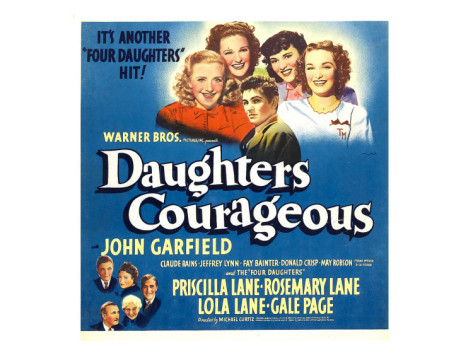
After many false starts he was finally cast in a supporting, yet crucial role as a tragic young composer in a Michael Curtiz film titled Four Daughters. After the picture’s release in 1938, he received wide critical acclaim and a nomination for the Academy Award for Best Supporting Actor. The studio quickly revised Garfield’s contract—designating him a star player rather than a featured one—for seven years without options. They also created a name-above-the-title vehicle for him titled: They Made Me a Criminal. Before the breakout success of Daughters Garfield had made a B movie feature called Blackwell’s Island. Not wanting their new star to appear in a low-budget film, Warner’s ordered an A movie upgrade by adding an additional $100,000 to its budget and recalling its director Michael Curtiz to shoot newly scripted scenes.
Garfield’s debut had a cinematic impact difficult to conceive in retrospect. As biographer Lawrence Swindell put it:
“Garfield’s work was spontaneous, non-actory; it had abandon. He didn’t recite dialogue, he attacked it until it lost the quality of talk and took on the nature of speech. The screen actor had been dialogue’s servant, but now Julie had switched those roles. Like Cagney, he was an exceptionally mobile performer from the start of his screen career. These traits were orchestrated with his physical appearance to create a screen persona innately powerful in the sexual sense. What Warners saw immediately was that Garfield’s impact was felt by both sexes. This was almost unique.”
His “honeymoon” with Warner’s over, Garfield entered a protracted period of conflict with the studio, they attempting to cast him in crowd-pleasing melodramas like Dust Be My Destiny and he insisting on quality scripts that would offer a challenge and highlight his versatility. The result was often a series of suspensions, Garfield refusing an assigned role and Warner’s refusing to pay him. Garfield’s problem was the same problem shared by any actor working in the studio system of the 1930s: by contract the studio had the right to cast him in any project they wanted to. But, as Robert Nott explains, “To be fair, most of the studios had a team of producers, directors, and writers who could pinpoint a particular star’s strengths and worked to capitalize on those strengths in terms of finding vehicles that would appeal to the public – and hence make the studio money. The forces that prevented him from getting high quality roles were really the result of the combined willpower of the Warner Bros., the studio system in general, and the general public, which also had its own perception of how Garfield (or Cagney or Bogart for that matter) should appear on screen.” A notable exception to this trend was Daughters Courageous, the sequel to his debut film. Now considered a late 1930s classic, the film did well critically but failed to find an audience, the public dissatisfied that it was not a true sequel (hard to pull off, since the original character Mickey Borden died in the first picture). The director, Curtiz, called the film “my obscure masterpiece.”
At the onset of World War II, Garfield immediately attempted to enlist in the armed forces, but was turned down because of his heart condition. Frustrated, he turned his energies to supporting the war effort. He and actress Bette Davis were the driving force behind the opening of the Hollywood Canteen, a club offering food and entertainment for American servicemen. He traveled overseas to help entertain the troops, made several bond selling tours and starred in a string of popular, patriotic films like Air Force, Destination Tokyo and Pride of the Marines (all box office successes). He was particularly proud of that last film based on the life of Al Schmid, a war hero blinded in combat. In preparing for the role Garfield lived for several weeks with Schmid and his wife in Philadelphia and would blindfold himself for hours at a time.
After the war Garfield starred in a series of successful films such as The Postman Always Rings Twice (1946) with Lana Turner, Humoresque (1946) with Joan Crawford, and the Oscar-winning Best Picture Gentleman’s Agreement (1947). In Gentleman’s Agreement, Garfield took a featured, but supporting, part because he believed deeply in the film’s exposé of anti-semitism in America. In 1948, he was nominated for the Academy Award for Best Actor for his starring role in Body and Soul (1947). That same year, Garfield returned to Broadway in the play Skipper Next to God. A strong-willed and often verbally combative individual, Garfield did not hesitate to venture out on his own when the opportunity arose. In 1946, when his contract with Warner Bros. expired, Garfield decided not to renew it and opted to start his own independent production company, one of the first Hollywood stars to take this step.
“I have nothing to hide and nothing to be ashamed of. My life is an open book. I am no Red. I am no ‘pink.’ I am no fellow traveler. I am a Democrat by politics, a liberal by inclination, and a loyal citizen of this country by every act of my life.”
Long involved in liberal politics, Garfield was caught up in the Communist scare of the late 1940s and early 1950s. He supported the Committee for the First Amendment, which opposed governmental investigation of political beliefs. When called to testify before the House Committee on Un-American Activities, which was empowered to investigate purported communist infiltration in America, Garfield refused to name communist party members or followers, testifying that, indeed, he knew none in the film industry. Garfield rejected Communism, and just prior to his death in hopes of redeeming himself in the eyes of the “Blacklisters,” wrote that he had been duped by Communist ideology, in an unpublished article called “I Was a Sucker for a Left Hook,” a reference to Garfield’s movies about boxing. However, his forced testimony before the committee had severely damaged his reputation. He was blacklisted in Red Channels, and barred from future employment as an actor by Hollywood movie studio bosses for the remainder of his career.
With film work scarce because of the blacklist, Garfield returned to Broadway and starred in a 1952 revival of Golden Boy, finally being cast in the lead role denied him years before.
On May 9, 1952 Garfield moved out of his New York apartment for the last time, indicating to friends it was not a temporary separation. He confided to columnist Earl Wilson that he would soon be divorced. Close friends speculated that it was his wife’s opposition to his plotted confession in Look magazine that triggered the separation. He heard that a HUAC investigator was reviewing his testimony for possible perjury charges. His agent reported that 20th Century-Fox wanted him for a film called Taxi but would not even begin talks unless the investigation concluded in his favor. Three actor friends, Canada Lee, Mady Christians and J. Edward Bromberg, had all recently died after being listed by the committee.
In the morning of May 20 Garfield, against his doctor’s strict orders, played several strenuous sets of tennis with a friend, mentioning the fact that he had not been to bed the night before. He met actress Iris Whitney for dinner and afterward became suddenly ill complaining that he felt chilled. She brought him to her apartment where he refused to let her call a doctor and instead went to bed. The next morning she found him dead. Long-term heart problems, allegedly aggravated by the stress of his blacklisting, had led to his death at the age of 39.
The funeral was the largest in New York since Rudolph Valentino with over ten thousand persons crowding the streets outside. His estate, valued at “more than $100,000,” was left entirely to his wife. Shortly afterward, ironically, the HUAC closed its investigation of John Garfield, leaving him in the clear. Garfield is interred at Westchester Hills Cemetery in Hastings-on-Hudson, Westchester County, New York.
In 1954, the widowed Roberta Garfield married attorney Sidney Cohn, who died in 1991. She died in January 2004.
He and Roberta Seidman married in February 1935. Though his wife had been a member of the Communist Party, there was no evidence that Garfield himself was ever a Communist. They had three children: Katherine (1938–1945), who died of an allergic reaction on March 18, 1945; David (1943–1994); and Julie (born 1946); the latter two later becoming actors themselves.
Garfield was nominated for the Academy Award for Best Supporting Actor for Four Daughters in 1939 and Best Actor for Body and Soul in 1948.
He was given a star on the Hollywood Walk of Fame at 7065 Hollywood Boulevard.
I loved Garfield’s persona. Like a polished agate with rough stone overtones.
In 1969, when I was a patrol sergeant in Hollywood I got a call to the Desilu studios on Gower. Eddie Albert greeted me on the set. In the next room was Lana Turner. Albert prevailed upon me that Turner was not feeling well and that it was nothing to worry about. I don’t recall the exact nature of the call, but I could tell that Albert was interested in keeping it low profile. Once I felt convinced there was no foul play, I had no problem in not going into the next room and checking on Turner. Albert was quite persuasive. I suppose I was a bit foolish, but often having been around actors, I understood their need for privacy, particularly in “iffy” situations like this one.
Lana Turner (February 8, 1921 – June 29, 1995) was an American actress popular during the 1940s and 1950s. Turner was born Julia Jean Turner in Wallace, Idaho. She was the only daughter of John Virgil Turner, a miner from Montgomery, Alabama (January 23, 1903 – December 14, 1930), and Mildred Frances Cowan, a sixteen-year-old native of Lamar, Arkansas (June 19, 1904 – February 22, 1982). Her father was of Dutch ancestry and her mother was of Scottish, English and Irish ancestry. A common and often repeated error is to add the given names of her mother Mildred Frances to her birth name. These names she used when she converted to Catholicism as a child.
Until her film career took off, young Julia Turner was known to family and friends as “Judy”. Hard times eventually forced the family to re-locate to San Francisco, where her parents soon separated. On December 14, 1930, her father won some money at a traveling craps game, stuffed his winnings in his left sock, and headed for home. He was later found dead on the corner of Minnesota and Mariposa Streets, on the edge of Potrero Hill and the Dogpatch District in San Francisco, his left shoe and sock missing. The robbery and murder were never solved. Soon after, her mother developed health problems and was advised by her doctor to move to a drier climate. With her ten-year-old daughter, she moved to Los Angeles in 1931.
Mildred and Lana were very poor, and Turner was sometimes separated from her mother, living with friends or acquaintances so that the family could save money. Her mother worked 80 hours a week as a beautician to support them. After Turner was discovered, her mother became the overseer of Turner’s career.
Turner’s discovery at a Hollywood drug store is a show-business legend. As a sixteen-year-old student at Hollywood High School, Turner skipped a typing class and bought a Coke at the Top Hat Malt Shop located on the southeast corner of Sunset Boulevard and McCadden Place (not Schwab’s Pharmacy, as is commonly believed), where she was spotted by William R. Wilkerson, publisher of The Hollywood Reporter. Wilkerson was attracted by her beauty and physique, and referred her to the actor/comedian/talent agent Zeppo Marx. Marx’s agency immediately signed her on and introduced her to film director Mervyn LeRoy, who cast her in her first film, They Won’t Forget (1937).
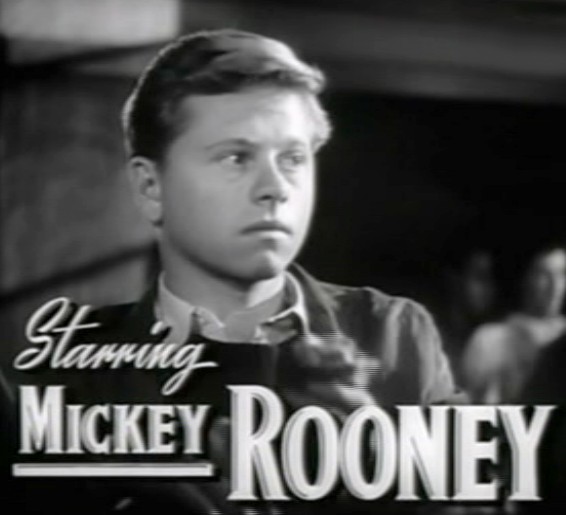
Turner earned the nickname “The Sweater Girl” from her form-fitting attire in a scene in They Won’t Forget. According to her daughter, this was a nickname Turner detested throughout her entire career.In late 1937, she signed a contract with Metro-Goldwyn-Mayer for $100 a week, and graduated from high school in between filming. According to LeRoy, it was thanks to him that she made the switch, for he left Warners to work at MGM and was advised by studio head Jack Warner to take her with him, because Warner believed that she wouldn’t “amount to anything.” Her first starring role for MGM was scheduled to be an adaptation of The Sea-Wolf, co-starring Clark Gable, but the project was eventually canned. Instead, she was assigned opposite teen idol Mickey Rooney in the Andy Hardy film Love Finds Andy Hardy (1938). It was this appearance, as a flirtatious girl described as “the kissing bug,” that convinced Louis B. Mayer that LeRoy’s protégée Turner could be the next Jean Harlow, a sex symbol who had died six months before Turner’s arrival at MGM.
Mayer turned her into a glamorous star, mostly popular among college boys, and gave her the leads in several teen-oriented films in the late 1930s and early 1940s, such as Dramatic School (1938), These Glamour Girls (1939) and Dancing Co-Ed (1939). In early 1940, she was also set to star in a remake of Our Dancing Daughters, but the film was never made.[10] From the beginning of her career, Turner stood her ground on her beliefs and was one of the few actresses at MGM to go against Mayer’s wishes.
Turner, an actress bolstered by her extreme beauty, reached the height of her fame in the 1940s and 1950s. During World War II, Turner became a popular pin-up girl due to her popularity in such films such as Ziegfeld Girl (1941), Johnny Eager (1942), Slightly Dangerous (1943) and four films with Metro-Goldwyn-Mayer’s “king of the lot”, Clark Gable. The Turner-Gable films’ successes were only heightened by gossip-column rumors about a relationship between the two. Turner even had a B-17 Flying Fortress—the Tempest Turner—named after her. Following the canned The Sea Wolf project, Turner and Gable were set to star in The Uniform in December 1940. Turner was eventually replaced by Rosalind Russell and the film was released as They Met in Bombay (1941).
Meanwhile, Turner was receiving much publicity for her personal life, and her career was one of the very few to be furthered by this. MGM boosted this by changing the title of her latest film to Slightly Dangerous (1943).
After the war, Turner’s career continued successfully with the release, The Postman Always Rings Twice (1946), which co-starred John Garfield. As claimed in a documentary, Turner did not get along with him and when she found he was her male lead, she responded: “Couldn’t they at least hire someone attractive?” The now-classic film noir marked a turning point in her career, and it marked Turner’s first femme fatale role. Reviews of the film, and in particular, Turner’s performance, were glowing, with a critic of The New York Times writing it was “the role of her career.” While not exactly giving up her pin-up credentials, Turner established herself as a skilled actress. The Postman Always Rings Twice was thus a turning point in her career. Turner commented on this:
“I finally got tired of making movies where all I did was walk across the screen and look pretty. I got a big chance to do some real acting in The Postman Always Rings Twice, and I’m not going to slip back if I can help it. I tried to persuade the studio to give me something different. But every time I went into my argument about how bad a picture was they’d say, ‘well, it’s making a fortune.’ That licked me.”
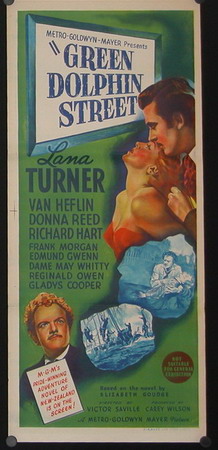
She got the role after turning down “four pretty-pretty parts in a row.” The film became a box office success, which prompted the studio to take more risks on the star. In August 1946, it was announced Turner was set to replace Katharine Hepburn in the big budgeted historical drama Green Dolphin Street (1947), a role for which she darkened her hair and lost 15 pounds. She was cast due to the persistence of producer Carey Wilson, who was overwhelmed by her performance in The Postman Always Rings Twice. Turner later recalled she was surprised about replacing Hepburn, saying: “And I guess I’m about the most un-Hepburnish actress on the lot. But it was just what I wanted to do.” It was her first starring role that did not center on her looks. In an interview, Turner said: “I even go running around in the jungles of New Zealand in a dress that’s filthy and ragged. I don’t wear any make-up and my hair’s a mess.” Nevertheless, she insisted she would not give up her glamorous image.
Later that year, Turner headlined Cass Timberlane, a role that Jennifer Jones, Vivien Leigh and Virginia Grey were previously considered for. As of early 1946, Turner was set for the role, but schedules with Green Dolphin Street almost prohibited her from taking the role, and by late 1946, she was almost recast.Production of Cass Timberlane was very exhausting for Turner, as it was shot in between retakes of Green Dolphin Street. Nevertheless, she took the female lead in Homecoming (1948) in August 1947, only moments after finishing Cass Timberlane. She was the studio’s first choice for the role, but they were reluctant to offer her the part, considering her overbooked schedule.[19] Paired again with Clark Gable in Homecoming, their chemistry projected on the screen was well received by the audience, and they were nicknamed “the team that generates steam”. By this period, Turner achieved the milestone of her film career, and was not only MGM’s most popular star, but also one of the ten best paid women in the United States.
In 1948, Turner appeared in her first Technicolor film, appearing as Lady de Winter in The Three Musketeers, opposite Gene Kelly, Van Heflin and June Allyson. In November 1947, she agreed to do the film, thereby giving up an unfinished film project called Bedeviled. However, in January 1948 it was reported that she had withdrawn from the film. Initially, Louis B. Mayer gave her permission for doing so because of her schedule, but she was later that month put on suspension. Eventually, Turner agreed to make the film, but did not start production until March due to having to lose weight. In 1949, she was to headline A Life of Her Own (1950). The project was shelved for several months, and Turner insisted in December 1949 that she had nothing to do with it, saying: “Everybody agrees that the script is still a pile of junk. I’m anxious to get started. By the time this one comes out, it will be almost three years since I was last on the screen, in The Three Musketeers. I don’t think it’s healthy to stay off the screen that long.”
During the 1950s, Turner starred in a series of films that failed to succeed at the box office, a situation MGM attempted to remedy by casting her in musicals. The first, Mr. Imperium (1951), was a flop, while The Merry Widow (1952) was more successful. She gave a widely praised performance in Vincente Minnelli’s film, The Bad and the Beautiful (1952) (in a role partly based on Diana Barrymore), and later starred with John Wayne in the adventure film The Sea Chase (1955). She was then cast in the epic The Prodigal (1955), but the film and her performance in general were not well received. After the film Diane (1956), MGM opted not to renew her contract. This was a difficult time for Hollywood’s major studios because a recent court decision forced them to divest themselves of their movie theaters. In addition, television had caught on in a big way; the public was staying home. Turner was just one of MGM’s star roster to be let go.
Turner’s career recovered briefly after she appeared in the hugely successful big-screen adaptation of Grace Metalious’s best-selling novel, Peyton Place (1957), for which she was nominated for an Academy Award for Best Actress. Another few box-office failures followed (Another Time, Another Place (1958), for example) when the 1958 scandal surrounding her daughter’s killing of Stompanato threatened to derail her career completely.
In the trail of the related negative publicity, Turner accepted the lead role in Ross Hunter’s remake of Imitation of Life (1959) under the direction of Douglas Sirk. Universal Studios capitalized on her new-found notoriety; the result was one of the biggest hits of the year, as well as the biggest hit of Turner’s career: she owned 50% of the earnings of the picture and for only the first year of the film’s career she earned $11 million. Critics and audiences couldn’t help noticing that the plots of both Peyton Place and Imitation of Life had borrowed heavily from Turner’s private life. Each film depicted the troubled, complicated relationship between a single mother and her teenage daughter.
She made her last film at MGM starring with Bob Hope in Bachelor in Paradise (1961). Other highlights of this era include By Love Possessed (1961), based on the James Gould Cozzens novel and two Hunter productions (for whom she did Imitation of Life), Portrait in Black (1960) and Madame X (1966), which proved to be her last major starring role.
In 1969, Turner appeared in her only lead starring role on television in ABC’s Harold Robbins’ The Survivors, but despite the presence of other big-name stars, the program fared badly opposite Mayberry R.F.D. and The Doris Day Show on CBS and The NBC Monday Movie, and was cancelled midway into the season.
In the 1970s and 1980s, Turner appeared in several television roles, most notably as a guest star for several episodes on the series Falcon Crest as the mysterious Jaqueline Perrault and The Love Boat, but the majority of her final decade was spent out of the public eye.
On October 25, 1981 the National Film Society presented Lana with an Artistry in Cinema award. In 1994 she received Donostia Lifetime Achievement Award at the San Sebastian International Film Festival, Spain. In 1982, Turner released a memoir, in which she stated that she had two abortions and three stillbirths. She said she was an alcoholic and had attempted suicide.
Turner spent most of the 1970s and early 1980s in semi-retirement, working only occasionally. In 1982 she accepted a much publicized and lucrative recurring guest role in the television series Falcon Crest. Her first appearance on the show gave the series the highest rating it ever achieved. Turner made her next final film appearance in 1991, and died from throat cancer in 1995.
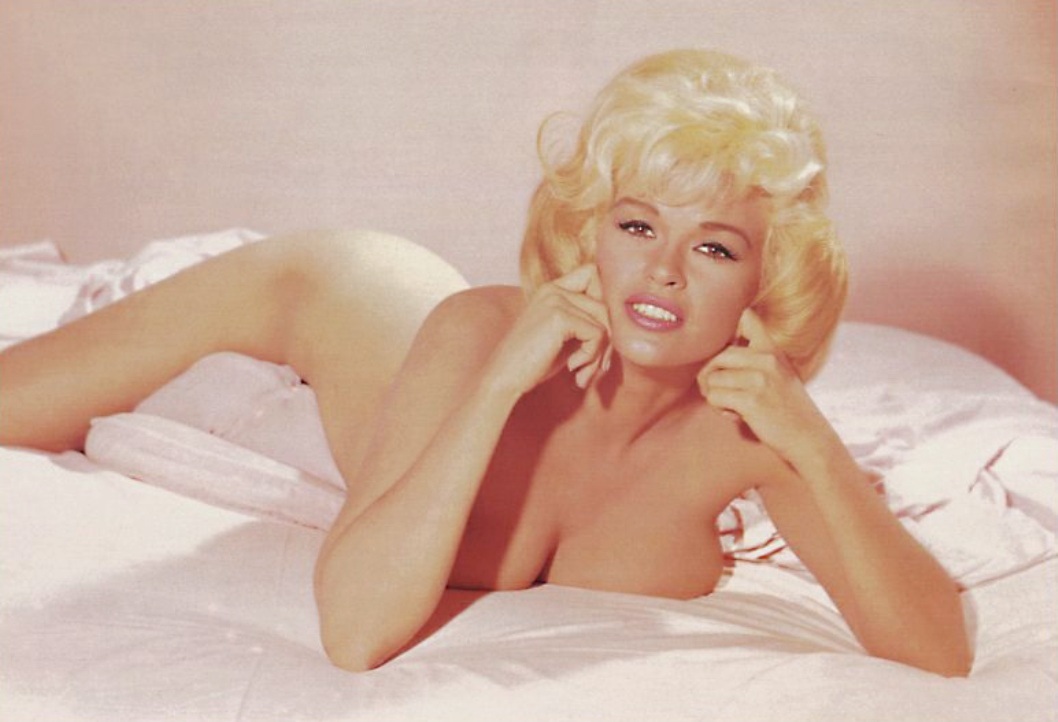
Jayne Mansfield (born Vera Jayne Palmer; April 19, 1933 – June 29, 1967) was an American actress in film, theatre, and television, a nightclub entertainer, a singer, and one of the early Playboy Playmates. She was a major Hollywood sex symbol of the 1950s and early 1960s. Mansfield was 20th Century Fox’s alternative Marilyn Monroe and came to be known as the Working Man’s Monroe. She was also known for her well-publicized personal life and publicity stunts.
Mansfield became a major Broadway star in 1955, a major Hollywood star in 1956, and a leading celebrity in 1957. She was one of Hollywood’s original blonde bombshells, and although many people have never seen her movies, Mansfield remains one of the most recognizable icons of 1950s celebrity culture. With the decrease of the demand for big-breasted blonde bombshells and the increase in the negative backlash against her over-publicity, she became a box-office has-been by the early 1960s.
While Mansfield’s film career was short-lived, she had several box office successes and won a Theatre World Award and a Golden Globe. She enjoyed success in the role of fictional actress Rita Marlowe in both the 1955–1956 Broadway version, and, in the 1957 Hollywood film version of Will Success Spoil Rock Hunter?. She showcased her comedic skills in The Girl Can’t Help It (1956), her dramatic assets in The Wayward Bus (1957), and her sizzling presence in Too Hot to Handle (1960). She also sang for studio recordings, including the album Shakespeare, Tchaikovsky & Me and the singles Suey and As the Clouds Drift by (with Jimi Hendrix). Mansfield’s notable television work included television dramas Follow the Sun and Burke’s Law, game shows The Match Game and What’s My Line?, variety shows The Jack Benny Program and The Bob Hope Show, the The Ed Sullivan Show, and a large number of talk shows.
By the early 1960s, Mansfield’s box office popularity had declined and Hollywood studios lost interest in her. Some of the last attempts that Hollywood took to publicize her were in The George Raft Story (1961) and It Happened in Athens (1962). But, towards the end of her career, Mansfield remained a popular celebrity, continuing to attract large crowds outside the United States and in lucrative and successful nightclub acts (including The Tropicana Holiday and The House of Love in Las Vegas), and summer-theater work. Her film career continued with cheap independent films and European melodramas and comedies, with some of her later films being filmed in United Kingdom, Italy, Germany, and Greece. In the sexploitation film Promises! Promises! (1963), she became the first major American actress to have a nude starring role in a Hollywood motion picture.
Mansfield, one-upping Sophia Loren
Mansfield took her professional name from her first husband, public relations professional Paul Mansfield, with whom she had a daughter. She was the mother of three children from her second marriage to actor–bodybuilder Mickey Hargitay. She married her third husband, film director Matt Cimber, in 1964, and separated from him in 1966. Mansfield and Cimber had a son. In 1967 Mansfield died in a car accident at the age of 34.
In January 1955 Mansfield appeared at a Silver Springs, Florida press junket promoting the film Underwater!, starring Jane Russell. Mansfield purposely wore a too-small red bikini, lent her by photographer friend Peter Gowland. When she dove into the pool for photographers her top came off, which created a burst of media attention. The ensuing publicity led to Warner Bros. and Playboy approaching her with offers. In June 8 of the same year, her dress fell down to her waist twice in a single evening – once at a movie party, and later at a nightclub. In February 1958, she was stripped to the waist at a Mardi Gras party in Rio de Janeiro. In June 1962, she shimmied out of her polka-dot dress in a Rome nightclub. In the three years since making her Broadway debut in Will Success Spoil Rock Hunter?, Mansfield had become the most controversial star of the decade.
In April 1957, her bosom was the focus of a notorious publicity stunt intended to deflect media attention from Sophia Loren during a dinner party in the Italian star’s honor. Photographs of the encounter were published around the world. The best-known photo showed Loren’s gaze falling on the cleavage of the American actress (who was seated between Loren and her dinner companion, Clifton Webb) when Mansfield leaned over the table, allowing her breasts to spill over her low neckline and exposing one nipple. Several similar photos were taken in a short time. Fearful of public outrage, most Italian newspapers refused to print the wirephotos; Il Giorno and Gazzetta del Popolo printed them after retouching to cover much of Mansfield’s bosom, and only Il Giornale d’Italia printed them uncensored. The photo inspired a number of later photographers. In 1993, Daniela Federici created an homage with Anna Nicole Smith as Mansfield and New York City DJ Sky Nellor as Loren for a Guess Jeans campaign. Later, Mark Seliger took a picture named Heidi Klum at Romanoff’s with Heidi Klum in a reproduction of the restaurant set.
A similar incident (resulting in the exposure of both breasts) occurred during a film festival in West Berlin, when Mansfield was wearing a low-cut dress and her husband, Mickey Hargitay, picked her up so she could bite a bunch of grapes hanging overhead at a party. The movement exposed both her breasts. The photograph of that episode was a UPI sensation, appearing in newspapers and magazines with the word “censored” hiding the actress’s exposed bosom.
At the same time, the world’s media were quick to condemn Mansfield’s stunts. One editorial columnist wrote, “We are amused when Miss Mansfield strains to pull in her stomach to fill out her bikini better; but we get angry when career-seeking women, shady ladies, and certain starlets and actresses…use every opportunity to display their anatomy unasked”. By the late 1950s, Mansfield began to generate a great deal of negative publicity because of repeated exposure of her breasts in carefully staged public “accidents”. Richard Blackwell, her wardrobe designer (who also designed for Jane Russell, Dorothy Lamour, Peggy Lee and Nancy Reagan), dropped her from his client list because of those accidents. In April 1967, Los Angeles Times wrote, “She confuses publicity and notoriety with stardom and celebrity and the result is very distasteful to the public.”
My only personal “connection” with Sandra Dee is that I dated a girl, a singer (Anna May) in ’54 when she attended Hollywood Professional School (Jimmy Boyd went there, too), a school Dee attended several years later.
Sandra Dee (April 23, 1942 – February 20, 2005) was an American actress. Dee began her career as a model and progressed to film. Best known for her portrayal of ingenues, (new young actress or one typecast in such roles. The term comes from the French adjective ingénu meaning “ingenuous” or innocent, virtuous, and candid. The term might also imply a lack of sophistication and cunning.)
Dee won a Golden Globe Award in 1959 as one of the year’s most promising newcomers, and over several years her films were popular. By the late 1960s her career had started to decline, and a highly publicized marriage to Bobby Darin ended in divorce.
Dee rarely acted after this time, and her final years were marred by illness; she died of complications from kidney disease in 2005.
Dee was born Alexandra Zuck in Bayonne, New Jersey. Her parents, Mary (née Cymboliak) and John Zuck, met as teenagers at a Russian Orthodox church dance. They married shortly after, but divorced before she was five. She was of Polish and Carpatho-Rusyn ancestry and was raised in the Russian Orthodox Church. Her son Dodd Darin wrote in his biographical book about his parents, Dream Lovers, that Dee’s mother, Mary, and her sister Olga “were first generation daughters of a working class Russian Orthodox couple. Dee herself recalled, “We belonged to a Russian Orthodox Church, and there was dancing at the social events.” Alexandra would soon take the name Sandra Dee. She became a professional model by the age of four and subsequently progressed to television commercials.
There has been some confusion as to Dee’s actual birth year, with evidence pointing to both 1942 and 1944. According to her son’s book, Dee was born in 1944, but, having begun modeling and acting at a very young age, she and her mother falsely inflated her age by two years so she could find more work. Therefore, 1942 was listed as her birth year in official studio press releases, leading to that year’s being considered truthful in verifiable sources. After having studied at Hollywood Professional School, she graduated from University High, Los Angeles, in June 1958. In a 1959 interview, Dee recalled that she “grew up fast”, surrounded mostly by older people, and was “never held back in anything [she] wanted to do.”
During her modeling career, Dee attempted to lose weight to “be as skinny as the high fashion models”, though an improper diet “ruined [her] skin, hair, nails – everything”. Having slimmed down, her body was unable to digest any food she ate, and it took the help of a doctor to regain her health. According to the actress, she “could have killed [herself]” and “had to learn to eat all over again.”
Ending her modeling career, Dee moved from New York to Hollywood in 1957. There, she made her first film, Until They Sail, in 1957. The following year, she won a Golden Globe Award for New Star Of The Year – Actress, along with Carolyn Jones and Diane Varsi.
She became known for her wholesome ingenue roles in such films as The Reluctant Debutante, Gidget, Imitation of Life, and A Summer Place. She later played “Tammy” in two Universal sequels to Tammy and the Bachelor, in the role created by Debbie Reynolds. During the 1970s, Dee took very few acting jobs but made occasional television appearances.
Dee’s marriage to Bobby Darin in 1960 kept her in the public eye for much of the decade. They met while making the film Come September (released in 1961) together. She was under contract to Universal Studios, which tried to develop Dee into a mature actress, and the films she made as an adult—including a few with Darin—were moderately successful. On 16 December 1961, they had one son, Dodd Mitchell Darin (also known as Morgan Mitchell Darin). She and Darin divorced in 1967 and Darin died in 1973.
In 1994, Dee’s son Dodd Darin published a book about his parents, Dream Lovers: The Magnificent Shattered Lives of Bobby Darin and Sandra Dee, in which he chronicled his mother’s anorexia, drug and alcohol problems, and her claim she had been sexually abused as a child by her stepfather, Eugene Douvan.
One of the popular songs of the Broadway musical and 1978 movie Grease is “Look at Me, I’m Sandra Dee”, in which the rebellious Rizzo satirizes new girl Sandy’s clean cut image, likened to Sandra Dee’s.
Dee’s life with Bobby Darin was dramatized in the 2004 film Beyond the Sea, in which Kevin Spacey played Darin and Dee was played by Kate Bosworth.
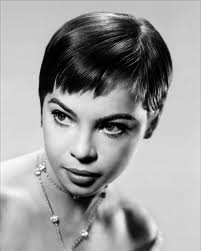
Leslie Claire Margaret Caron was born 1 July 1931. She is a French film actress and dancer, who appeared in 45 films between 1951 and 2003.
Caron is best known for the musical films An American in Paris (1951), Lili (1953), Daddy Long Legs (1955), Gigi (1958), and for the non-musical films Fanny (1961), The L-Shaped Room (1962), and Father Goose (1964). She received two Academy Award nominations for Best Actress. In 2006, her performance in Law and Order: Special Victims Unit won her an Emmy for guest actress in a drama series. Her autobiography Thank Heaven, was published in 2010 in the UK and US, and in 2011 in a French version. She speaks French, English, and Italian.
Caron with Gene Kelly in An American in Paris

Caron started her career as a ballerina. Gene Kelly discovered her in Roland Petit Company “Ballet des Champs Elysées”, and cast her to appear opposite him in the musical An American in Paris (1951), a role in which a pregnant Cyd Charisse was originally cast. This led to a long-term MGM contract and a sequence of films, which included the musical The Glass Slipper (1955) and the drama Man with a Cloak (1956), with Joseph Cotten and Barbara Stanwyck. Still, she has said of herself: “Unfortunately, Hollywood considers musical dancers as hoofers. Regrettable expression.”
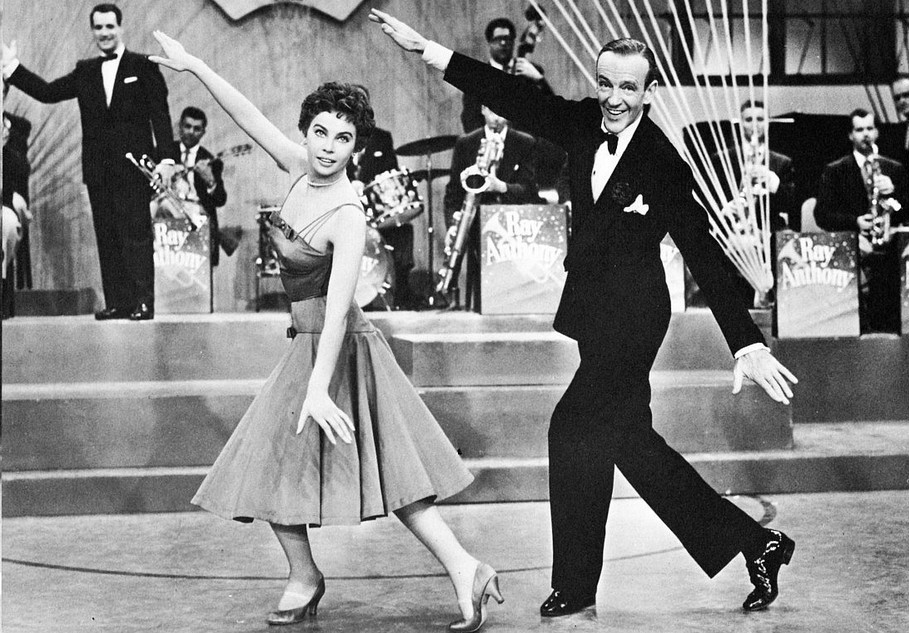
With Fred Astaire in Daddy Long Legs
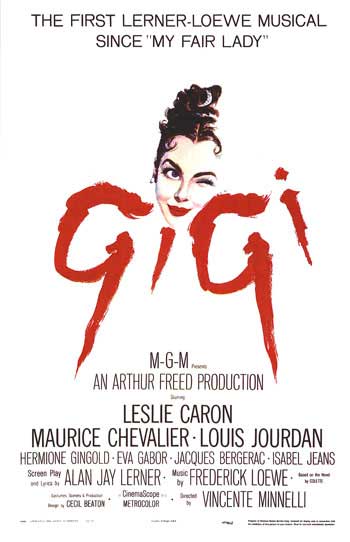
She also starred in the successful musicals Lili (1953), with Mel Ferrer; Daddy Long Legs (1955), with Fred Astaire, and Gigi (1958) with Louis Jourdan and Maurice Chevalier.
Daddy Long Legs (1955) is a Hollywood musical comedy film set in France, New York City, and the fictional college town of “Walston” in Massachusetts. The film was directed by Jean Negulesco, with music and lyrics by Johnny Mercer. The screenplay was written by Phoebe Ephron and Henry Ephron, and was loosely based on the 1912 novel Daddy-Long-Legs by Jean Webster.
It was one of Astaire’s personal favorites, largely due to the script that, for once, directly addresses the complications inherent in a love affair between a young woman and a man thirty years her senior. However, the making of it was marred by his wife’s death from lung cancer. Deeply traumatized, Astaire offered to pay the production expenses already incurred in order to quit the project, but then changed his mind.
This was the first of three consecutive Astaire films set in France or with a French theme (the others being Funny Face and Silk Stockings), following the fashion for French-themed musicals established by ardent Francophile Gene Kelly with An American in Paris (1951), which also featured Kelly’s protégée Caron.
In 1953, Caron was nominated for an Academy Award for Best Actress for her starring role in Lili. In 1963, she was also nominated for the Academy Award for Best Actress for her performance in the British drama The L-Shaped Room.
In the 1960s and thereafter, Caron worked in European films as well. Her later film assignments included Father Goose (1964), with Cary Grant; Ken Russell’s Valentino (1977), in the role of silent-screen legend Alla Nazimova; and Louis Malle’s Damage (1992).
In 1967 she was a member of the jury of the 5th Moscow International Film Festival.[3] In 1989 she was a member of the jury at the 39th Berlin International Film Festival.
She has continued to act, appearing in the film Chocolat (2000). She is one of the few actors from the classic era of MGM musicals who is still active in film—a group that includes Mickey Rooney, Debbie Reynolds, Dean Stockwell, Rita Moreno, Margaret O’Brien, June Lockhart. Her other recent credits include Funny Bones (1995) with Jerry Lewis and Oliver Platt, The Last of the Blonde Bombshells (2000) with Judi Dench and Cleo Laine, and Le Divorce (2003) by Merchant/Ivory with Kate Hudson and Naomi Watts.
On 30 June 2003, Caron traveled to San Francisco to appear as the special guest star in The Songs of Alan Jay Lerner: I Remember It Well, a retrospective concert staged by San Francisco’s 42nd Street Moon Company. In 2007, Caron’s guest appearance on Law and Order: Special Victims Unit earned her a 2007 Primetime Emmy Award. On 27 April 2009, Caron traveled to New York as an honored guest at a tribute to Alan Jay Lerner and Frederick Loewe at the Paley Center for Media.
On 8 December 2009, Caron received the 2,394th Star on the Hollywood Walk of Fame. In February 2010, she played Madame Armfeldt in A Little Night Music at the Théâtre du Châtelet in Paris, which also featured Greta Scacchi and Lambert Wilson.
Caron married George Hormel III, a grandson of the founder of Hormel (a meat-packing company) in September 1951. They divorced in 1954. Her second husband was British theater director Peter Hall. They married in 1956 and had two children, Christopher John Hall (TV producer) in 1957 and Jennifer Caron Hall, a writer, painter and actress, in 1958. Caron had an affair with Warren Beatty (1961). When she and Hall divorced in 1965, Beatty was named as a co-respondent and was ordered by the London court to pay “the costs of the case.” In 1969, Caron married Michael Laughlin, best known as producer of the film Two-Lane Blacktop; they divorced in 1980. Her son-in-law is Glenn Wilhide the producer and screenwriter.
Caron was also romantically linked to Dutch television actor Robert Wolders from 1994 to 1995.
From June 1993 until September 2009 Caron owned and operated a hotel and restaurant, Auberge La Lucarne aux Chouettes (The Owls’ Nest), located in Villeneuve-sur-Yonne, located about 130 km (81 mi) south of Paris.
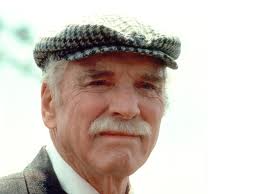
Burton Stephen “Burt” Lancaster (November 2, 1913 – October 20, 1994) was an American film actor noted for his athletic physique, blue eyes and distinctive smile (which he called “The Grin”). After initially building his career on “tough guy” roles Lancaster abandoned his “all-American” image in the late 1950s in favor of more complex and challenging roles, and came to be regarded as one of the best actors of his generation as a result.
Lancaster was nominated four times for Academy Awards and won once—for his work in Elmer Gantry in 1960. He also won a Golden Globe for that performance and BAFTA Awards for The Birdman of Alcatraz (1962) and Atlantic City (1980). His production company, Hecht-Hill-Lancaster, was the most successful and innovative star-driven independent production company in Hollywood of the 1950s, making movies such as Marty (1955), Trapeze (1956), and Sweet Smell of Success (1957).
In 1999, the American Film Institute named Lancaster 19th among the greatest male stars of all time.
Lancaster was born in Manhattan, New York City, at his parents’ home at 209 East 106th Street, between Second and Third Avenues, today the site of Benjamin Franklin Plaza. Lancaster was the son of Elizabeth (née Roberts) and James Henry Lancaster, who was a postman. Both of his parents were Protestants of working-class origin. Lancaster’s maternal grandparents were Northern Irish immigrants to the U.S. from Belfast and descendants of English immigrants to Ireland. The family believed themselves to be related to Frederick Roberts, 1st Earl Roberts. Lancaster grew up in East Harlem and spent much of his time on the streets, where he developed great interest and skill in gymnastics while attending the DeWitt Clinton High School, where he was a basketball star. Before he graduated from DeWitt Clinton, his mother died of a cerebral hemorrhage. Lancaster was accepted into New York University with an athletic scholarship but subsequently dropped out.
At the age of 19, Lancaster met Nick Cravat, with whom he continued to work throughout his life. Together they learned to act in local theatre productions and circus arts at Union Settlement, one of the city’s oldest settlement houses. They formed the acrobat duo “Lang and Cravat” in the 1930s and soon joined the Kay Brothers circus. However, in 1939, an injury forced Lancaster to give up the profession, with great regret. He then found temporary work until 1942—first as a salesman for Marshall Fields, and then as a singing waiter in various restaurants.
The United States having then entered World War II, Lancaster joined the US Army and performed with the Army’s Twenty-First Special Services Division, one of the military groups organized to follow the troops on the ground and provide USO entertainment to keep up morale. He served with General Mark Clark’s Fifth Army in Italy from 1943–1945.
A young Burt Lancaster, in The Killers
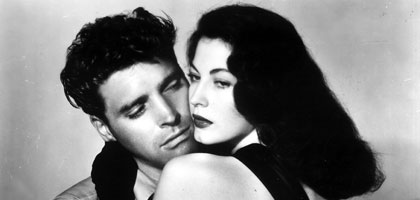
Though initially unenthusiastic about acting, he returned from service, auditioned for a Broadway play, and was offered a role. Although Harry Brown’s A Sound of Hunting had a run of only three weeks, Lancaster’s performance drew the attention of a Hollywood agent, Harold Hecht, and through him to Hal Wallis, who cast Lancaster in The Killers (1946). (Hecht and Lancaster later formed several production companies in the 1950s to give Lancaster greater creative control.) The tall, muscular actor won significant acclaim and appeared in two more films the following year. Subsequently, he played in a variety of films, especially in dramas, thrillers, and military and adventure films. In two, The Flame and the Arrow and The Crimson Pirate, a friend from his circus years, Nick Cravat, played a key supporting role, and both actors impressed audiences with their acrobatic prowess.
Lancaster with Deborah Kerr, on the infamous beach in From Here to Eternity
In 1953, Lancaster played one of his best-remembered roles with Deborah Kerr in From Here to Eternity. The American Film Institute acknowledged the iconic status of the scene from that film in which he and Deborah Kerr make love on a Hawaiian beach amid the crashing waves. The organization named it one of “AFI’s top 100 Most Romantic Films” of all time.
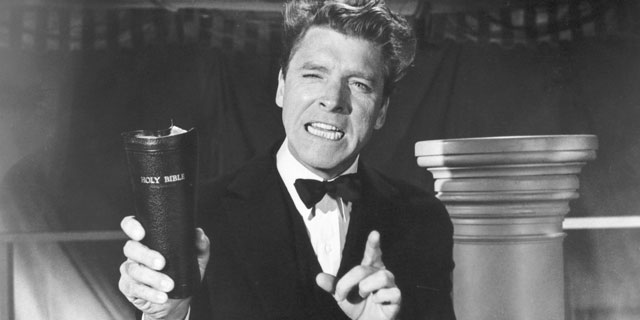
Elmer Gantry
Lancaster won the 1960 Academy Award for Best Actor, a Golden Globe Award, and the New York Film Critics Award for his performance in Elmer Gantry.
In 1966, at the age of 52, Lancaster appeared nude in director Frank Perry’s film, The Swimmer.
During the latter part of his career, Lancaster left adventure and acrobatic films behind and portrayed more distinguished characters. This period brought him work on several European productions, with directors such as Luchino Visconti and Bernardo Bertolucci. Lancaster sought demanding roles, and if he liked a part or a director, he was prepared to work for much lower pay than he might have earned elsewhere. He even helped to finance movies whose artistic value he believed in. He also mentored directors such as Sydney Pollack and John Frankenheimer and appeared in several television films. Lancaster’s last film was Field of Dreams (1989).
For his contribution to the motion picture industry, Lancaster has a star on the Hollywood Walk of Fame at 6801 Hollywood Boulevard.
Lancaster was an early and successful actor/producer. In 1952, Lancaster co-produced The Crimson Pirate with producer Harold Hecht (who had previously produced three Lancaster films under his own production company Norma Productions; Kiss the Blood Off My Hands (1948), The Flame and the Arrow (1950), and Ten Tall Men (1951)). In 1954, they collaborated again on His Majesty O’Keefe, with Lancaster acting and Hecht producing. The writer for this film was James Hill. The trio started a production company, originally with Hill as a silent partner, under the name “Hecht-Lancaster.” The name was later extended to include all three with “Hecht-Hill-Lancaster.”
The “H-H-L” team impressed Hollywood with its success; as Life wrote in 1957, “[a]fter the independent production of a baker’s dozen of pictures it has yet to have its first flop … (They were also good pictures.).” Together they produced the films Apache (1954), Vera Cruz (1954), Marty (1955) (which won both the Academy Award for Best Picture and the Palme d’Or award at the Cannes Film Festival), The Kentuckian (1955), Trapeze (1956), The Bachelor Party (1956), Sweet Smell of Success (1957), Run Silent, Run Deep (1958), Separate Tables (1958), The Devil’s Disciple (1959), Take a Giant Step (1959), Summer of the Seventeenth Doll (1960), and The Unforgiven (1960). The company dissolved in 1960, but Hecht would produce two more films in which Lancaster acted, under Norma Productions, The Young Savages (1961) and Birdman of Alcatraz (1962). Twelve years later, Hecht and Lancaster produced Ulzana’s Raid (1972) together.
In the late 1960s, Lancaster teamed with Roland Kibbee to form “Norlan Productions” and along with “Bristol Films” produce The Scalphunters (1968), Valdez Is Coming (1971), and The Midnight Man (1974).
In addition, Lancaster directed two films, The Kentuckian (1955) and The Midnight Man (1974). The Midnight Man was in fact starred in, co-written, produced, and directed by Lancaster.
Apart from acting in a total of seventeen films produced by Harold Hecht, Lancaster also appeared in eight films produced by Hal B. Wallis.
Lancaster made seven films over the years with Kirk Douglas, including I Walk Alone (1948), Gunfight at the O.K. Corral (1957), The Devil’s Disciple (1959), The List of Adrian Messenger (1963), Seven Days in May (1964), Victory at Entebbe (1976) and Tough Guys (1986), all of which fixed the notion of the pair as something of a team in the public imagination. The connection was firmly cemented by the time Lancaster and Douglas reteamed for their final movie, Tough Guys. Although Douglas was always second-billed under Lancaster in these films, their roles were usually more or less the same size with the exceptions of I Walk Alone, in which Douglas played a villain, and in Seven Days in May, where Douglas’ part was larger than Lancaster’s but not as dramatic.
Lancaster also often asked his close friend Nick Cravat to appear in his films. They co-starred together in nine films: The Flame and the Arrow (1952), Ten Tall Men (1951), The Crimson Pirate (1952), Run Silent, Run Deep (1958), The Scalphunters (1968), Airport (1970), Valdez Is Coming (1971), Ulzana’s Raid (1972), The Midnight Man (1974), and The Island of Dr. Moreau (1977).
Lancaster starred in three films with Deborah Kerr; From Here to Eternity, Separate Tables, and The Gypsy Moths.
In addition, John Frankenheimer directed five films with Lancaster: The Young Savages (1961), Birdman of Alcatraz (1962), Seven Days in May (1964), The Train (1964), and The Gypsy Moths (1969).
Lancaster used make-up veteran Robert Schiffer in 20 credited films. Lancaster hired Schiffer on nearly all the films he produced.
Finally, I personally got to watch Burt Lancaster being filmed in a football “kicking” scene in North Hollywood Park in 1950 while on my walk home through the park from junior high school.
Jim Thorpe – All-American is a 1951 biographical film produced by Warner Bros. and directed by Michael Curtiz, honoring Jim Thorpe, the great Native American athlete who won medals at the 1912 Olympics and distinguished himself in various sports, both in college and on professional teams.
The film starred Burt Lancaster as Thorpe and featured some archival footage of both the 1912 and 1932 Summer Olympics, as well as other footage of the real Thorpe (seen in long shots). Charles Bickford played the famed coach Glenn Scobey “Pop” Warner, who was Thorpe’s longtime mentor. Bickford also narrated the film, which told of Thorpe’s athletic rise and fall, ending on an upbeat note when he was asked by a group of boys to coach them. Phyllis Thaxter portrayed Thorpe’s first wife. Warner Bros. used a number of contract players in the film, as well as a few Native American actors.





























 Jess Waid