Category Archives: Movies

Hollywood’s Golden Age

Screenshot 2015-04-01 12.17.46

Classical Hollywood cinema or the classical Hollywood narrative, are terms used in film history which designate both a visual and sound style for making motion pictures and a mode of production used in the American film industry between 1927 and 1963. This period is often referred to as the “golden age of Hollywood.” An identifiable cinematic form emerged during this period called classical Hollywood style.

Classical style is fundamentally built on the principle of continuity editing or “invisible” style. That is, the camera and the sound recording should never call attention to themselves (as they might in films from earlier periods, other countries or in a modernist or postmodernist work).


The Golden Age

Screenshot 2015-04-01 12.19.07

During the golden age of Hollywood, which lasted from the end of the silent era in American cinema in the late 1920s to the early 1960s, films were prolifically issued by the Hollywood studios. The start of the golden age was arguably marked by the release of The Jazz Singer in 1927, and increased box-office profits for films as sound was introduced to feature films. Most Hollywood pictures adhered closely to a genre—Western, slapstick comedy, musical, animated cartoon, biopic (biographical picture)—and the same creative teams often worked on films made by the same studio. For instance, Cedric Gibbons and Herbert Stothart always worked on MGM films, Alfred Newman worked at Twentieth Century Fox for twenty years, Cecil B. DeMille’s films were almost all made at Paramount, director Henry King’s films were mostly made for Twentieth-Century Fox, etc.

After The Jazz Singer was released in 1927, Warner Brothers gained huge success and was able to acquire its own string of movie theatres, after purchasing Stanley Theatres and First National Productions in 1928. MGM had also owned a string of theatres since forming in 1924, known as Loews Theatres, and the Fox film Corporation owned the Fox Theatre string as well. Also, RKO, another company that owned theatres,  formed in 1928, the result of  a merger with Keith-Orpheum

Screenshot 2015-04-01 12.20.52

Theaters and the Radio Corporation of America

RKO formed in response to the monopoly Western Electric’s ERPI had over sound in films, and began to use their own method, known as Photophone. Paramount, who had acquired Balaban and Katz in 1926, answered Warner Bros. and RKO by buying a number of theaters in the late 1920s.  Paramount made its final purchase in 1929, acquiring the individual theaters belonging to the Cooperative Box Office, located in Detroit, in the process dominating the Detroit theater market.

Filmmaking is of course a business, and motion picture companies made money by operating under the studio system. The major studios kept thousands of people on salary— actors, producers, directors, writers, stunt men, crafts-persons, and technicians, in addition to the hundreds of theaters they owned across America, theaters that showed their films and that were always in need of fresh material.

Screenshot 2015-04-01 12.21.48

Throughout the early 1930s, risqué films and salacious advertising became widespread in the short period known as Pre-Code Hollywood. In 1930, MPDDA President Will Hays created the Hays (Production) Code, which followed censorship guidelines and went into effect after government threats of censorship expanded by 1930. However the code was not enforced until 1934, after the new Catholic Church organization, The Legion of Decency, appalled by Mae West’s very sexual (and successful ) appearances in She Done Him Wrong and I’m No Angel, threatened a boycott of motion pictures if the code did not go into effect. Those films that failed to obtain a seal of approval from the Production Code Administration had to pay a $25,000 fine and could not profit in the theaters, as the MPDDA effectively controlled every theater in the country through the Big Five studios.

Screenshot 2015-04-01 12.22.45

MGM dominated the industry at this time. The studio boasted the top stars in Hollywood, and was credited for creating the Hollywood star system. MGM’s contracted actors and actresses, including those on loan from other studios, included Clark Gable, Joan Fontaine, Norma Shearer, Greta Garbo, Joan Crawford, Jean Harlow, William Powell, Myrna Loy, Gary Cooper, Mary Pickford, Carmen Miranda, Henry Fonda, Rita Hayworth, Marilyn Monroe, Elizabeth Taylor, Judy Garland, Ava Gardner, James Stewart, Doris Day, Frank Sinatra, Katharine Hepburn, Spencer Tracy, Vivien Leigh, Grace Kelly, Gene Kelly, Gloria Stuart, Fred Astaire, Ginger Rogers, John Wayne, Mickey Rooney, Barbara Stanwyck, John Barrymore, Audrey Hepburn, Lauren Bacall, Humphrey Bogart, Kirk Douglas, Anna May Wong, and Buster Keaton.

Screenshot 2015-04-01 12.24.09

Another great achievement of American cinema during this era came via Walt Disney’s animation efforts. In 1937, Disney created the most successful film of its time, Snow White and the Seven Dwarfs.

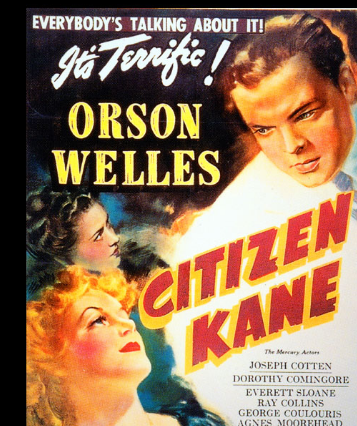
Film historians have remarked upon the many great works of cinema that emerged from this period of highly regimented filmmaking. One reason this was possible is that, with so many being made, not every film needed to be a big hit. A studio could gamble on a medium-budget feature with a good script and relatively unknown actors. Citizen Kane, directed by Orson Welles and regarded by some as the greatest film of all time, fits that description. In other cases, strong-willed directors like Howard Hawks, Alfred Hitchcock, and Frank Capra battled the studios in order to achieve their artistic visions. The apogee of the studio system may have been the year 1939, which saw the release of such classics as The Wizard of Oz, Gone with the Wind, Stagecoach, Mr. Smith Goes to Washington, Destry Rides Again, Young Mr. Lincoln, Wuthering Heights, Only Angels Have Wings, Ninotchka, Beau Geste, Babes in Arms, Gunga Din, Goodbye, Mr. Chips, and The Roaring Twenties.
Screenshot 2015-04-01 12.25.36

Other films from the golden age  now considered to be classics include Casablanca, The Adventures of Robin Hood, It’s a Wonderful Life, It Happened One Night, King Kong, Citizen Kane, Swing Time, Some Like It Hot, A Night at the Opera, Sergeant York, All About Eve, Mildred Pierce, The Maltese Falcon, The Searchers, Breakfast At Tiffany’s, Laura, North by Northwest, Dinner at Eight, Morocco, Rebel Without a Cause, Rear Window, Double Indemnity, Mutiny on the Bounty, City Lights, Red River, Suspicion, High Noon, The Manchurian Candidate, Bringing Up Baby, Meet John Doe, Singin’ in the Rain, Ben-Hur, To Have and Have Not, Roman Holiday, Giant, Jezebel, A Streetcar Named Desire, East of Eden, From Here To Eternity, and On the Waterfront.


Style

The style of classical Hollywood cinema, as elaborated by David Bordwell, was heavily influenced by the ideas of the Renaissance and its focus on humanity.

Classical narration always progresses through psychological motivation, i.e. by the will of a human character and his or her struggle with obstacles toward a defined goal. Space and time are subordinated to the narrative element which is usually composed of two lines of action: a romance intertwined with a more generic thread, such as a business deal or, in the case of Alfred Hitchcock films, solving a crime.

Screenshot 2015-04-01 12.27.17

Time in classical Hollywood is continuous, since non-linearity calls attention to the illusory workings of the medium. The only permissible manipulation of time in this format is the flashback. It is mostly used to introduce a character’s memory sequence , such as Bogart’s in Casablanca.

Similarly, the treatment of space in classic Hollywood strives to overcome or conceal the two-dimensionality of film (“invisible style”), and is strongly centered on the human body. The majority of shots in a classical film focus on gestures or facial expressions (medium-long and medium shots). André Bazin once compared classical film to a photographed play in that the events seem to exist objectively, with cameras simply serving to give us the best view of the entirety of the play.

This treatment of space consists of four main aspects: centering, balancing, “frontality,” and depth. Persons or objects of significance are mostly in the center of the frame and are never out of focus. Balancing refers to visual composition, i.e. characters are evenly distributed throughout the frame. Action is subtly addressed toward the spectator (frontality), and set, lighting (mostly three-point lighting), and costumes are designed to separate foreground from the background (depth).


Narrative

The classic Hollywood narrative is structured with an unmistakable beginning, middle, and end. There is usually a distinct resolution at the end. Utilizing actors, events, causal effects, main points, and secondary points are basic characteristics of this type of narrative. The characters in classical Hollywood cinema have clearly definable traits, are active, and very goal oriented. They are causal agents motivated by psychological rather than social concerns.


Production

The mode of film production during this period came to be known as the “Hollywood studio system” as well as “the star system,” an approach that standardized the way movies were produced. All film workers (actors, directors, etc.) were employees of a particular film studio. This resulted in a certain uniformity to film style. Directors were encouraged to think of themselves as employees rather than artists, and hence “auteurs” did not flourish (although some directors, such as Alfred Hitchcock, John Ford, and Howard Hawks worked within this system and still managed to fulfill their artistic visions).
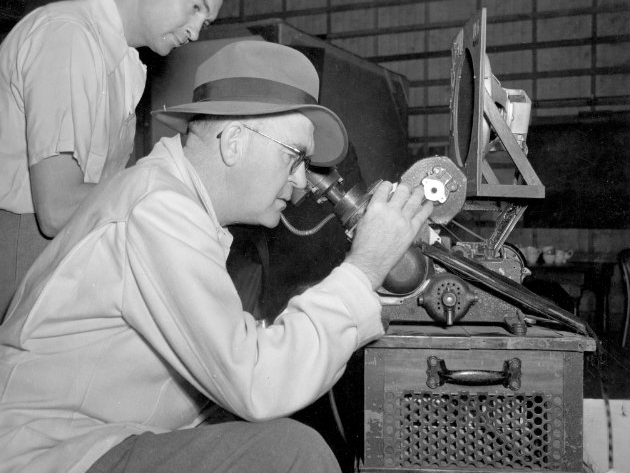
Director John Ford
Director John Ford

The “Big Eight” studios controlled the Hollywood studio system, however among these the Big Five fully integrated studios —  MGM, Warner Brothers, 20th Century Fox, Paramount, and RKO — were the most powerful. They operated their own theater chains, and produced and distributed films as well. The “Little Three” studios (Universal Studios, Columbia Pictures, and United Artists) were also full-fledged film factories, but they lacked the financial resources of the Big Five and therefore produced fewer A-class features that were the foundation of the studio system.


Periodization

Hollywood classicism gradually declined with the collapse of the studio system, the advent of television, the growing popularity of auteurism among directors and the increasing influence of foreign films and independent filmmaking.

The 1948 U.S. Supreme Court decision, which outlawed the practice of block booking and the above-mentioned ownership and operation of theater chains by the major film studios (as it was believed to constitute anti-competitive and monopolistic trade practices) was  a major blow to the studio system. The way was cleared for a growing number of independent producers (some of them the actors) and other studios to produce their film product free of major studio interference. The decision effectively killed  the original business model and left studios struggling to adapt.

At the time of the Court decision, the assumption was the quality, consistency, and availability of movies would go up and prices would fall. Quite the opposite happened. By 1955, the number of produced films had fallen by 25 percent. More than 4,200 theaters (or 23 percent of the total) had shut their doors. More than half of those remaining were unable to earn a profit. They could not afford to rent and exhibit the best and most costly films, the ones most likely to compete with television. The classical period was at an end.


Natalie Wood

Natalie_Wood_1961_Splendor_in_the_Grass

Natalie Wood was born on July 20, 1938, in San Francisco, California, as Natalia Nikolaevna Zakharenko. Her parents were Russian-born émigrés, of Ukrainian and Russian descent, who spoke barely comprehensible English; they changed the family name to Gurdin after becoming US citizens. When she was just four years old, Natalie appeared in her first film, Happy Land (1943). A production company had come to Santa Rosa, California, where the Gurdins were living and Natalie won a bit part of a crying little girl who had just dropped her ice cream cone. With stars in her eyes for her daughter, Mrs. Gurdin packed the family and moved south to Los Angeles in the hopes that more films would come her daughter’s way. Unfortunately they did not, at least not at first, and the family continued to scrape by much as they had done in Santa Rosa. In 1946 Natalie tested for a role in Tomorrow Is Forever (1946). She was only seven at the time, and flunked the screen test. Natalie’s mother convinced the studio heads to give her another test, and this time she was convincing enough that they gave Natalie the role.

Miracle

In 1947’s Miracle on 34th Street (1947), she won the hearts of movie patrons around the country as Susan Walker in a film that is considered a Christmas classic to this day.

NW-nataliewood-rebel-myfriend
Natalie stayed very busy as a child actress, appearing in no less than 18 films in the late 1940s and early 1950s. When she was 16 Natalie appeared in Rebel Without a Cause (1955) with James DeanSal Mineo and Dennis Hopper. She played Judy, a rebellious high school student who was more concerned with hanging out with the wrong crowd than being a sweet teenager like her contemporaries. The result was her first Academy Award nomination and a defining moment in her development as an adult actress. She appeared in Splendor in the Grass (1961), West Side Story (1961), Gypsy(1962), and Love with the Proper Stranger (1963).

Love-with-the-Proper-Stranger-natalie-wood-10317287-800-600
While Natalie was reported to be unhappy making “West Side Story,” the film won Oscars for Best Picture, Best Direction, Best Supporting Actor, and Best Supporting Actress. In short, it was a smash hit.

982015-west-side-story

Although she wasn’t nominated for an Academy Award in that one, she did receive nominations for her roles in “Splendor in the Grass” and “Love with the Proper Stranger.” After This Property Is Condemned (1966) in 1966, Natalie stayed away from Hollywood for three years to have time for herself and to consider where she was going. When she did return, her star quality had not diminished, as evidenced by her playing Carol Sanders in the hit Bob & Carol & Ted & Alice(1969). From that point on Natalie didn’t work as much. She made a few television appearances, but nothing of substance with the exception of the TV mini-series From Here to Eternity (1979).

Brainstorm
After making The Last Married Couple in America (1980), Natalie began work on Brainstorm (1983) in the fall of 1981 with Christopher Walken. She did not live to see it released. On November 29, 1981, she was sailing on the yacht she shared with her husband, Robert Wagner, and their friend Walken, when she fell in the ocean while trying to board the dinghy tied up alongside the yacht and drowned. She was 43 years old. Natalie had made 56 films for TV and the silver screen. “Brainstorm” was finally released in 1983.

Rory Calhoun

rory_calhoun_201003_3

Rory Calhoun (August 8, 1922 – April 28, 1999) was an acclaimed American television and film actor, screenwriter, and producer.

EARLY LIFE

Born Francis Timothy McCown in Los Angeles, California, Calhoun spent his early years in Santa Cruz, California. The son of a professional gambler, he was of Irish and English ancestry. He was only nine months old when his father died; Calhoun’s mother remarried, and he occasionally went by Frank Durgin, using the last name of his stepfather. At age thirteen, he stole a revolver, for which he was sent to the California Youth Authority’s Preston School of Industry reformatory at Ione, California. He escaped while in the adjustment center (jail within the jail). After robbing several jewelry stores, he stole a car and drove it across state lines. This made it a federal offense, and when he was recaptured, he was sentenced to three years in the penitentiary at Springfield, Missouri. After finishing his sentence, he was transferred to San Quentin prison on other charges. He remained there until he was paroled shortly before his twenty-first birthday.

CAREER

After his release from San Quentin, Calhoun worked at a number of odd jobs. In 1943, while riding horseback in the Hollywood Hills, he met actor Alan Ladd, whose wife was an agent. Susan Carol Ladd landed Calhoun a one-line role in a Laurel and Hardy comedy, The Bullfighters, credited under the name Frank McCown. Shortly afterwards, the Ladds hosted a party attended by David O. Selznick employee Henry Willson, an agent known for his assortment of young, handsome and marginally talented actors to whom he gave new, unusual names. Willson signed McCown to a contract and initially christened him “Troy Donahue”; it was soon changed to “Rory Calhoun.” Willson carefully groomed his new client and taught him the social manners he had never learned in prison.

images

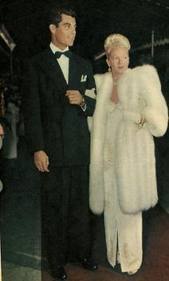
Calhoun’s first public appearance in the film capital was as Lana Turner’s escort to the premiere of Alfred Hitchcock’s Spellbound (1945), a Selznick production. The glamorous blonde and her handsome companion attracted the paparazzi, and photos appeared in newspapers and fan magazines. Selznick then began loaning his contract player to other studios; subsequently, Calhoun appeared in Adventure Island with Rhonda Fleming, The Red House with Edward G. Robinson, and That Hagen Girl with Shirley Temple.

As Calhoun’s career gained momentum, he next appeared in several westerns, musicals and comedies, including Way of a Gaucho with Gene Tierney, With a Song in My Heart with Susan Hayward, How to Marry a Millionaire (as the love interest of Betty Grable) and River of No Return. The last two films featured Marilyn Monroe.

RoryAint

Willson maintained careful control over his rising star, arranging his social life and ending his engagement to French actress Corinne Calvet. In 1955, Willson disclosed information about Calhoun’s years in prison to Confidential magazine in exchange for the tabloid not printing an exposé about the secret homosexual life of Rock Hudson, another Willson client. The disclosure had no negative effect on Calhoun’s career and only served to solidify his bad boy image.

images-1

In 1957, Calhoun formed a production company with Victor Orsatti they named Rorvic to make and star in the films The Hired Gun, The Domino Kid and Apache Territory. In the same year, he co-produced and starred in CBS’s The Texan, a Western series that ran on Monday evenings until 1960. On March 26, 1959, he appeared as himself in the episode “Rory Calhoun, The Texan” on the CBS sitcom December Bride, starring Spring Byington, then in its last season of production. While filming The Texan, Calhoun would continue to produce and write screenplays throughout his career. After The Texan was canceled, he was strongly considered for the lead of James West in The Wild Wild West, but the producers were not impressed with his screen test. Like many American actors, Calhoun also made a variety of films in Europe.

He continued to appear in both television and film throughout the 1970s and 1980s, including Thunder in Carolina, Rawhide, Gilligan’s Island, Hawaii Five-O, Alias Smith and Jones and Starsky and Hutch. In 1982, Calhoun had a regular role on the soap opera Capitol, being persuaded to do it by his family after his regret over turning down a part on Dallas. He stayed with the series until 1987.

Calhoun became known to a new generation for several roles in cult films such as Night of the Lepus (1972), Motel Hell, Angel (1984) and its sequel Avenging Angel (1985), as well as Hell Comes to Frogtown (1987).

His final role was that of grizzled family patriarch and rancher Ernest Tucker in the 1992 film Pure Country.

PERSONAL LIFE

Calhoun was married twice and had five daughters, three with wife (1948-1970) Lita Baron, one with his second wife (1971-1999, his death), journalist Sue Rhodes and one with actress Vitina Marcus while he was married to Baron.

When Baron sued Calhoun for divorce, she named Betty Grable as one of 79 women he had adulterous relationships with. Calhoun replied to her charge, “Heck, she didn’t even include half of them.”

In 1966, a paternity suit by Vitina Marcus against Calhoun was settled in Los Angeles Superior Court for an undisclosed sum. At the time, he was 43, and she was 28; their daughter, Athena Marcus Calhoun, was 7. Athena went on to become “The World’s Most Beautiful Showgirl” and received a “Key To The City Of Las Vegas” in 1987.

Calhoun’s second cousin is popular Canadian sports talk show host Bob McCown.

Rory Calhoun died in Burbank, California at the age of 76 from complications resulting from emphysema and diabetes.

The following depicts Rory in photo clips from his numerous movies:


Finally, I must tell my personal memory of the man: I was 12 years old when I won a two-week vacation that I shared with a dozen or more other kids at Rory’s Sespe Valley Ranch north of Ojai. He and his wife, Lita Baron, were wonderful hosts. When Rory showed up, we kids decided to “initiate” him by tossing him into the pool. We weren’t successful, but I ended up in the water. I’d seen his wristwatch and wanted to keep it from getting wet, so I tried to take it off. Mistake. Instantly, I was airborne, hitting the water so hard I got a nosebleed.

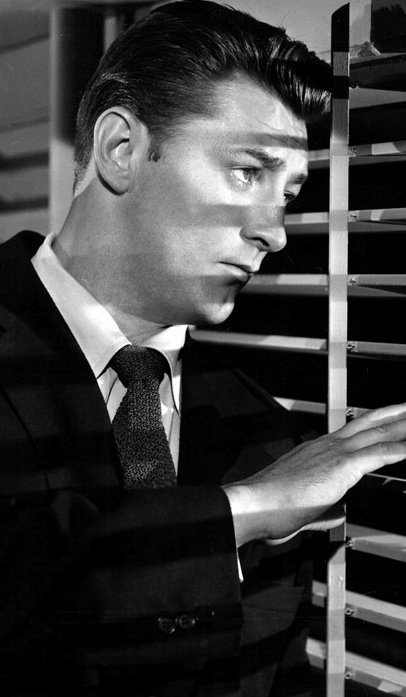
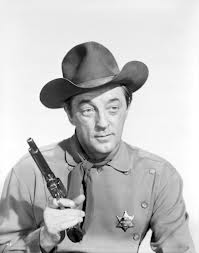
Robert Mitchum

rmitchum

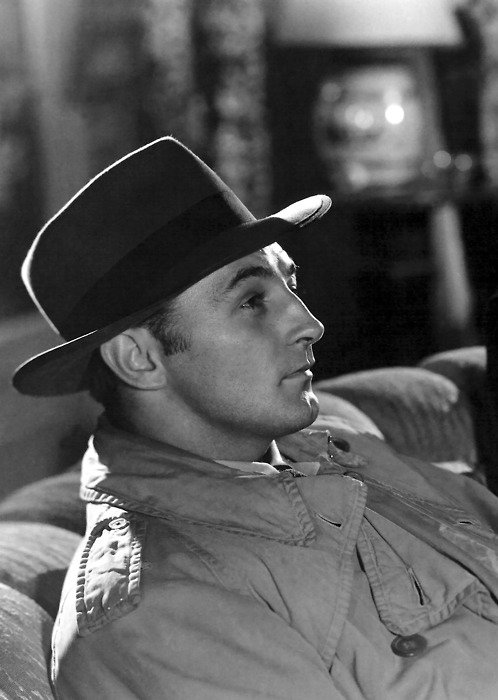
Robert Charles Durman Mitchum (August 6, 1917 – July 1, 1997) was an American film actor, author, composer and singer. He is #23 on the American Film Institute’s list of the greatest male American screen legends of all time. Mitchum rose to prominence for his starring roles in several major works of the film noir style, and is considered a forerunner of the anti-heroes prevalent in film during the 1950s and 1960s.

EARLY YEARS

Mitchum was born in Bridgeport, Connecticut, into a Methodist family. His mother, Harry Anniette (née Gunderson), was a Norwegian immigrant and sea captain’s daughter, and his father, James Thomas Mitchum, was a shipyard and railroad worker. A sister, Annette, (known as Julie Mitchum during her acting career) was born in 1914. James Mitchum was crushed to death in a rail yard accident in Charleston, South Carolina, in February 1919, when his son was less than two years old. After his death, Ann Mitchum was awarded a government pension, and soon realized she was pregnant. She returned to her family in Connecticut, and married a former British Army major who helped her care for the children. In September 1919 a second son, John, was born. When all of the children were old enough to attend school, Ann found employment as a linotype operator for the Bridgeport Post.


Throughout Mitchum’s childhood, he was known as a prankster, often involved in fistfights and mischief. When he was 12, his mother sent Mitchum to live with his grandparents in Felton, Delaware, where he was promptly expelled from his middle school for scuffling with a principal. A year later, in 1930, he moved in with his older sister, in New York’s Hell’s Kitchen. After being expelled from Haaran High School, he left his sister and traveled throughout the country on railroad cars, taking a number of jobs including as a ditch-digger for the Civilian Conservation Corps and as a professional boxer. He experienced numerous adventures during his years as one of the Depression era’s “wild boys of the road.” At age 14 in Savannah, Georgia, he was arrested for vagrancy and put on a local chain gang. By Mitchum’s own account, he escaped and returned to his family in Delaware. It was during this time, while recovering from injuries that nearly lost him a leg, that he met the woman he would marry, a teenaged Dorothy Spence. He soon went back on the road, eventually riding the rails to California.

ACTING CAREER

Mitchum arrived in Long Beach, California, in 1936, staying again with his sister Julie. Soon the rest of the Mitchum family joined them in Long Beach. During this time he worked as a ghostwriter for astrologer Carroll Righter. It was sister Julie who convinced him to join the local theater guild with her. In his years with the Players Guild of Long Beach, he made a living as a stagehand and occasional bit player in company productions. He also wrote several short pieces that were performed by the guild. According to Lee Server’s biography (Robert Mitchum: Baby, I Don’t Care), Mitchum put a talent for poetry to work writing song lyrics and monologues for his sister Julie’s nightclub performances. In 1940 he returned East to marry Dorothy, taking her back to California. He remained a footloose character until the birth of their first child, James Mitchum, nicknamed Josh (two more children would follow, Christopher Mitchum and Petrine). Mitchum then got a steady job as a machine operator with the Lockheed Aircraft Corporation.

A nervous breakdown (which resulted in temporary blindness), apparently from job-related stress, led Mitchum to look for work as an actor or extra in movies. An agent he had met got him an interview with the producer of the Hopalong Cassidy series of B-westerns; he was hired to play the villain in several films in the series during 1942 and 1943. He continued to find further work as an extra and supporting actor in numerous productions for various studios. After impressing director Mervyn LeRoy during the making of Thirty Seconds Over Tokyo, Mitchum signed a seven-year contract with RKO Radio Pictures. He found himself groomed for B Western stardom in a series of Zane Grey adaptations.

images-1

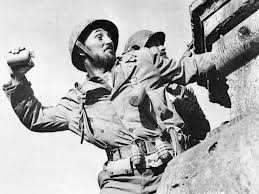
Following the moderately successful western Nevada, Mitchum was lent from RKO to United Artists for the William Wellman-helmed The Story of G.I. Joe. In the film, he portrayed war-weary officer Bill Walker (based on Captain Henry T. Waskow), who remains resolute despite the troubles he faces. The film, which followed the life of an ordinary soldier through the eyes of journalist Ernie Pyle (played by Burgess Meredith), became an instant critical and commercial success. Shortly after making the film, Mitchum himself was drafted into the U.S. Army, serving at Fort MacArthur, California. At the 1946 Academy Awards, The Story of G.I. Joe was nominated for four Oscars, including Mitchum’s only nomination for Best Supporting Actor. He finished the year off with a western (West of the Pecos) and a story of returning Marine veterans (Till the End of Time), before filming in a genre that came to define Mitchum’s career and screen persona: film noir.

robertprofile

FILM NOIR

Mitchum was initially known for his work in film noir. His first foray into the genre was a supporting role in the B-film When Strangers Marry, about newlyweds and a New York City serial killer. Undercurrent, another of Mitchum’s early noirs, featured him playing against type as a troubled, sensitive man entangled in the affairs of his brother (Robert Taylor) and his brother’s suspicious wife (Katharine Hepburn). The film was director Vincente Minnelli’s only film noir.

John Brahm’s The Locket (1946) featured Mitchum as bitter ex-husband to Laraine Day’s femme fatale, while Raoul Walsh’s Pursued (1947) combined western and noir styles, with Mitchum’s character attempting to recall his past and find those responsible for killing his family. Crossfire (also 1947) featured Mitchum as a member of a group of soldiers, one of whom killed a Jewish man in an act of anti-Jewish hatred. It featured themes of anti-Semitism and the failings of military training. The film, directed by Edward Dmytryk, earned five Academy Award nominations.

nuit-du-chasseur-55-tou-02-g

Following Crossfire, Mitchum starred in Out of the Past (also called Build My Gallows High), directed by Jacques Tourneur and featuring the cinematography of Nicholas Musuraca. Mitchum played Jeff Markham, a small-town gas station owner whose unfinished business with gambler Whit Sterling (Kirk Douglas) and femme fatale Kathie Moffett (Jane Greer), comes back to haunt him. Though ignored by most critics on its release, the film was a modest box office hit at the time and has received a positive reappraisal as one of the greatest film noir movies of all time. Musuraca in the Robert Wise psychological western Blood on the Moon the following year photographed Mitchum again.

On September 1, 1948, after a string of successful films for RKO, Mitchum and actress Lila Leeds were arrested for possession of marijuana. The arrest was the result of a sting operation designed to capture other Hollywood partiers as well, but Mitchum and Leeds did not receive the tip-off. After serving a week at the county jail, (he described the experience to a reporter as being “like Palm Springs, but without the riff-raff”) Mitchum spent 43 days (February 16 to March 30) at a Castaic, California, prison farm, with Life magazine photographers right there taking photos of him mopping up in his prison uniform. The arrest became the inspiration for the exploitation film She Shoulda Said No! (1949), which starred Leeds. The Los Angeles court and District Attorney’s office later overturned the conviction on January 31, 1951, with the following statement, after it was exposed as a set-up:

“ After an exhaustive investigation of the evidence and testimony presented at the trial, the court orders that the verdict of guilty be set aside and that a plea of not guilty be entered and that the information or complaint be dismissed. ”

Whether despite, or because of, his troubles with the law and his studio, the films released immediately after his arrest were box-office hits. Rachel and the Stranger (1948) featured Mitchum in a supporting role as a mountain man competing for the hand of Loretta Young, the indentured servant and wife of William Holden, while he appeared in the film adaptation of John Steinbeck’s novella The Red Pony (1949) as a trusted cowhand to a ranching family.

Mitchum returned to true film noir in The Big Steal (also 1949), where he again joined Jane Greer in an early Don Siegel film.

CAREER IN THE 1950s AND 1960s

49sm

In Where Danger Lives (1950), Mitchum played a doctor who comes between a mentally unbalanced Faith Domergue and cuckolded Claude Rains. The Racket was a noir remake of the early crime drama of the same name and featured Mitchum as a police captain fighting corruption in his precinct. The Josef von Sternberg film Macao (1952) saw Mitchum a victim of mistaken identity at an exotic resort casino, playing opposite Jane Russell. Otto Preminger’s Angel Face was the first of three collaborations between Mitchum and British stage actress Jean Simmons. In the film, Simmons plays an insane heiress who plans to use young ambulance driver Mitchum to kill for her.

Mitchum’s cynical, mischievous attitude through his career had led him to shrug off fame as a fluke. His expulsion from Blood Alley (1955) is frequently attributed to his pranks, especially one in which he reportedly threw the film’s transportation manager into San Francisco Bay. According to Sam O’Steen’s memoir, Cut to the Chase, Mitchum showed up on set after a night of drinking and tore apart a studio office when they didn’t have a car ready for him. Mitchum walked off the set of the third day of filming Blood Alley, claiming he could not work with the director. Because he was showing up late and behaving erratically, producer John Wayne, after failing to obtain Humphrey Bogart as a replacement, took over the role himself.

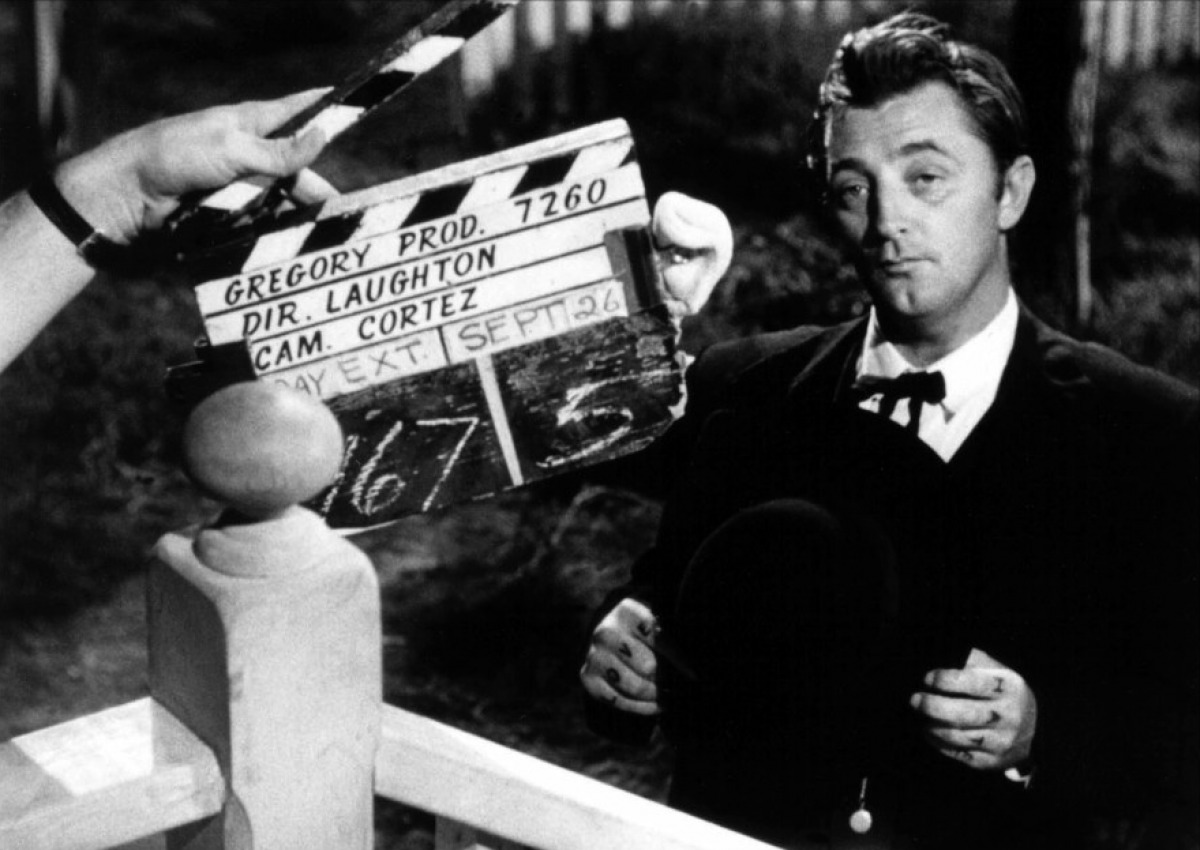
Following a series of conventional westerns and films noirs, including the Marilyn Monroe vehicle River of No Return (1954), he appeared in Charles Laughton’s only film as director, The Night of the Hunter (1955). Based on a novel by Davis Grubb, the film noir thriller starred Mitchum as a monstrous criminal posing as a preacher to find money hidden by his cellmate in the cellmate’s home. His performance as Reverend Harry Powell is considered by many to be one of the best of his career. Stanley Kramer’s melodrama Not as a Stranger though, also released in 1955, was a box office hit for Mitchum. The film starred Mitchum against type, as an idealistic young doctor, who marries an older nurse (Olivia de Havilland), only to question his morality many years later. However, the film was not well received, with most critics pointing out that Mitchum, Frank Sinatra and Lee Marvin were all too old for their characters. Olivia de Havilland received top billing over Mitchum and Sinatra.

images

Following a succession of average westerns and the poorly received Foreign Intrigue (1956), Mitchum starred in the first of three films with British actress Deborah Kerr. The John Huston war drama Heaven Knows, Mr. Allison starred Mitchum as a marine corporal shipwrecked on a Pacific Island with a nun, Sister Angela (Deborah Kerr), being his sole companion. In this character study they struggle to resist the elements and the invading Japanese army. The film was nominated for two Academy Awards, including Best Actress and Best Adapted Screenplay. For his role, Mitchum was nominated for a BAFTA Award for Best Foreign Actor.

Thunder Road (1958) was loosely based on an incident in which a driver transporting moonshine was said to have crashed to his death on Kingston Pike in Knoxville, Tennessee, somewhere between Bearden Hill and Morrell Road. According to Metro Pulse writer Jack Renfro, the incident occurred in 1952 and may have been witnessed by James Agee, who passed the story on to Mitchum – who not only starred in the movie, but also produced the film, co-wrote the screenplay, and is rumored to have directed much of the film himself. Mitchum also co-wrote (with Don Raye) the theme song, “The Ballad of Thunder Road.”

Mitchum and Kerr reunited for the Fred Zinnemann film, The Sundowners (1960), where they played husband and wife struggling in Depression-era Australia. Opposite Mitchum, Kerr was nominated for yet another Academy Award for Best Actress, while the film was nominated for a total of five Oscars. Robert Mitchum was awarded that year’s National Board of Review award for Best Actor for his performance. The award also recognized his superior performance in the Vincente Minnelli western drama Home from the Hill (also 1960). He was teamed with both Kerr and previous leading lady Jean Simmons as well as Cary Grant for the extremely offbeat Stanley Donen ensemble comedy The Grass Is Greener the same year.

Mitchum’s performance as the menacing southern rapist Max Cady in Cape Fear (1962) brought him even more attention and furthered his renown as playing cool, predatory characters. The 1960s were marked by a number of lesser films and missed opportunities. Among the films Mitchum passed on during the decade was John Huston’s The Misfits, the last film of its stars Clark Gable and Marilyn Monroe, the Academy Award–winning Patton, and Dirty Harry. The most notable of his films in the decade included the war epics The Longest Day (1962) and Anzio (1968), the Shirley MacLaine comedy-musical What a Way to Go! (1964), and the Howard Hawks western El Dorado (1966), a remake of Rio Bravo (1959), in which Mitchum took over Dean Martin’s role of the drunk who comes to the aid of John Wayne.

MUSIC CAREER

images-1

One of the lesser known aspects of Mitchum’s career was his forays into music, both as singer and composer. Mitchum’s voice was often used instead of that of a professional singer when his characters sang in his films. Notable productions featuring Mitchum’s own singing voice included Rachel and the Stranger, River of No Return and The Night of the Hunter. After hearing traditional calypso music and meeting artists such as Mighty Sparrow and Lord Invader while filming Heaven Knows, Mr. Allison in the Caribbean island of Tobago, he recorded Calypso — is like so … in March 1957. On the album, released through Capitol Records, he emulated the calypso sound and style, even adopting the style’s unique pronunciations and slang. A year later he recorded a song he had written for the film Thunder Road, titled “The Ballad of Thunder Road”. The country-styled song became a modest hit for Mitchum, reaching #69 on the Billboard Pop Singles Chart. The song was included as a bonus track on a successful reissue of Calypso… and helped market the film to a wider audience

Though Mitchum continued to use his singing voice in his film work, he waited until 1967 to record his follow-up record, That Man, Robert Mitchum, Sings. The album, released by Nashville-based Monument Records, took him further into country music, and featured songs similar to The Ballad of Thunder Road. “Little Old Wine Drinker Me,” the first single, was a top ten hit at country radio, reaching #9 there, and crossed over onto mainstream radio, where it peaked at #96. Its follow-up, “You Deserve Each Other,” also charted on the Billboard Country Singles Chart. He also sang the title song to the western Young Billy Young, made in 1969.

Mitchum also co-wrote and composed the music for an oratorio that was produced by Orson Welles at the Hollywood Bowl.

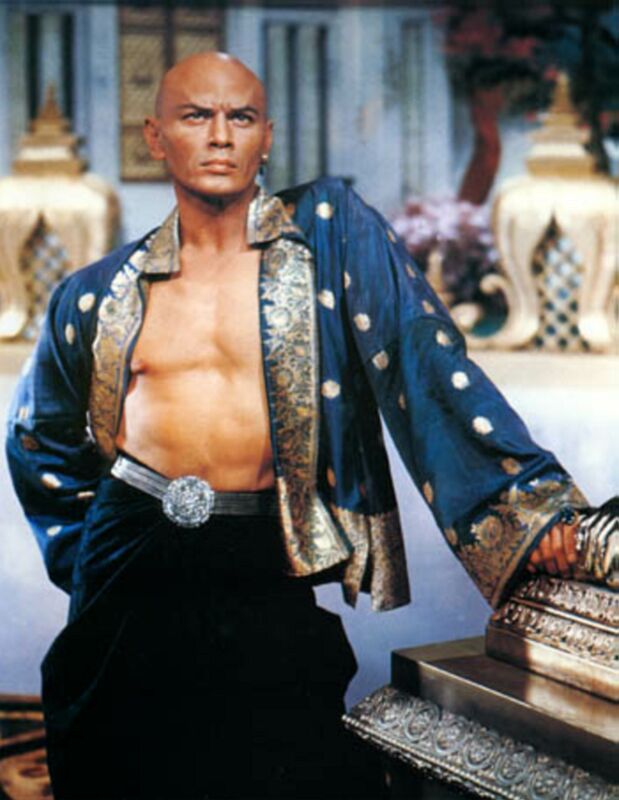
Yul Brynner


YulBrynner

Yul Brynner (b. July 11, 1920, d. October 10, 1985) was a Russian-born American stage and film actor. He was best known for his portrayal of the King of Siam in the Rodgers and Hammerstein musical The King and I, for which he won two Tony Awards and an Academy Award for the film version; he played the role 4,625 times on stage. He is also remembered as Rameses II in the 1956 Cecil B. DeMille blockbuster The Ten Commandments, General Bounine in the 1956 film Anastasia, and Chris Adams in The Magnificent Seven. Brynner was noted for his distinctive voice and for his shaved head, which he maintained as a personal trademark long after adopting it in 1951 for his role in The King and I. Earlier, he was a model and television director, and later a photographer and the author of two books.

Yul Brynner was born Yuliy Borisovich Briner in 1920. He exaggerated his background and early life for the press, claiming that he was born Taidje Khan of part-Mongol parentage, on the Russian island of Sakhalin. In reality, he was born at home in a four-story residence at 15 Aleutskaya Street, Vladivostok, in the Far East Russian Republic (present-day Primorsky Krai, Russia). He also occasionally referred to himself as Julius Briner, Jules Bryner, or Youl Bryner. A 1989 biography by his son, Rock Brynner, clarified these issues.

During World War II, Brynner worked as a French-speaking radio announcer and commentator for the U.S. Office of War Information, broadcasting propaganda to occupied France. At the same time, he studied acting in Connecticut with the Russian teacher Michael Chekhov. Brynner’s first Broadway performance was a small part in Shakespeare’s Twelfth Night in December 1941. Brynner found little acting work during the next few years, but among other acting stints, he co-starred in a 1946 production of Lute Song with Mary Martin. He also did some modeling work and was photographed nude by George Platt Lynes.

Brynner married his first wife, actress Virginia Gilmore, in 1944, and soon after began working as a director at the new CBS television studios, directing Studio One, among other shows. In 1949, he made his film debut in Port of New York, his only film with his natural head of hair. The next year, at the urging of Martin, he auditioned for Rodgers and Hammerstein’s new musical in New York. He recalled that, as he was finding success as a director on television, he was reluctant to go back on the stage. Once he read the script, however, he was fascinated by the character of the King and was eager to do the project.

brynner52

His best-known role remains that of King Mongkut of Siam in The King and I in which he played 4,625 times on stage over the span of his career. He appeared in the original 1951 production and later touring productions as well as a 1977 Broadway revival, a London Production in 1979 and another Broadway revival in 1985. He won Tony Award for both the first and the last of these Broadway productions. He also appeared in the 1956 film version, for which he won an Academy Award as Best Actor and in a short-lived TV version (Anna and the King) on CBS in 1972. Brynner is one of only nine people who have won both a Tony Award and an Academy Award for the same role. His connection to the story and the role of King Mongkut is so deep that he was mentioned in the song “One Night in Bangkok” from the 1984 musical Chess whose second act is set in Bangkok.

In 1951 Brynner shaved his head for his role in The King and I. Following the huge success of the Broadway production and subsequent film, Brynner continued to shave his head for the rest of his life, though he would sometimes wear a wig for certain roles. Brynner’s shaved head was unusual at the time, and his striking appearance helped to give him an iconic appeal. Some fans shaved off their hair to emulate him, and a shaved head was often referred to as the “Yul Brynner look.”

yul1

Brynner made an immediate impact upon launching his mainstream film career in 1956 and quickly gained superstar status after appearing not only in The King and I that year but also in starring roles in The Ten Commandments, and Anastasia with Ingrid Bergman. Brynner, at 5’10”, was reportedly concerned about being overshadowed by co-star Charlton Heston’s height and physical presence in The Ten Commandments and prepared his impressive physique seen in the film with an intensive weight-lifting program.

yul-brynner

He appeared in more than 40 other films over the next two decades, including the epic Solomon and Sheba (1959), The Magnificent Seven (1960), Taras Bulba (1962) and Kings of the Sun (1963). He co-starred with Marlon Brando in Morituri (1965), Katharine Hepburn in The Madwoman of Chaillot (1969) and Lee J. Cobb in a film version of The Brothers Karamazov (1958). He played the titular role of The Ultimate Warrior (1975) and starred with Barbara Bouchet in Death Rage (1976). Among his final feature film appearances were in Michael Crichton’s Westworld (1973) and its sequel Futureworld (1976). Brynner also appeared in drag (as a torch singer) in an unbilled role in the Peter Sellers comedy The Magic Christian (1969).

In addition to his work as a director and performer, Brynner was an active photographer and wrote two books. His daughter Victoria put together Yul Brynner: Photographer (ISBN 0-8109-3144-3) a collection of his photographs of family, friends, and fellow actors, as well as those he took while serving as a UN special consultant on refugees. Brynner wrote Bring Forth the Children: A Journey to the Forgotten People of Europe and the Middle East (1960), with photographs by himself and Magnum photographer Inge Morath, and also The Yul Brynner Cookbook: Food Fit for the King and You.

A student of music from childhood, Brynner was an accomplished guitarist. In his early period in Europe he often played and sang gypsy songs in Parisian nightclubs with Aliosha Dimitrievitch. He sang some of those same songs in the film The Brothers Karamazov. In 1967 he and Dimitrievitch released a record album The Gypsy and I: Yul Brynner Sings Gypsy Songs (Vanguard VSD 79265).

Brynner married four times. The first three ended in divorce. He fathered three children and adopted two.

He and his first wife, actress Virginia Gilmore (1944–1960), had one child, Rock Yul Brynner, born on December 23, 1946. His father nicknamed him “Rock” when he was six years old in honor of boxer Rocky Graziano. Rock is a historian, novelist, and university history lecturer at Marist College in Poughkeepsie, New York and Western Connecticut State University in Danbury, Connecticut. In 2006, Rock wrote a book about his father and his family history titled Empire and Odyssey: The Brynners in Far East Russia and Beyond. Rock regularly returns to Vladivostok, the city of his father’s birth, for the “Pacific Meridian” Film Festival. Yul Brynner had a long affair with Marlene Dietrich, who was 19 years his senior, during the first production of The King and I.

Brynner’s daughter Lark Brynner was born out of wedlock in 1959 and raised by her mother, Frankie Tilden, who was 20 years old when Lark was born. Brynner supported her financially. His second wife, from 1960 to 1967, Doris Kleiner, was a Chilean model whom he married on the set during shooting of The Magnificent Seven in 1960. They had one child, Victoria Brynner (born November 1962), whose godmother was Audrey Hepburn.

His third wife, Jacqueline Thion de la Chaume (1971–1981), was a French socialite, the widow of Philippe de Croisset (he was the son of French playwright Francis de Croisset and a publishing executive). Brynner and Jacqueline adopted two Vietnamese children: Mia (1974) and Melody (1975). The first house that he ever owned was the Manoir de Criqueboeuf, a sixteenth-century manor house that he and Jacqueline purchased. His 1980 announcement that he would continue in the role of the King for another long tour and Broadway run, together with his affairs with female fans and his neglect of his wife and children, broke up their marriage.

At the age of 63, he married his fourth wife, Kathy Lee, a 24-year-old ballerina from a small town in Malaysia whom he had met in a production of The King and I in which she had a small dancing role. They remained married for the last 2 years (1983–1985) of Brynner’s life.

Brynner, a Swiss citizen, was naturalized as a US citizen, but in June 1965, he renounced his US citizenship at the US Embassy in Berne, Switzerland for tax reasons. He had lost his tax exemption as an American resident abroad by working too long in the U.S. and would have been bankrupted by his tax and penalty debt.

yusultry

Brynner began smoking heavily at age 12, and his promotional photos almost always showed him with a cigarette in his hand, but he quit in 1971. In September 1983, Brynner found a lump on his vocal cords. In Los Angeles, only hours before his 4,000th performance in The King and I, he received the test results. His throat would be fine, but he had inoperable lung cancer. Brynner and the national tour of the musical were forced to take a few months off while he underwent radiation therapy, which hurt his throat and made it impossible for him to sing or speak easily. The tour then resumed.

In January 1985, nine months before his death, the tour reached New York for a farewell Broadway run. Aware he was dying, Brynner gave an interview on Good Morning America discussing the dangers of smoking and expressing his desire to make an anti-smoking commercial. The Broadway production of The King and I ran from January 7 to June 30 of that year, with Mary Beth Peil as Anna. His last performance marked the 4,625th time he had played the role of the King. Meanwhile, Brynner and the American Cancer Society created a public service announcement using a clip from the Good Morning America interview. Brynner died of lung cancer on October 10, 1985 in New York City on the same day as his Battle of Neretva co-star Orson Welles. Only a few days after his death, the public service announcement was showing on all the major U.S. television networks and was shown in many other countries around the world. He looked directly into the camera for 30 seconds, “His distinctive voice uttering one last haunting plea: ‘Now that I’m gone, I tell you: Don’t smoke. Whatever you do, just don’t smoke.’”

His remains are interred in France on the grounds of the Saint-Michel-de-Bois-Aubry Russian Orthodox monastery near Luzé between Tours and Poitiers.

On September 28, 2012, an eight-foot-tall statue was inaugurated at Yul Brynner Park, in front of the home where he was born at Aleutskaya St. No. 15 in Vladivostok, Russia. Created by local sculptor Alexei Bokiy, the monument was carved in granite from China. The grounds for the park were donated by the city of Vladivostok, which also paid additional costs. Vladivostok Mayor Igor Pushkariov, U.S. Consul General Sylvia Curran, and Rock Brynner participated in the ceremony, along with hundreds of city residents.

Brynner has a star on the Hollywood Walk of Fame at 6162 Hollywood Blvd.

The cottage at his childhood country home, at Sidimi near Vladivostok, is now a family museum.

In 1952, he received the Tony Award for Best Featured Actor in a Musical for his portrayal of the King of Siam in The King and I.

He won the 1956 Academy Award for Best Actor for the same role in the film version of  The King and I, and made the “Top 10 Stars of the Year” list in both 1957 and 1958.

In 1985, he received a Special Tony Award honoring his 4,525 performances in The King and I.

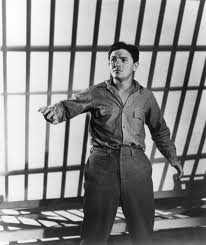
John Garfield

“If I hadn’t become an actor, I might have become Public Enemy Number One.”

port39

John Garfield (March 4, 1913 – May 21, 1952) was an American actor adept at playing brooding, rebellious, working-class characters. He grew up in poverty in Depression-era New York City and in the early 1930s became an important member of the Group Theater. In 1937, he moved to Hollywood, eventually becoming one of Warner Bros.’ major stars. Called to testify before the U.S. Congressional House Committee on Un-American Activities (HUAC), he denied Communist affiliation and refused to “name names,” effectively ending his film career. Some have claimed that the stress of this incident led to his premature death at 39 from a heart attack. (Rumors abounded that he “died in the saddle.”)


Garfield is acknowledged as a predecessor of such Method actors as Montgomery Clift, Marlon Brando, and James Dean.

Garfield was born Jacob Garfinkle in a small apartment on Rivington Street in Manhattan’s Lower East Side, to David and Hannah Garfinkle, Russian Jewish immigrants, and grew up in the heart of the Yiddish Theater District. In early infancy a middle name—Julius—was added, and for the rest of his life those who knew him well called him Julie. His father, a clothes presser and part-time cantor, struggled to make a living and to provide even marginal comfort for his small family. When Garfield was five, his brother Max was born and their mother never fully recovered from what was described as a “difficult” pregnancy. She died two years later and the young boys were sent to live with various relatives, all poor, scattered across the boroughs of Brooklyn, Queens and the Bronx. Several of these relatives lived in tenements in a section of East Brooklyn called Brownsville and there Garfield lived in one house and slept in another. At school he was judged a poor reader and speller, deficits that were aggravated by irregular attendance. He would later say of his time on the streets there, that he learned “all the meanness, all the toughness it’s possible for kids to acquire.”

images-2

His father remarried and moved to the West Bronx where Garfield joined a series of gangs. Much later he would recall: “Every street had its own gang. That’s the way it was in poor sections… the old safety in numbers.” He soon became gang leader. It was at this time people started to notice his ability to mimic well-known performers, both bodily and facially. He also began to hang out and eventually spar at a boxing gym on Jerome Avenue. At some point he contracted scarlet fever, (it was diagnosed later in adulthood) causing permanent damage to his heart and causing him to miss a lot of school. After being expelled three times and expressing a wish to quit school altogether, his parents sent him to P.S. 45, a school for difficult children. It was under the guidance of the school’s principal—the noted educator Angelo Patri—that he was introduced to acting. Noticing Garfield’s tendency to stammer, Patri assigned him to a speech therapy class taught by a charismatic teacher named Margaret O’Ryan. She gave him acting exercises and made him memorize and deliver speeches in front of the class and, as he progressed, in front of school assemblies. O’Ryan thought he had natural talent and cast him in school plays. She encouraged him to sign up for a citywide debating competition sponsored by the New York Times. To his own surprise, he took second prize.

With Patri and O’Ryan’s encouragement he began to take acting lessons at a drama school that was part of The Heckscher Foundation and began to appear in their productions. At one of the latter he received back-stage congratulations and an offer of support from the Yiddish actor Jacob Ben-Ami who recommended him to the American Laboratory Theater. Funded by the Theatre Guild, “the Lab” had contracted with Richard Boleslavski to stage its experimental productions and with Russian actress and expatriate Maria Ouspenskaya to supervise classes in acting. Former members of the Moscow Art Theater, they were the first proponents of Stanislavsky’s “system” in the United States. Garfield took morning classes and began volunteering time at the Lab after hours, auditing rehearsals, building and painting scenery, and doing crew work. He would later view this time as beginning his apprenticeship in the theater. Among the people becoming disenchanted with the Guild and turning to the Lab for a more radical, challenging environment were Stella Adler, Lee Strasberg, Franchot Tone, Cheryl Crawford and Harold Clurman. In varying degrees, all would become influential in Garfield’s later career.

After a stint with Eva Le Gallienne’s Civic Repertory Theater and a short period of vagrancy involving hitchhiking, freight hopping, picking fruit, and logging in the Pacific Northwest (Preston Sturges conceived the film Sullivan’s Travels after hearing Garfield tell of his hobo adventures) Garfield made his Broadway debut in 1932, in a play called Lost Boy. It ran for only two weeks but gave Garfield something critically important for an actor struggling to break into the theater: a credit.

Garfield received feature billing in his next role, that of Henry the office boy, in Elmer Rice’s play Counsellor-at-Law starring Paul Muni. The play ran for three months, made an eastern tour and returned for an unprecedented second return engagement, only closing when Muni was contractually compelled to return to Hollywood to make a film for Warners. At this point the Warner company expressed an interest in Garfield and sought to arrange a screen test. He turned them down.

Garfield’s former colleagues Crawford, Clurman and Strasburg had begun a new theater collective, calling it simply “the Group,” and Garfield lobbied his friends hard to get in. After months of rejection he began frequenting the inside steps of the Broadhurst Theater where the Group had its offices. Cheryl Crawford noticed him one day and greeted him warmly. Feeling encouraged, he made his request for apprenticeship. Something intangible impressed her and she recommended him to the other directors. They made no dissent.

Clifford Odets had been a close friend of Garfield from the early days in the Bronx. After Odets’ one-act play Waiting for Lefty became a surprise hit, the Group announced it would mount a production of his full-length drama Awake and Sing. At the playwright’s insistence, Garfield was cast as Ralph, the sensitive young son who pled for “a chance to get to first base.” The play opened in February 1935 and Garfield was singled out by critic Brooks Atkinson for having a “splendid sense of character development.”

Garfield’s apprenticeship was officially over; the company voted him full membership. Odets was the man of the moment and he claimed to the press that Garfield was his “find”; that he would soon write a play just for him. That play would turn out to be Golden Boy and when Luther Adler was cast in the lead role instead, a disillusioned Garfield began to take a second look at the overtures being made by Hollywood.

Garfield had been approached by Hollywood studios before—both Paramount and Warner’s offering screen tests—but talks had always stalled over a clause he wanted inserted in his contract, one that would allow him time off for stage work. Now Warner Bros. acceded to his demand and Garfield signed a standard feature-player agreement—seven years with options—in Warner’s New York office. Many in the Group were livid over what they considered his betrayal. Elia Kazan’s reaction was different, suggesting that the Group did not so much fear that Garfield would fail, but that he would succeed. Jack Warner’s first order of business was a change of name to John Garfield.

images-1

After many false starts he was finally cast in a supporting, yet crucial role as a tragic young composer in a Michael Curtiz film titled Four Daughters. After the picture’s release in 1938, he received wide critical acclaim and a nomination for the Academy Award for Best Supporting Actor. The studio quickly revised Garfield’s contract—designating him a star player rather than a featured one—for seven years without options. They also created a name-above-the-title vehicle for him titled: They Made Me a Criminal. Before the breakout success of Daughters Garfield had made a B movie feature called Blackwell’s Island. Not wanting their new star to appear in a low-budget film, Warner’s ordered an A movie upgrade by adding an additional $100,000 to its budget and recalling its director Michael Curtiz to shoot newly scripted scenes.

Garfield’s debut had a cinematic impact difficult to conceive in retrospect. As biographer Lawrence Swindell put it:

“Garfield’s work was spontaneous, non-actory; it had abandon. He didn’t recite dialogue, he attacked it until it lost the quality of talk and took on the nature of speech. The screen actor had been dialogue’s servant, but now Julie had switched those roles. Like Cagney, he was an exceptionally mobile performer from the start of his screen career. These traits were orchestrated with his physical appearance to create a screen persona innately powerful in the sexual sense. What Warners saw immediately was that Garfield’s impact was felt by both sexes. This was almost unique.”

daughters-courageous-top-center-john-garfield-on-window-card-1939

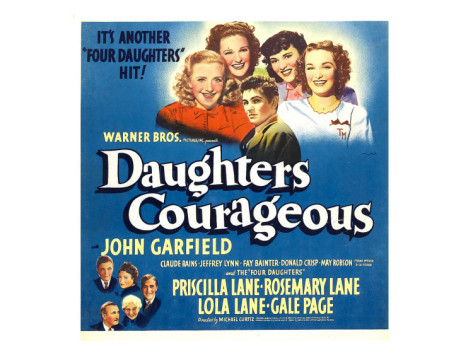
His “honeymoon” with Warner’s over, Garfield entered a protracted period of conflict with the studio, they attempting to cast him in crowd-pleasing melodramas like Dust Be My Destiny and he insisting on quality scripts that would offer a challenge and highlight his versatility. The result was often a series of suspensions, Garfield refusing an assigned role and Warner’s refusing to pay him. Garfield’s problem was the same problem shared by any actor working in the studio system of the 1930s: by contract the studio had the right to cast him in any project they wanted to. But, as Robert Nott explains, “To be fair, most of the studios had a team of producers, directors, and writers who could pinpoint a particular star’s strengths and worked to capitalize on those strengths in terms of finding vehicles that would appeal to the public – and hence make the studio money. The forces that prevented him from getting high quality roles were really the result of the combined willpower of the Warner Bros., the studio system in general, and the general public, which also had its own perception of how Garfield (or Cagney or Bogart for that matter) should appear on screen.” A notable exception to this trend was Daughters Courageous, the sequel to his debut film. Now considered a late 1930s classic, the film did well critically but failed to find an audience, the public dissatisfied that it was not a true sequel (hard to pull off, since the original character Mickey Borden died in the first picture). The director, Curtiz, called the film “my obscure masterpiece.”

At the onset of World War II, Garfield immediately attempted to enlist in the armed forces, but was turned down because of his heart condition. Frustrated, he turned his energies to supporting the war effort. He and actress Bette Davis were the driving force behind the opening of the Hollywood Canteen, a club offering food and entertainment for American servicemen. He traveled overseas to help entertain the troops, made several bond selling tours and starred in a string of popular, patriotic films like Air Force, Destination Tokyo and Pride of the Marines (all box office successes). He was particularly proud of that last film based on the life of Al Schmid, a war hero blinded in combat. In preparing for the role Garfield lived for several weeks with Schmid and his wife in Philadelphia and would blindfold himself for hours at a time.

147849-004-D4252DF8

After the war Garfield starred in a series of successful films such as The Postman Always Rings Twice (1946) with Lana Turner, Humoresque (1946) with Joan Crawford, and the Oscar-winning Best Picture Gentleman’s Agreement (1947). In Gentleman’s Agreement, Garfield took a featured, but supporting, part because he believed deeply in the film’s exposé of anti-semitism in America. In 1948, he was nominated for the Academy Award for Best Actor for his starring role in Body and Soul (1947). That same year, Garfield returned to Broadway in the play Skipper Next to God. A strong-willed and often verbally combative individual, Garfield did not hesitate to venture out on his own when the opportunity arose. In 1946, when his contract with Warner Bros. expired, Garfield decided not to renew it and opted to start his own independent production company, one of the first Hollywood stars to take this step.

“I have nothing to hide and nothing to be ashamed of. My life is an open book. I am no Red. I am no ‘pink.’ I am no fellow traveler. I am a Democrat by politics, a liberal by inclination, and a loyal citizen of this country by every act of my life.”

Long involved in liberal politics, Garfield was caught up in the Communist scare of the late 1940s and early 1950s. He supported the Committee for the First Amendment, which opposed governmental investigation of political beliefs. When called to testify before the House Committee on Un-American Activities, which was empowered to investigate purported communist infiltration in America, Garfield refused to name communist party members or followers, testifying that, indeed, he knew none in the film industry. Garfield rejected Communism, and just prior to his death in hopes of redeeming himself in the eyes of the “Blacklisters,” wrote that he had been duped by Communist ideology, in an unpublished article called “I Was a Sucker for a Left Hook,” a reference to Garfield’s movies about boxing. However, his forced testimony before the committee had severely damaged his reputation. He was blacklisted in Red Channels, and barred from future employment as an actor by Hollywood movie studio bosses for the remainder of his career.

$(KGrHqVHJE4FCcLEemFyBQykQH3EvQ~~60_35

With film work scarce because of the blacklist, Garfield returned to Broadway and starred in a 1952 revival of Golden Boy, finally being cast in the lead role denied him years before.

On May 9, 1952 Garfield moved out of his New York apartment for the last time, indicating to friends it was not a temporary separation. He confided to columnist Earl Wilson that he would soon be divorced. Close friends speculated that it was his wife’s opposition to his plotted confession in Look magazine that triggered the separation. He heard that a HUAC investigator was reviewing his testimony for possible perjury charges. His agent reported that 20th Century-Fox wanted him for a film called Taxi but would not even begin talks unless the investigation concluded in his favor. Three actor friends, Canada Lee, Mady Christians and J. Edward Bromberg, had all recently died after being listed by the committee.

In the morning of May 20 Garfield, against his doctor’s strict orders, played several strenuous sets of tennis with a friend, mentioning the fact that he had not been to bed the night before. He met actress Iris Whitney for dinner and afterward became suddenly ill complaining that he felt chilled. She brought him to her apartment where he refused to let her call a doctor and instead went to bed. The next morning she found him dead. Long-term heart problems, allegedly aggravated by the stress of his blacklisting, had led to his death at the age of 39.

The funeral was the largest in New York since Rudolph Valentino with over ten thousand persons crowding the streets outside. His estate, valued at “more than $100,000,” was left entirely to his wife. Shortly afterward, ironically, the HUAC closed its investigation of John Garfield, leaving him in the clear. Garfield is interred at Westchester Hills Cemetery in Hastings-on-Hudson, Westchester County, New York.

In 1954, the widowed Roberta Garfield married attorney Sidney Cohn, who died in 1991. She died in January 2004.

He and Roberta Seidman married in February 1935. Though his wife had been a member of the Communist Party, there was no evidence that Garfield himself was ever a Communist. They had three children: Katherine (1938–1945), who died of an allergic reaction on March 18, 1945; David (1943–1994); and Julie (born 1946); the latter two later becoming actors themselves.

Garfield was nominated for the Academy Award for Best Supporting Actor for Four Daughters in 1939 and Best Actor for Body and Soul in 1948.

john_garfield_motion_pictures

He was given a star on the Hollywood Walk of Fame at 7065 Hollywood Boulevard.

I loved Garfield’s persona. Like a polished agate with rough stone overtones.

Lana Turner

Lana2

In 1969, when I was a patrol sergeant in Hollywood I got a call to the Desilu studios on Gower. Eddie Albert greeted me on the set. In the next room was Lana Turner. Albert prevailed upon me that Turner was not feeling well and that it was nothing to worry about. I don’t recall the exact nature of the call, but I could tell that Albert was interested in keeping it low profile. Once I felt convinced there was no foul play, I had no problem in not going into the next room and checking on Turner. Albert was quite persuasive. I suppose I was a bit foolish, but often having been around actors, I understood their need for privacy, particularly in “iffy” situations like this one.

Lana Turner (February 8, 1921 – June 29, 1995) was an American actress popular during the 1940s and 1950s. Turner was born Julia Jean Turner in Wallace, Idaho. She was the only daughter of John Virgil Turner, a miner from Montgomery, Alabama (January 23, 1903 – December 14, 1930), and Mildred Frances Cowan, a sixteen-year-old native of Lamar, Arkansas (June 19, 1904 – February 22, 1982). Her father was of Dutch ancestry and her mother was of Scottish, English and Irish ancestry. A common and often repeated error is to add the given names of her mother Mildred Frances to her birth name. These names she used when she converted to Catholicism as a child.

Until her film career took off, young Julia Turner was known to family and friends as “Judy”. Hard times eventually forced the family to re-locate to San Francisco, where her parents soon separated. On December 14, 1930, her father won some money at a traveling craps game, stuffed his winnings in his left sock, and headed for home. He was later found dead on the corner of Minnesota and Mariposa Streets, on the edge of Potrero Hill and the Dogpatch District in San Francisco, his left shoe and sock missing. The robbery and murder were never solved. Soon after, her mother developed health problems and was advised by her doctor to move to a drier climate. With her ten-year-old daughter, she moved to Los Angeles in 1931.

Mildred and Lana were very poor, and Turner was sometimes separated from her mother, living with friends or acquaintances so that the family could save money. Her mother worked 80 hours a week as a beautician to support them. After Turner was discovered, her mother became the overseer of Turner’s career.

theywontforget

Turner’s discovery at a Hollywood drug store is a show-business legend. As a sixteen-year-old student at Hollywood High School, Turner skipped a typing class and bought a Coke at the Top Hat Malt Shop located on the southeast corner of Sunset Boulevard and McCadden Place (not Schwab’s Pharmacy, as is commonly believed), where she was spotted by William R. Wilkerson, publisher of The Hollywood Reporter. Wilkerson was attracted by her beauty and physique, and referred her to the actor/comedian/talent agent Zeppo Marx. Marx’s agency immediately signed her on and introduced her to film director Mervyn LeRoy, who cast her in her first film, They Won’t Forget (1937).

Turner earned the nickname “The Sweater Girl” from her form-fitting attire in a scene in They Won’t Forget. According to her daughter, this was a nickname Turner detested throughout her entire career.In late 1937, she signed a contract with Metro-Goldwyn-Mayer for $100 a week, and graduated from high school in between filming. According to LeRoy, it was thanks to him that she made the switch, for he left Warners to work at MGM and was advised by studio head Jack Warner to take her with him, because Warner believed that she wouldn’t “amount to anything.” Her first starring role for MGM was scheduled to be an adaptation of The Sea-Wolf, co-starring Clark Gable, but the project was eventually canned. Instead, she was assigned opposite teen idol Mickey Rooney in the Andy Hardy film Love Finds Andy Hardy (1938). It was this appearance, as a flirtatious girl described as “the kissing bug,” that convinced Louis B. Mayer that LeRoy’s protégée Turner could be the next Jean Harlow, a sex symbol who had died six months before Turner’s arrival at MGM.

09lana

Mayer turned her into a glamorous star, mostly popular among college boys, and gave her the leads in several teen-oriented films in the late 1930s and early 1940s, such as Dramatic School (1938), These Glamour Girls (1939) and Dancing Co-Ed (1939). In early 1940, she was also set to star in a remake of Our Dancing Daughters, but the film was never made.[10] From the beginning of her career, Turner stood her ground on her beliefs and was one of the few actresses at MGM to go against Mayer’s wishes.

Turner, an actress bolstered by her extreme beauty, reached the height of her fame in the 1940s and 1950s. During World War II, Turner became a popular pin-up girl due to her popularity in such films such as Ziegfeld Girl (1941), Johnny Eager (1942), Slightly Dangerous (1943) and four films with Metro-Goldwyn-Mayer’s “king of the lot”, Clark Gable. The Turner-Gable films’ successes were only heightened by gossip-column rumors about a relationship between the two. Turner even had a B-17 Flying Fortress—the Tempest Turner—named after her. Following the canned The Sea Wolf project, Turner and Gable were set to star in The Uniform in December 1940. Turner was eventually replaced by Rosalind Russell and the film was released as They Met in Bombay (1941).

Meanwhile, Turner was receiving much publicity for her personal life, and her career was one of the very few to be furthered by this. MGM boosted this by changing the title of her latest film to Slightly Dangerous (1943).

After the war, Turner’s career continued successfully with the release, The Postman Always Rings Twice (1946), which co-starred John Garfield. As claimed in a documentary, Turner did not get along with him and when she found he was her male lead, she responded: “Couldn’t they at least hire someone attractive?” The now-classic film noir marked a turning point in her career, and it marked Turner’s first femme fatale role. Reviews of the film, and in particular, Turner’s performance, were glowing, with a critic of The New York Times writing it was “the role of her career.” While not exactly giving up her pin-up credentials, Turner established herself as a skilled actress. The Postman Always Rings Twice was thus a turning point in her career. Turner commented on this:

“I finally got tired of making movies where all I did was walk across the screen and look pretty. I got a big chance to do some real acting in The Postman Always Rings Twice, and I’m not going to slip back if I can help it. I tried to persuade the studio to give me something different. But every time I went into my argument about how bad a picture was they’d say, ‘well, it’s making a fortune.’ That licked me.”

1947_GREENDOLPHINSTREET

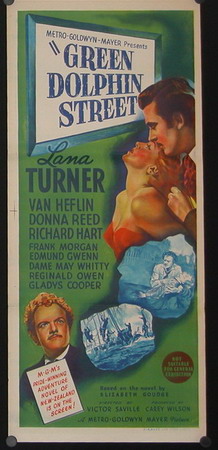
She got the role after turning down “four pretty-pretty parts in a row.” The film became a box office success, which prompted the studio to take more risks on the star. In August 1946, it was announced Turner was set to replace Katharine Hepburn in the big budgeted historical drama Green Dolphin Street (1947), a role for which she darkened her hair and lost 15 pounds. She was cast due to the persistence of producer Carey Wilson, who was overwhelmed by her performance in The Postman Always Rings Twice. Turner later recalled she was surprised about replacing Hepburn, saying: “And I guess I’m about the most un-Hepburnish actress on the lot. But it was just what I wanted to do.” It was her first starring role that did not center on her looks. In an interview, Turner said: “I even go running around in the jungles of New Zealand in a dress that’s filthy and ragged. I don’t wear any make-up and my hair’s a mess.” Nevertheless, she insisted she would not give up her glamorous image.

Later that year, Turner headlined Cass Timberlane, a role that Jennifer Jones, Vivien Leigh and Virginia Grey were previously considered for. As of early 1946, Turner was set for the role, but schedules with Green Dolphin Street almost prohibited her from taking the role, and by late 1946, she was almost recast.Production of Cass Timberlane was very exhausting for Turner, as it was shot in between retakes of Green Dolphin Street. Nevertheless, she took the female lead in Homecoming (1948) in August 1947, only moments after finishing Cass Timberlane. She was the studio’s first choice for the role, but they were reluctant to offer her the part, considering her overbooked schedule.[19] Paired again with Clark Gable in Homecoming, their chemistry projected on the screen was well received by the audience, and they were nicknamed “the team that generates steam”. By this period, Turner achieved the milestone of her film career, and was not only MGM’s most popular star, but also one of the ten best paid women in the United States.

10658036_2

In 1948, Turner appeared in her first Technicolor film, appearing as Lady de Winter in The Three Musketeers, opposite Gene Kelly, Van Heflin and June Allyson. In November 1947, she agreed to do the film, thereby giving up an unfinished film project called Bedeviled. However, in January 1948 it was reported that she had withdrawn from the film. Initially, Louis B. Mayer gave her permission for doing so because of her schedule, but she was later that month put on suspension. Eventually, Turner agreed to make the film, but did not start production until March due to having to lose weight. In 1949, she was to headline A Life of Her Own (1950). The project was shelved for several months, and Turner insisted in December 1949 that she had nothing to do with it, saying: “Everybody agrees that the script is still a pile of junk. I’m anxious to get started. By the time this one comes out, it will be almost three years since I was last on the screen, in The Three Musketeers. I don’t think it’s healthy to stay off the screen that long.”

During the 1950s, Turner starred in a series of films that failed to succeed at the box office, a situation MGM attempted to remedy by casting her in musicals. The first, Mr. Imperium (1951), was a flop, while The Merry Widow (1952) was more successful. She gave a widely praised performance in Vincente Minnelli’s film, The Bad and the Beautiful (1952) (in a role partly based on Diana Barrymore), and later starred with John Wayne in the adventure film The Sea Chase (1955). She was then cast in the epic The Prodigal (1955), but the film and her performance in general were not well received. After the film Diane (1956), MGM opted not to renew her contract. This was a difficult time for Hollywood’s major studios because a recent court decision forced them to divest themselves of their movie theaters. In addition, television had caught on in a big way; the public was staying home. Turner was just one of MGM’s star roster to be let go.

51FKV2ZZXVL._SL500_AA300_

Turner’s career recovered briefly after she appeared in the hugely successful big-screen adaptation of Grace Metalious’s best-selling novel, Peyton Place (1957), for which she was nominated for an Academy Award for Best Actress. Another few box-office failures followed (Another Time, Another Place (1958), for example) when the 1958 scandal surrounding her daughter’s killing of Stompanato threatened to derail her career completely.

In the trail of the related negative publicity, Turner accepted the lead role in Ross Hunter’s remake of Imitation of Life (1959) under the direction of Douglas Sirk. Universal Studios capitalized on her new-found notoriety; the result was one of the biggest hits of the year, as well as the biggest hit of Turner’s career: she owned 50% of the earnings of the picture and for only the first year of the film’s career she earned $11 million. Critics and audiences couldn’t help noticing that the plots of both Peyton Place and Imitation of Life had borrowed heavily from Turner’s private life. Each film depicted the troubled, complicated relationship between a single mother and her teenage daughter.

She made her last film at MGM starring with Bob Hope in Bachelor in Paradise (1961). Other highlights of this era include By Love Possessed (1961), based on the James Gould Cozzens novel and two Hunter productions (for whom she did Imitation of Life), Portrait in Black (1960) and Madame X (1966), which proved to be her last major starring role.

In 1969, Turner appeared in her only lead starring role on television in ABC’s Harold Robbins’ The Survivors, but despite the presence of other big-name stars, the program fared badly opposite Mayberry R.F.D. and The Doris Day Show on CBS and The NBC Monday Movie, and was cancelled midway into the season.

In the 1970s and 1980s, Turner appeared in several television roles, most notably as a guest star for several episodes on the series Falcon Crest as the mysterious Jaqueline Perrault and The Love Boat, but the majority of her final decade was spent out of the public eye.

On October 25, 1981 the National Film Society presented Lana with an Artistry in Cinema award. In 1994 she received Donostia Lifetime Achievement Award at the San Sebastian International Film Festival, Spain. In 1982, Turner released a memoir, in which she stated that she had two abortions and three stillbirths. She said she was an alcoholic and had attempted suicide.

Turner spent most of the 1970s and early 1980s in semi-retirement, working only occasionally. In 1982 she accepted a much publicized and lucrative recurring guest role in the television series Falcon Crest. Her first appearance on the show gave the series the highest rating it ever achieved. Turner made her next final film appearance in 1991, and died from throat cancer in 1995.

Jane Mansfield

Jane-mansfield-main

Jayne Mansfield (born Vera Jayne Palmer; April 19, 1933 – June 29, 1967) was an American actress in film, theatre, and television, a nightclub entertainer, a singer, and one of the early Playboy Playmates. She was a major Hollywood sex symbol of the 1950s and early 1960s. Mansfield was 20th Century Fox’s alternative Marilyn Monroe and came to be known as the Working Man’s Monroe. She was also known for her well-publicized personal life and publicity stunts.

Mansfield became a major Broadway star in 1955, a major Hollywood star in 1956, and a leading celebrity in 1957. She was one of Hollywood’s original blonde bombshells, and although many people have never seen her movies, Mansfield remains one of the most recognizable icons of 1950s celebrity culture. With the decrease of the demand for big-breasted blonde bombshells and the increase in the negative backlash against her over-publicity, she became a box-office has-been by the early 1960s.

While Mansfield’s film career was short-lived, she had several box office successes and won a Theatre World Award and a Golden Globe. She enjoyed success in the role of fictional actress Rita Marlowe in both the 1955–1956 Broadway version, and, in the 1957 Hollywood film version of Will Success Spoil Rock Hunter?. She showcased her comedic skills in The Girl Can’t Help It (1956), her dramatic assets in The Wayward Bus (1957), and her sizzling presence in Too Hot to Handle (1960). She also sang for studio recordings, including the album Shakespeare, Tchaikovsky & Me and the singles Suey and As the Clouds Drift by (with Jimi Hendrix). Mansfield’s notable television work included television dramas Follow the Sun and Burke’s Law, game shows The Match Game and What’s My Line?, variety shows The Jack Benny Program and The Bob Hope Show, the The Ed Sullivan Show, and a large number of talk shows.

036-jayne-mansfield

By the early 1960s, Mansfield’s box office popularity had declined and Hollywood studios lost interest in her. Some of the last attempts that Hollywood took to publicize her were in The George Raft Story (1961) and It Happened in Athens (1962). But, towards the end of her career, Mansfield remained a popular celebrity, continuing to attract large crowds outside the United States and in lucrative and successful nightclub acts (including The Tropicana Holiday and The House of Love in Las Vegas), and summer-theater work. Her film career continued with cheap independent films and European melodramas and comedies, with some of her later films being filmed in United Kingdom, Italy, Germany, and Greece. In the sexploitation film Promises! Promises! (1963), she became the first major American actress to have a nude starring role in a Hollywood motion picture.

Mansfield, one-upping Sophia Loren

Mansfield took her professional name from her first husband, public relations professional Paul Mansfield, with whom she had a daughter. She was the mother of three children from her second marriage to actor–bodybuilder Mickey Hargitay. She married her third husband, film director Matt Cimber, in 1964, and separated from him in 1966. Mansfield and Cimber had a son. In 1967 Mansfield died in a car accident at the age of 34.

tumblr_m7wjn1Jfwt1qh0yodo1_1280

In January 1955 Mansfield appeared at a Silver Springs, Florida press junket promoting the film Underwater!, starring Jane Russell. Mansfield purposely wore a too-small red bikini, lent her by photographer friend Peter Gowland. When she dove into the pool for photographers her top came off, which created a burst of media attention. The ensuing publicity led to Warner Bros. and Playboy approaching her with offers. In June 8 of the same year, her dress fell down to her waist twice in a single evening – once at a movie party, and later at a nightclub. In February 1958, she was stripped to the waist at a Mardi Gras party in Rio de Janeiro. In June 1962, she shimmied out of her polka-dot dress in a Rome nightclub. In the three years since making her Broadway debut in Will Success Spoil Rock Hunter?, Mansfield had become the most controversial star of the decade.

In April 1957, her bosom was the focus of a notorious publicity stunt intended to deflect media attention from Sophia Loren during a dinner party in the Italian star’s honor. Photographs of the encounter were published around the world. The best-known photo showed Loren’s gaze falling on the cleavage of the American actress (who was seated between Loren and her dinner companion, Clifton Webb) when Mansfield leaned over the table, allowing her breasts to spill over her low neckline and exposing one nipple. Several similar photos were taken in a short time. Fearful of public outrage, most Italian newspapers refused to print the wirephotos; Il Giorno and Gazzetta del Popolo printed them after retouching to cover much of Mansfield’s bosom, and only Il Giornale d’Italia printed them uncensored. The photo inspired a number of later photographers. In 1993, Daniela Federici created an homage with Anna Nicole Smith as Mansfield and New York City DJ Sky Nellor as Loren for a Guess Jeans campaign. Later, Mark Seliger took a picture named Heidi Klum at Romanoff’s with Heidi Klum in a reproduction of the restaurant set.
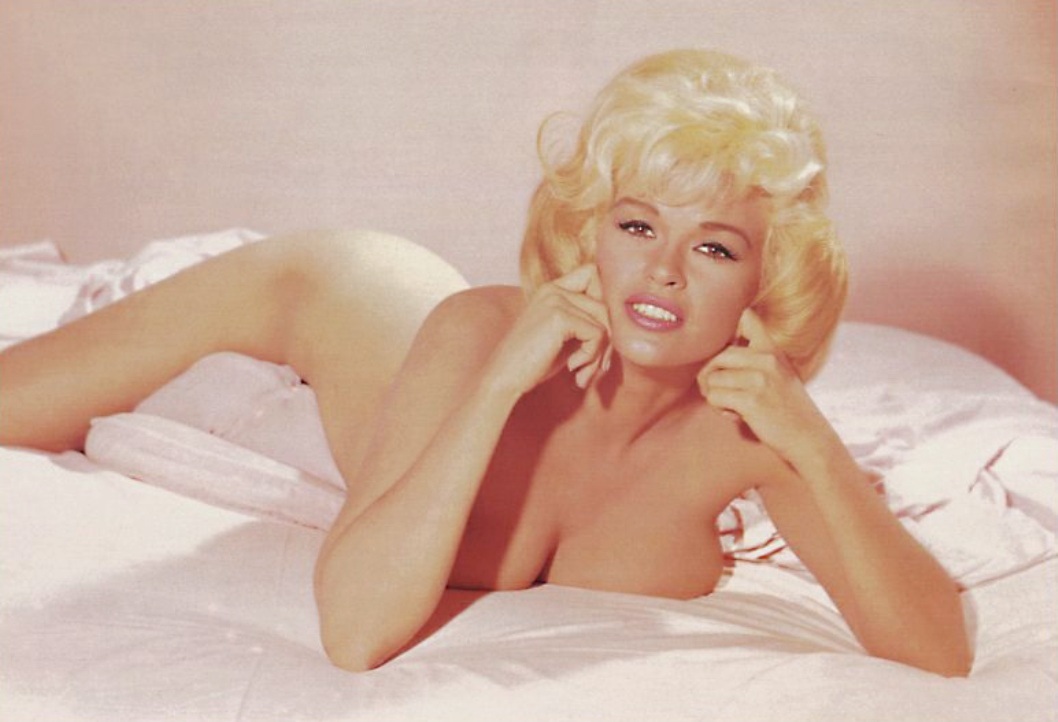
JMlife3

A similar incident (resulting in the exposure of both breasts) occurred during a film festival in West Berlin, when Mansfield was wearing a low-cut dress and her husband, Mickey Hargitay, picked her up so she could bite a bunch of grapes hanging overhead at a party. The movement exposed both her breasts. The photograph of that episode was a UPI sensation, appearing in newspapers and magazines with the word “censored” hiding the actress’s exposed bosom.

At the same time, the world’s media were quick to condemn Mansfield’s stunts. One editorial columnist wrote, “We are amused when Miss Mansfield strains to pull in her stomach to fill out her bikini better; but we get angry when career-seeking women, shady ladies, and certain starlets and actresses…use every opportunity to display their anatomy unasked”. By the late 1950s, Mansfield began to generate a great deal of negative publicity because of repeated exposure of her breasts in carefully staged public “accidents”. Richard Blackwell, her wardrobe designer (who also designed for Jane Russell, Dorothy Lamour, Peggy Lee and Nancy Reagan), dropped her from his client list because of those accidents. In April 1967, Los Angeles Times wrote, “She confuses publicity and notoriety with stardom and celebrity and the result is very distasteful to the public.”