All posts by jesswaid

Unknown's avatar

About jesswaid

Currently, I write police procedural novels with the stories taking place in Hollywood during the early 1960s; a period when I was a street cop there. I've moved to Mexico to be closer to my hobby of studying Mexican history. My friend and fellow author, Professor Michael Hogan, is my mentor. I am planning to write a three-part epic story that takes place in the mid-nineteenth century. What has inspired me was hearing about Los Ninos Heroes, martyrs of the Battle of Chapultepec. Also, my father was born in Concordia, Mexico and knowing his family history is an added incentive.

1962

marlboro_man


1962 is right in the temporal sweet spot of my Mike Montego novels — Shades of Blue, 459-Framed in Red, The Purple Hand, and He Blew Blue Jazz. Here are a few fun facts about this swingin’ year...


1962 Tidbits


Tobacco: Philip Morris introduced “Marlboro Country” to advertise its top filter-tip cigarette against R. J. Reynolds’ Winston brand. The cowboy theme will make Marlboro the leading brand worldwide.


Lt. Co John H. Glenn, Jr., Marine Corps pilot, became the first American in orbit February 20th when he circled Earth three times, covering 81,000 miles at an altitude of 160 miles in the Mercury capsule Friendship 7.


President Kennedy on February 14th announced that U.S. military advisers in Vietnam would fire back if fired upon.


Supreme Court on March 26th backed “one-man one-vote” apportionment of seats in state legislatures.


Europe’s Arlberg-Orient Express goes out of service May 27th after nearly 79 years of operation between Paris and Istanbul; and the Simplon-Orient Express ends service as well. Both have been victims of the airplane that has cut travel time between the cities to two hours.


Economic, Finance, and Retailing: K Mart discount stores are opened by the 63-year-old S.S. Kresge Co., whose five-and-ten-cent stores are losing money. By 1977 Kresge sales will be second only to those of Sears, but Wal-Mart will pass it in the 1980s.


The first Wal-Mart store opens July 2nd at Rogers, Arkansas. Retail merchant Sam Moore Walton, 44, had run a Ben Franklin store with his brother James at Bentonville; Sam proposed a chain of discount stores in small towns; Ben Franklin dismissed the idea and Walton goes into business for himself. His chain will surpass sales of Sears, Roebuck by 1991.


Food and Drink:  Diet-Rite Cola, introduced by Royal Crown Cola, is the first sugar-free soft drink to be sold nationwide to the general public. The cyclamate-sweetened cola will soon have powerful competitors.


First U.S. communications satellite is launched in July.


Rachel Carson’s Silent Spring launches the environmental movement.


James Howard Meredith, 29, an Air Force veteran, became the first black student at University of Mississippi, “Old Miss,” October 1st after 3,000 troops put down riots. His admission was ordered by a federal appellate court and upheld by the Supreme Court.


President Kennedy revealed A Soviet offensive missile buildup in Cuba October 22nd. He ordered a naval and air quarantine on shipment of offensive military equipment to the island nation. Kennedy and Soviet Premier Khrushchev reached agreement on October 28 on a formula to end the crisis. Kennedy announced November 2nd that Soviet missile bases in Cuba were being dismantled.


Cigar smokers are the chief U.S. victims of President Kennedy’s embargo on trade with Cuba. U.S. cigar sales exceed six billion per year with 95 percent of Cuban cigars rolled and wrapped in U.S. plants, but without Cuban tobacco cigar sales will fall to 5.3 billion per ear by 1976 despite population growth.


Sports: Ohio golfer Jack William Nicklaus, 22, wins the U.S. Open by defeating Arnold Palmer in a playoff.


Sonny Liston wins the world heavyweight boxing title September 25th. Now 28, he knocks out Floyd Patterson in the first round of a championship bout at Chicago.


New York Yankees win the World Series by defeating the San Francisco Giants 4 games to 3.


Technology: Electronic Data Systems (EDS) is founded by Dallas salesman H. (Henry) Ross Perot, 32, whose data processing firm will make him a billionaire.


Polaroid Corp. introduces color film invented by Edwin H. Land. The high-speed film produces color prints in 60 seconds (Polaroid’s black-and-white film produces prints in 10 seconds).


Films: Roman Polanski’s Knife in the Water; David Lean’s Lawrence of Arabia; Sidney Lumet’s A Long Day’s Journey Into Night; John Ford’s The Man Who Shot Liberty Valance; Sam Peckinpah’s Ride the High Country; François Truffaut’s Shoot the Piano Player; Akira Kurosawa’s Yojimbo; Perter Ustinov’s Billy Budd; Hiroshi Imagaki’s Chushingura; George Seaton’s The Counterfeit Traitor; Blake Edwards’ Days of Wine and Roses; Pietro Germi’s Divorce—Italian Style; Luis Buñuels The Exterminating Angel; John Huston’s Freud; Tony Richardson’s The loneliness of the Long Distance Runner; John Frankenheimer’s The Manchurian Candidate; Artgyr Oebb;s The Miracle Worker; Kon Ichikawa’s The Outcast; Richard Brooks’ Sweet Bird of Youth; Robert Mulligan’s To Kill a Mockingbird; Robert Aldrich’s What Ever Happened to Baby Jane?; and, Ingmar Bergman’s Winter Light.


Music — Popular songs: “Those Lazy, Hazy, Crazy Days of Summer” by Hoagy Carmichael; “Days of Wine and Roses” by Henry Mancini (title song for film about alcoholism); “Dream Baby” and “Leah” by Roy Orbison; “Ramblin’ Rose by Noel and Joe Sherman; “Roses Are Red, My Love” by Al Byron and Hugh Evans’ “The Wanderer” by Ernest Maresca; “I left My Heart in San Francisco” by George Cory; “The Lonely Bull” by California trumpet player-vocalist-composer Herb Alpert, 27; “Surfin’ Safari” by the Beach Boys Brian Wilson, 20, Dennis Wilson, 17, Mike Love, 21, Al Jardine, 19, and Carl Wilson, 25.


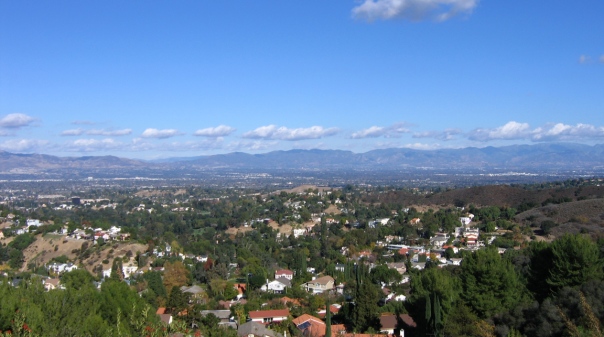
The San Fernando Valley (anything you could possibly want to know!)


San_Fernando_Valley_vista


The San Fernando Valley (locally known as “The Valley“) is an urbanized valley located in the Los Angeles metropolitan area of southern California, United States, defined by the mountains of the Transverse Ranges circling it. Home to 1.76 million people, it lies north of the larger and more populous Los Angeles Basin.

Nearly two thirds of the Valley’s land area is part of the city of Los Angeles. The other incorporated cities in the valley are Burbank, Glendale, San Fernando, Hidden Hills and Calabasas.


Geography

The San Fernando Valley is about 260 square miles (670 km) bounded by the Santa Susana Mountains to the northwest, the Simi Hills to the west, the Santa Monica Mountains and Chalk Hills to the south, the Verdugo Mountains to the east, and the San Gabriel Mountains to the northeast. The northern Sierra Pelona Mountains, northwestern Topatopa Mountains, southern Santa Ana Mountains, and Downtown Los Angeles skyscrapers can be seen from higher neighborhoods, passes, and parks in the San Fernando Valley.

The Los Angeles River begins at the confluence of Calabasas Creek (Arroyo Calabasas) and Bell Creek (Escorpión Creek) at Canoga Park High School beside Vanowen Street in Canoga Park. Those creeks’ headwaters are in the Santa Monica Calabasas foothills, the Simi Hills’ Hidden Hills, Santa Susana Field Laboratory, and Santa Susana Pass Park lands. The River flows eastward along the southern regions of the Valley. One of the river’s two unpaved sections can be found at the Sepulveda Basin. A seasonal river, the Tujunga Wash, drains much of the western facing San Gabriel Mountains and passes into and then through the Hansen Dam Recreation Center in Lake View Terrace. It flows south along the Verdugo Mountains through the eastern communities of the Valley to join the Los Angeles River in Studio City. Other notable tributaries of the River include Dayton Creek, Caballero Creek, Bull Creek, Pacoima Wash, and Verdugo Wash. The elevation of the floor of the valley varies from about 600 ft (180 m) to 1,200 ft (370 m) above sea level.

Most of the San Fernando Valley is within the jurisdiction of the city of Los Angeles, although a few other incorporated cities are located within the Valley as well: Burbank and Glendale are in the southeast corner of the Valley, Hidden Hills and Calabasas are in the southwest corner, and San Fernando, which is completely surrounded by Los Angeles, is in the northeast valley. Universal City, an enclave in the southern part of the Valley, is unincorporated land housing the Universal Studios filming lot. Mulholland Drive, which runs along the ridgeline of the Santa Monica Mountains, marks the boundary between the Valley and the communities of Hollywood and the Los Angeles Westside.

Services


History Pre-statehood

The Tongva, later known as the Gabrieleño Mission Indians after colonization, and the Tataviam to the north and Chumash to the west, had lived and thrived in the Valley and its arroyos for over 8,000 years. They had numerous settlements, and trading and hunting camps, before the Spanish arrived in 1769 to settle in the Valley.

The first Spanish land grant in the San Fernando Valley (or El Valle de Santa Catalina de Bononia de los Encinos was called ‘Rancho Encino’ (present day Mission Hills on the Camino Viejo before Newhall Pass), in the northern part of the San Fernando Valley. Juan Francisco Reyes built an adobe dwelling beside a Tongva village or rancheria at natural springs, but the land was soon taken from him so a Mission could be built there. Mission San Fernando Rey de España was established in 1797 as the 17th of the twenty-one missions.[6] The land trade granted Juan Francisco Reyes the similarly named Rancho Los Encinos, also beside springs (Los Encinos State Historic Park in present day Encino). Later the Mexican land grants of Rancho El Escorpión (West Hills), Rancho Providencia and Rancho Cahuenga (Burbank), and Rancho Ex-Mission San Fernando (rest of valley) covered the San Fernando Valley.

The Treaty of Cahuenga, ending the Mexican-American War fighting in Alta California, was signed in 1847 by Californios and Americans at Campo de Cahuenga, the Verdugo Family adobe at the entrance to the Cahuenga Pass in the southeast San Fernando Valley (North Hollywood). The 1848 Treaty of Guadalupe Hidalgo ended the entire war.

Statehood and beyond

The valley’s climate is not as some describe, a desert, and originally was naturally a “temperate grasslands, savannas, and shrub lands biome” of grassland, oak savanna, and chaparral shrub forest types of plant community habitats, along with lush riparian plants along the river, creeks, and springs. In this Mediterranean climate, post-1790s European agriculture for the mission’s support consisted of grapes, figs, olives, and general garden crops.[7] In 1874 dry wheat farming was introduced by J. B. Lankershim and Isaac Van Nuys and became very productive for their San Fernando Homestead Association that owned the southern half of the Valley. In 1876 they sent the very first wheat shipment from both San Pedro Harbor and from the United States to Europe.

20th century

Aqueduct

Through late 19th century court decisions, Los Angeles had won the rights to all surface flow water atop an aquifer groundwater beneath the Valley, without it being within the city limits. San Fernando Valley farmers offered to buy the surplus aqueduct water, but the federal legislation that enabled the construction of the aqueduct prohibited Los Angeles from selling the water outside of the city limits. This induced several independent towns surrounding Los Angeles to vote on and approve annexation to the city so they could connect to the municipal water system. These rural areas became part of Los Angeles in 1915. Concurrently and perhaps pre-aware, the Los Angeles Suburban Homes Company, a syndicate led by Harry Chandler, Hobart Johnstone Whitley, president of the company, James B. Lankershim, and Isaac Van Nuys, extended the Pacific Electric Railway (Red Cars) through the Valley to Owensmouth (now Canoga Park and West Hills) and laid out plans for roads and the towns of Lankershim (now Toluca Lake), Van Nuys, Marian (now Reseda) and Owensmouth. The rural areas became annexed by Los Angeles in 1915. The growing towns voted for annexation – for example: Owensmouth (Canoga Park) in 1917, Laurel Canyon and Lankershim in 1923, Sunland in 1926, La Tuna Canyon in 1926, and the incorporated city of Tujunga in 1932 – more than doubling the size of the city. A fictionalized story based on these events is told in the 1974 film Chinatown.

The Aqueduct water shifted farming from wheat to irrigated crops such as corn, beans, squash, and cotton; orchards of apricots, persimmons, and walnuts; and major citrus groves of oranges and lemons. They continued until the next increment of development converted land use, with post-war suburbanization leaving only a few enclaves, such as the ‘open air museum’ groves at the Orcutt Ranch Park and CSUN campus.

Developments

Also the advent of three new industries in the early 20th century – motion pictures, automobiles, and aircraft – spurred urbanization and population growth. World War II production and the subsequent postwar boom accelerated this growth so that by 1960, the valley had a population of well over one million. Los Angeles continued to consolidate its territories in the San Fernando Valley by annexing the former Rancho El Escorpión for Canoga Park-West Hills in 1959, and the huge historic “Porter Ranch” at the foot of the Santa Susana Mountains for the new planned developments in Porter Ranch in 1965. The additions expanded the Los Angeles portion of San Fernando Valley from the original 169 square miles (438 km) to 224 square miles (580 km) today.

Six Valley cities incorporated independently from Los Angeles: Glendale in 1906, Burbank and San Fernando in 1911, Hidden Hills in 1961, and Calabasas in 1991. Universal City is an unincorporated enclave that is home to Universal Studios theme park and Universal CityWalk. Other unincorporated areas in the Valley are Bell Canyon.

Northridge earthquake

The 1994 Northridge earthquake, struck on January 17 and measured 6.7 on the Richter Scale and produced the largest ground motions ever recorded in an urban environment and caused the greatest damage in the United States since the 1906 San Francisco. Its epicenter was located between Arminta St. and Ingomar St. just east of Reseda Blvd. under the community of Reseda. The death toll was 57, and more than 1,500 people were seriously injured. A few days after the earthquake, 9,000 homes and businesses were still without electricity; 20,000 were without gas; and more than 48,500 had little or no water. About 12,500 structures were moderately to severely damaged, which left thousands of people temporarily homeless. Of the 66,546 buildings inspected, 6% were severely damaged (red tagged) and 17% were moderately damaged (yellow tagged). In addition, damage to several major freeways serving Los Angeles choked the traffic system in the days following the earthquake. Major freeway damage occurred as far away as 25 miles (40 km) from the epicenter. Collapses and other severe damage forced closure of portions of 11 major roads to downtown Los Angeles.

This was the second time in 23 years that the San Fernando Valley had been affected by a strong earthquake. On February 9, 1971, a magnitude 6.6 event struck about 20 miles (32 km) northeast of the epicenter of the 1994 event. The 1971 earthquake caused 58 fatalities and about 2,000 injuries. At the time, the 1971 earthquake had been the most destructive event to affect greater Los Angeles since the magnitude 6.3 Long Beach earthquake of 1933.

Parks and recreation

The San Fernando Valley is home to numerous neighborhood ‘pocket parks,’ city parks, Recreation areas, and large Regional Open Space preserves. Many preserves are maintained as public parkland by the National Park Service’s Santa Monica Mountains National Recreation Area, the California State Parks, and local county and municipal parks districts.

Small garden parks and missions


Recreation areas


Mountain open-space parks


Economy

The Valley is home to numerous companies, the most well known of which work in motion pictures, music recording, and television production. The former movie ranches were branches of original studios now consisting of CBS Studio Center, NBCUniversal, The Walt Disney Company (and its ABC television network), and Warner Bros.

The Valley was previously known for advances in aerospace technology and nuclear research by companies such as Lockheed, Rocketdyne and its Santa Susana Field Laboratory, Atomics International, Litton Industries, Marquardt, and TRW’s predecessor Thompson Ramo Wooldridge.

Adult entertainment

The Valley became the pioneering region for producing adult films in the 1970s and since then has been home to a multi-billion dollar pornography industry, earning the monikers “Porn Valley” and “San Pornando Valley”. The leading trade paper for the industry, AVN Magazine, is based in the Northwest Valley, as are a majority of the nation’s adult video and magazine distributors. According to the HBO series Pornucopia, nearly 90% of all legally distributed pornographic films made in the United States are either filmed in or produced by studios based in the San Fernando Valley.

Rail and air

Metrolink commuter rail has two Valley lines, the Antelope Valley Line and Ventura County Line, connect the Valley and beyond to downtown Los Angeles and south, becoming one line at the Burbank station.

Amtrak‘s Pacific Surfliner long distance rail line has stops at Glendale, Burbank Airport station, Van Nuys, and Chatsworth station, before proceeding on to Ventura County, Santa Barbara, and Northern California or Union Station and San Diego.

The California High-Speed Rail Authority is planning two stations in the Valley, one in downtown Burbank and the other in Sylmar with an initial section of the railroad possibly opening in 2020.

The Valley’s two major airports are Bob Hope Airport and the Van Nuys Airport. The Van Nuys – Airport FlyAway Terminal provides non-stop scheduled shuttle service to LAX and back to the Valley, with parking.

Valley independence and secession


Many neighborhoods of Los Angeles in the San Fernando Valley have ‘seceded’ from one another in the form of renaming and reforming known community boundaries. Groups are motivated by the desire to disassociate themselves from undesirable connotations that some communities have inherited and, in the process, increase property values. Lake Balboa broke away from Van Nuys. Valley Village separated from North Hollywood. Valley Glen included portions of both Van Nuys and North Hollywood. West Hills and Winnetka separated from Canoga Park. Porter Ranch seceded from Northridge. Arleta broke off from Pacoima but failed to establish its own ZIP code. The new separatist districts are so in name only; none of them gained any governmental authority, and they remain districts within the City of Los Angeles, merely with new names.

Demographics

According to the 2010 San Fernando Valley U.S. Census report, the population of the San Fernando Valley is 1.77 million. Of the population 41.1% were non-Hispanic white, 42.0% were Hispanic or Latino, 3.8% were African Americans and 10.7% were Asian. The largest cities located entirely in the valley are Glendale and Burbank. The most populous districts of Los Angeles in the valley are North Hollywood and Van Nuys. Each of the two cities and the two districts named has more than 100,000 residents. Despite the San Fernando Valley’s reputation for sprawling, low-density development, the valley communities of Panorama City, North Hollywood, Van Nuys, Reseda, Canoga Park, and Northridge, all in Los Angeles, have numerous apartment complexes and contain some of the densest census tracts in Los Angeles.

Latinos and non-Hispanic whites are nearly even in numbers. In general, communities in the northeastern and central parts of the Valley have the highest concentration of Latinos. Non-Hispanic Whites live mainly in the communities along the region’s mountain rim and in the northwestern, western, southwestern, southern, and southeastern sections of the valley, including the Shadow Hills neighborhood.

Asian Americans make up 10% of the population and live throughout the valley, but are most numerous in the city of Glendale and the Los Angeles communities of Chatsworth, Panorama City, Northridge, Porter Ranch and Granada Hills. Another large ethnic element of the populace is the Iranian community with 200,000 people living mainly in west San Fernando Valley such as Tarzana, Calabasas, Woodland Hills, Encino, & Sherman Oaks. The valley is also home to a large Jewish community, with a large part of its population in the North Hollywood and Valley Village areas. The city of Glendale has a large Armenian community. African Americans compose 3.8% of the Valley’s population, living mainly in the Los Angeles sections of Lake View Terrace, Pacoima, Reseda, Valley Village, Van Nuys, and Northridge.

Poverty rates in the San Fernando Valley are lower than the rest of the county (15.3% compared to 17.9%). Nevertheless, in eight San Fernando Valley communities, at least one in five residents lives in poverty.

The Pacoima district of Los Angeles is widely known in the region as a hub of suburban blight. Other San Fernando Valley communities, such as the Los Angeles sections of Mission Hills, Arleta, and Northridge, have poverty rates well below the regional average.

Many wealthy families live in the hills south of Ventura Boulevard.

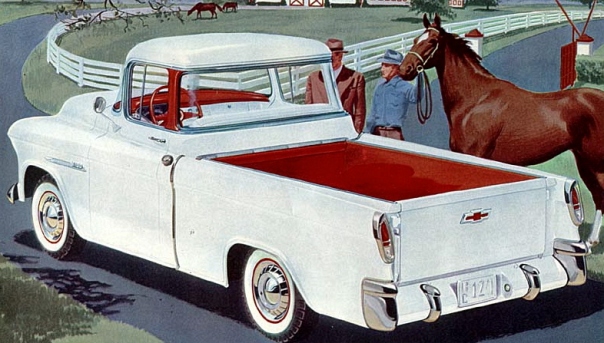
Mike Montego’s sweet ride

A 1955 Chevrolet Cameo Carrier


The main character in three of my novels, all of them about to be released —  Shades of Blue, 459-Framed in Red, The Purple Hand — and the forthcoming He Blew Blue Jazz, LAPD cop Mike Montego, drives a sweet Chevy Cameo Carrier. Here’s some background on one of the blue bow-tie’s most interesting vehicles.


Boasting V-8 power, automatic transmission, two-tone paint, and deluxe interior, the 1955 Chevrolet Cameo shortened the distance between car and truck. Although not a big seller, it set the stage for other stylish trucks – Ford’s Styleside, Dodge’s Sweptside, and Chevy’s own Fleetside quickly followed suit.


Stylist Chuck Jordan, later to become GM Vice-President of Design, had originally envisioned a one-piece cab-bed bodied pickup, but engineers were concerned over the sheet metal distorting due to torsion-stress on the frame. It was decided that the clean look could still be achieved with a conventional cab/bed combination. Fiberglass panels were added to Chevy’s existing steel cargo-box, saving the expense of the tooling process required for steel panels. This also allowed the truck to be brought into production quicker. Besides, fiberglass was convenient; Chevrolet had recently given Molded Fiberglass Products Company a $4 million contract to manufacture Corvette bodies.


The tailgate of the Cameo also used a fiberglass outer panel, with latches mounted inside and supported by retractable cables. The middle of the rear bumper hinged downward, accessing the hidden spare tire compartment. Unique chrome-plated taillights capped off the clean, uncluttered bed.


1955 Chevy Cameo


The smooth-sided bed of the 3124 series Cameo seemed to perfectly complement Chevy’s new Task Force Series line of trucks. Its 114-inch wheelbase carried a 6.5-foot-long cargo bed, which shared the same 5,000 pound G.V.W. as the 3100 and 3200 series half-ton trucks. Base motor was the durable 235-cid six-cylinder, with Chevy’s new 265-cid V-8 optional. Five transmissions, including an automatic, were available. Chrome bumpers, chrome grille, and full wheel covers, optional on other models, were standard on the Cameo.


All first-year Cameos were painted two-tone white and red. Inside, the upholstery was also two-tone, and came with arm rests, dual sun-visors, a cigarette lighter, chrome interior door knobs, and a large wrap-around rear window. Priced 30% higher than their standard half-ton truck, Chevrolet sold 5,220 Cameos in 1955.


1956 Chevy Cameo


With the exception of a few minor trim items, 1956 Chevrolet trucks remained the same as 1955 models. Despite low production numbers, the Cameo was carried over, now offered in several two-tone paint schemes. Base price was $2,150, while a standard half-ton pickup listed at $1,670. Cameo truck production for 1956 was 1,452.


1957 Chevy Cameo


Along with Chevy’s other pickup models, the Cameo received a new grille in 1957. V-8 engine displacement increased to 283 cubic-inches, with power output at 185-bhp. Cameo production rose to 2,244 units.


1958 Cameo Carrier


Industry-wide adoption of quad headlights, along with a larger front grille, were highlights of the 1958 re-design for all Chevrolet trucks. Ford’s Styleside pickup, introduced in 1957, had smooth outer bed-walls and sold for much less than the Cameo. Chevrolet countered with their new Fleetside, with an all-steel cargo-box larger than the Cameo’s. With just 1,405 produced for the year, Cameo production stopped in early 1958.


NOTE: Mike Montego’s pickup truck is white with red trim. The interior is red-and-white, tuck-and-rolled Naugahyde, a customized look.

The art of a city hall

joenicoletti_sm


(The following was excerpted from the Los Angeles Times, December 23, 2012, by Kate Linthicum. The original articles is titled, “L.A. City Hall is one of painter’s masterpieces”)

Joe Nicoletti started out painting houses in New Jersey. These days, he paints Los Angeles City Hall.

Since a major renovation of the historic building began nearly 20 years ago, Nicoletti has been the city’s go-to guy when a skilled hand is needed to restore a frieze or touch up a mural.

His most recent assignment — repainting the elaborately decorated ceiling of the Main Street lobby — took the 50-year-old Santa Monica resident two weeks and eight assistants to complete. His crew toiled at night, the better to stay out of the way of city bureaucrats, and Nicoletti livened the workspace with the sounds of Ella Fitzgerald, Frank Sinatra and the like. Around midnight, they would break for “lunch,” usually takeout from downtown eateries such as Pete’s Cafe or Cole’s French Dip.

The last night of the job, Nicoletti and some members of his crew were finishing up a few final details. Some cracked plaster needed repairing, and a small section of gold didn’t look quite rich enough. Nicoletti had brought several sheets of gold leaf that he hoped would do the trick.

“It’s $1,700 an ounce,” he said, waving the sheets like little flags. The gold is also edible, he added. “You can sprinkle it on some soufflé.”

He was standing atop precarious-looking scaffolding. An assistant, Luke Adkins, steadied the apparatus down below as Nicoletti excitedly pointed out noteworthy patterns in the ceiling’s design. “This is a medallion, that’s a ziggurat, and I think this is a cartouche,” he said.

06-11-07-JoeNicoletti3

Then he dabbed some glue, pressed the gold leaf into place and gently peeled off the backing, as if applying a temporary tattoo.

“That is sweet,” Adkins called up. “That is very nice. Man, you nailed it.”

Nicoletti smiled.

His company, Chameleon Paintworks, has done custom jobs at downtown’s Millennium Biltmore Hotel, an 89-year-old historic landmark, and for celebrity clients including Quentin Tarantino and Sting.

But there’s something special about City Hall, he said. Over the years he has painted its hallways, ceilings and even the City Council chambers. He plans to bid on future contracts for restoration work in the building’s rotunda and other areas.

“I’m really proud of this building,” he said. “I like it a lot.”


Griffith Observatory

Griffith_observatory

Griffith Observatory is in Los Angeles, California. Sitting on the south-facing slope of Mount Hollywood in L.A.’s Griffith Park, it commands a view of the Los Angeles Basin, including Downtown Los Angeles to the southeast, Hollywood to the south, and the Pacific Ocean to the southwest. The observatory is a popular tourist attraction with an extensive array of space and science-related displays.

3,015 acres (12.20 km2) of land surrounding the observatory was donated to the City of Los Angeles by Colonel Griffith J. Griffith on December 16, 1896. In his will Griffith donated funds to build an observatory, exhibit hall, and planetarium on the donated land. As a Works Progress Administration (WPA) project, construction began on June 20, 1933, using a design developed by architect John C. Austin based on preliminary sketches by Russell W. Porter. The observatory and accompanying exhibits were opened to the public on May 14, 1935. In its first five days of operation the observatory logged more than 13,000 visitors. Dinsmore Alter was the museum’s director during its first years; today, Dr. Ed Krupp is the director of the Observatory.

EXHIBITS

The first exhibit visitors encountered in 1935 was the Foucault pendulum, which was designed to demonstrate the rotation of the Earth.[3] The exhibits also included a twelve-inch (305 mm) Zeiss refracting telescope in the east dome, a triple-beam coelostat (solar telescope) in the west dome, and a thirty-eight foot relief model of the moon’s north polar region.

Col. Griffith requested that the observatory include a display on evolution which was accomplished with the Cosmochron exhibit which included a narration from Caltech Professor Chester Stock and an accompanying slide show. The evolution exhibit existed from 1937 to the mid 1960s.

Also included in the original design was a planetarium under the large central dome. The first shows covered topics including the Moon, worlds of the solar system, and eclipses.

During World War II the planetarium was used to train pilots in celestial navigation. The planetarium was again used for this purpose in the 1960s to train Apollo program astronauts for the first lunar missions.

The planetarium theater was renovated in 1964 and a Mark IV Zeiss projector was installed.

RENOVATION & EXPANSION

The observatory closed in 2002 for renovation and a major expansion of exhibit space. It reopened to the public on November 3, 2006, retaining its art deco exterior. The $93 million renovation, paid largely by a public bond issue, restored the building, as well as replaced the aging planetarium dome. The building was expanded underground, with completely new exhibits, a café, gift shop, and the new Leonard Nimoy Event Horizon Theater. The Café at the End of the Universe, an homage to Restaurant at the End of the Universe, is one of the many cafés run by celebrity chef Wolfgang Puck. One wall inside the building is covered with the largest astronomically accurate image ever constructed (152 feet long by 20 feet (6.1 m) high), called “The Big Picture” (http://bigpicture.caltech.edu), depicting the Virgo Cluster of galaxies; visitors can explore the highly detailed image from within arm’s reach or through telescopes 60 feet (18 m) away. The 1964-vintage Zeiss Mark IV star projector was replaced with a Zeiss Mark IX Universarium. The former planetarium projector is part of the underground exhibit on ways in which humanity has visualized the skies.

Since the observatory opened in 1935, admission has been free, in accordance with Griffith’s will. Tickets for the show Centered in the Universe in the 290-seat Samuel Oschin Planetarium Theater are purchased separately at the box office within the observatory. Tickets are sold on a first-come, first-served basis.

Children under 5 are free, but are admitted to only the first planetarium show of the day. Only members of the observatory’s support group, Friends Of The Observatory, may reserve tickets for the planetarium show.

Centered in the Universe features a high-resolution immersive video projected by an innovative laser system developed by Evans and Sutherland Corporation, along with a short night sky simulation projected by the Zeiss Universarium. A team of animators worked more than two years to create the 30-minute program. Actors, holding a glowing orb, perform the presentation, under the direction of Chris Shelton.

A wildfire in the hills came dangerously close to the observatory on May 10, 2007.

On May 25, 2008, the Observatory offered visitors live coverage of the Phoenix landing on Mars.

VISITING GRIFFITH OBSERVATORY

Admission to the building and grounds of Griffith Observatory is free of charge, excluding some of the shows for a minimal price at the planetarium. The Observatory is open five days a week. There is a small parking lot next to the Observatory. Additional parking is along the steep road leading up to the observatory. Parking is free of charge.

There are photo opportunities and scenery at and around the Observatory, with views of the Pacific Ocean, the Hollywood Sign and Downtown Los Angeles. Ideal for tourist destination, field trips, dates and outings with the family and friends.

FILMING LOCATION

The observatory was featured in two major sequences of the celebrated James Dean film Rebel Without a Cause (1955); a bust of Dean was subsequently placed at the west side of the grounds.

It has also appeared in a number of other movies:

The Phantom Empire (1935)

Phantom from Space (1953)

War of the Colossal Beast (1958)

The Cosmic Man (1959)

The Spy with My Face (1964)

Flesh Gordon (1974)

Midnight Madness (1980)

The Terminator (1984)

Dragnet (1987)

Earth Girls Are Easy (1988)

The Rocketeer (1991)

Devil in a Blue Dress (1995)

The People vs. Larry Flynt (1996)

The End of Violence (1997)

Bowfinger (1999)

House on Haunted Hill (1999 remake)

Queen of the Damned (2002)

Charlie’s Angels: Full Throttle (2003)

Transformers (2007 live-action film)

Yes Man (2008)

Terminator Salvation (2009)

Valentine’s Day (2010) (In the opening scene of credits in the theater version a quick shot of the Observatory is shown)

Television

The Observatory has appeared in episodes of the following TV shows:

Other media

  • An image of the observatory is shown in a 2Pac music video, To Live And Die In L.A.. The video pays homage to Los Angeles and its best known landmarks.
  • Some interview segments with rock musician Ringo Starr for the Beatles Anthology video were conducted on the observatory grounds during the early 1990s.

It is assumed to be in Grand Theft Auto V, after being seen in the second trailer

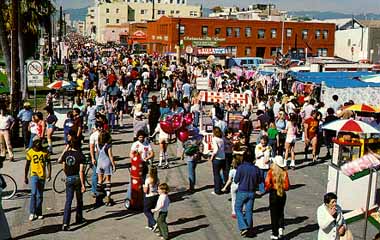
The Venice of America

busyweekend

Venice is a beachfront neighborhood on the Westside of Los Angeles, California, United States. It is known for its canals, beaches and circus-like Ocean Front Walk, a two-and-a-half-mile pedestrian-only promenade that features performers, fortune-tellers, artists, and vendors. Venice was home to some of Los Angeles’ early beat poets and artists and has served as an important cultural center of the city.

HISTORY

Venicewas founded by tobacco millionaire Abbot Kinney in 1905 as a beach resort town, 14 miles (23 km) west of Los Angeles. He and his partner Francis Ryan had bought two miles (3.24 km) of oceanfront property south of Santa Monica in 1891. They built a resort town on the north end of the property called Ocean Park, which was soon annexed to Santa Monica. After Ryan died, Kinney and his new partners continued building south of Navy Street in the unincorporated territory. After the partnership dissolved in 1904, Kinney built on the marshy land on the south end of the property, intending to create a seaside resort like its namesake in Italy.

When “Venice of America” opened on July 4, 1905, Kinney had dug several miles of canals to drain the marshes for his residential area, built a 1,200-foot (370 m)-long pleasure pier with an auditorium, ship restaurant, and dance hall, constructed a hot salt-water plunge, and built a block-long arcaded business street with Venetian architecture. Tourists, mostly arriving on the “Red Cars” of the Pacific Electric Railway from Los Angeles and Santa Monica, then rode Venice’s miniature railroad and gondolas to tour the town. But the biggest attraction was Venice’s mile-long, gently sloping beach. Cottages and housekeeping tents were available for rent.

The town’s population increased; it annexed adjacent housing tracts and changed its official name from Ocean Park to Venice in 1911. The population (3,119 residents in 1910) soon exceeded 10,000; the town drew 50,000 to 150,000 tourists on weekends.

Attractions on the Kinney Pier became more amusement-oriented by 1910, when a Venice Scenic Railway, Aquarium, Virginia Reel, Whip, Racing Derby, and other rides and game booths were added. Since the business district was allotted only three one-block-long streets, and the City Hall was more than a mile away, other competing business districts developed. Unfortunately, this created a fractious political climate. Kinney, however, governed with an iron hand and kept things in check. When he died in November 1920, Venice became harder to govern. With the amusement pier burning six weeks later in December 1920, and Prohibition (which had begun the previous January), the town’s tax revenue was severely affected.

The Kinney family rebuilt their amusement pier quickly to compete with Ocean Park’s Pickering Pleasure Pier and the new Sunset Pier. When it opened it had two roller coasters, a new Racing Derby, a Noah’s Ark, a Mill Chutes, and many other rides. By 1925 with the addition of a third coaster, a tall Dragon Slide, Fun House, and Flying Circus aerial ride, it was the finest amusement pier on the West Coast. Several hundred thousand tourists visited on weekends. In 1923 Charles Lick built the Lick Pier at Navy Street in Venice, adjacent to the Ocean Park Pier at Pier Avenue in Ocean Park. Another pier was planned for Venice in 1925 at Leona Street (now Washington Street).

For the amusement of the public, Kinney hired aviators to do aerial stunts over the beach. One of them, movie aviator and Venice airport owner B. H. DeLay, implemented the first lighted airport in the United States on DeLay Field (previously known as Ince Field). He also initiated the first aerial police in the nation, after a marine rescue attempt was thwarted. DeLay also performed many of the world’s first aerial stunts for motion pictures in Venice.

By 1925, Venice’s politics became unmanageable. It’s roads, water and sewage systems badly needed repair and expansion to keep up with its growing population. When it was proposed that Venice be annexed to Los Angeles, the board of trustees voted to hold an election. Those for annexation and those against were nearly evenly matched, but many Los Angeles residents, who moved to Venice to vote, turned the tide. Venice became part of Los Angeles in November 1925.

Los Angeles had annexed the Disneyland of its day and proceeded to remake Venice in its own image. It was felt that the town needed more streets – not canals – and most of them were paved in 1929 after a three-year court battle led by canal residents. They wanted to close Venice’s three amusement piers but had to wait until the first of the tidelands leases expired in 1946.

In 1929, oil was discovered south of Washington Street on the Venice Peninsula. Within two years, 450 oil wells covered the area, and drilling waste clogged the remaining waterways. It was a short-lived boom that provided needed income to the community, which suffered during the Great Depression. The wells produced oil into the 1970s.

Los Angeles had neglected Venice so long that, by the 1950s, it had become the “Slum by the Sea.” With the exception of new police and fire stations in 1930, the city spent little on improvements after annexation. The city did not pave Trolleyway (Pacific Avenue) until 1954 when county and state funds became available. Low rents for run-down bungalows attracted predominantly European immigrants (including a substantial number of Holocaust survivors) and young counterculture artists, poets, and writers. The Beat Generation hung out at the Gas House on Ocean Front Walk and at Venice West Cafe on Dudley. Police raids were frequent during that era

Venice and neighboring Santa Monica were hosts for a decade to Pacific Ocean Park (POP), an amusement and pleasure-pier built atop the old Lick Pier and Ocean Park Pier by CBS and the Los Angeles Turf Club (Santa Anita). It opened in July 1958, in Santa Monica. They kept the pier’s old roller coaster, airplane ride, and historic carousel but converted its theaters and smaller pier buildings into sea-themed rides and space-themed attractions designed by Hollywood special-effects people. Visitors could travel in space on the Flight to Mars ride, tour the world in Around the World in 80 Turns, go beneath the sea in the Diving Bells or at Neptune’s Kingdom, take a fantasy excursion into the Tales of the Arabian Nights on the Flying Carpet ride, visit a pirate world at Davy Jones’ Locker, or visit a tropical paradise and its volcano by riding a train on Mystery Island. There were also thrill rides like the Whirlpool (rotor whose floor dropped out), the Flying Fish wild mouse coaster, an auto ride, gondola ride, double Ferris wheel, safari ride, and an area of children’s rides called Fun Forest. Sea lion shows were performed at the Sea Circus.

Since attendance at the park was too low to justify winter operation, and with competition from Disneyland, Knott’s Berry Farm, and Marineland, it was sold after two seasons to a succession of owners, who allowed the park to deteriorate. Since Santa Monica was redeveloping the surrounding area for high-rise apartments and condos, it became difficult for patrons to reach the park, and it was forced into bankruptcy in 1967. The park suffered a series of arson fires beginning in 1970, and it was demolished by 1974. Another aging attraction in the 1960s was the Aragon Ballroom that had been the longtime home of The Lawrence Welk Show and the Spade Cooley Show, and later the Cheetah Club where rock bands such as the Doors, Blue Cheer, & many other top bands performed. It burned in the 1970 fire. The district around POP in the southside of Santa Monica is known as Dogtown. It is a common misconception that Dogtown is in Venice, but the original Z-boys surfing and skateboarding shop was and is still on Main St. in Santa Monica. Venice and Santa Monica were home to pioneering skateboarders the Z-Boys, as profiled in the documentary film, Dogtown and Z-Boys. It is little known that POP pier was actually completely in Santa Monica; it started at the end of Ocean Park Blvd and extended to the line where Venice meets Santa Monica.

Producer Roger Corman owned a production facility, the Concorde/New Horizons Studio, on Main Street, where many of his films were shot. This facility was razed to build the Venice Art Lofts and Dogtown Station lofts.

DEMOGRAPHICS

As of 2008, the population was estimated to be around 40,885. The median household income was $67,057, making it one the wealthiest neighborhoods in the city. The racial and ethnic composition in Venice in 2008 was White (63.9%), Latino (22.2%), African American (5.6%), Asian (3.7%), and Other (4.6%).

ATTRACTIONS & NEIGHBORHOODS

Venice is today one of the most vibrant and eclectic areas in Los Angeles and it continues a tradition of liberal social change involving prominent Westsiders. Venice Family Clinic is the largest free clinic in the country.

The Venice Farmers’ Market, founded in 1987, operates every Friday morning from 7–11 a.m. on Venice Blvd at Venice Way.

72 Market Street Oyster Bar and Grill was one of several historical footnotes associated with Market Street in Venice, one of the first streets designated for commerce when the city was founded in 1905. During the depression era, Upton Sinclair had an office there when he was running for governor, and the same historic building where the restaurant was located was also the site of the first Ace/Venice Gallery in the early 1970s and, before that, the studio of American installation artist Robert Irwin.

Many of Venice’s houses have their principal entries from pedestrian-only streets and have house numbers on these footpaths. (Automobile access is by alleys in the rear.) However, like much of Los Angeles, Venice is also well known for traffic congestion. It lies 2 miles (3.2 km) away from the nearest freeway, and its unusually dense network of narrow streets was not planned for modern traffic. Mindful of the tourist nature of much of the district’s vehicle traffic, its residents have successfully fought numerous attempts to extend the Marina Freeway (SR 90) into southern Venice.

Venice Beach includes the beach, the promenade that runs parallel to the beach (“Ocean Front Walk” or just “the boardwalk“), Muscle Beach, the handball courts, the paddle tennis courts, Skate Dancing plaza, the numerous beach volleyball courts, the bike trail and the businesses on Ocean Front Walk. The basketball courts in Venice are renowned across the country for their high level of streetball; numerous NBA players developed their games or are recruited on these courts.

Along the southern portion of the beach, at the end of Washington Boulevard, is the Venice Fishing Pier. A 1,310-foot (400 m) concrete structure, it first opened in 1964, was closed in 1983 due to El Niño storm damage, and re-opened in the mid-1990s. On December 21, 2005, the pier again suffered damage when waves from a large northern swell caused the part of the pier where the restrooms were located to fall into the ocean.

The pier remained closed until May 25, 2006, when it was finally re-opened after an engineering study concluded the pier was structurally sound.

The Venice Breakwater is an acclaimed local surf spot in Venice. It is located north of the Venice Pier and Lifeguard Headquarters and south of the Santa Monica Pier. This spot is sheltered on the north by an artificial barrier, the breakwater, consisting of an extending sand bar, piping, and large rocks at its end.

OAKWOOD

The Oakwood portion of Venice, also known as Ghost Town and the “Oakwood Pentagon,” lies inland from the tourist areas and is one of the few historically African American areas in West Los Angeles; however, Latinos now constitute the overwhelming majority of the residents. During the age of restrictive covenants that enforced racial segregation, Oakwood was set aside as a settlement area for blacks, who came by the hundreds to Venice to work in the oil fields during the 1930s and 1940s. After the construction of the San Diego Freeway, which passed through predominantly Mexican American and immigrant communities, those groups moved further west and into Oakwood where black residents were already established. Whites moved in Oakwood during the 1980s and 1990s.

The Venice Shoreline Crips and the Latino Venice 13 gangs, which are under a shaky truce, continue to remain active in Venice. By 2002, numbers of gang members in Oakwood were reduced due to gentrification and increased police presence. According to a Los Angeles City Beat article, by 2003, many Los Angeles Westside gang members resettled in the city of Inglewood.

By the end of the 20th century, gentrification had altered Oakwood. Although still a primarily Latino and African-American neighborhood, the neighborhood is in flux. According to Los Angeles City Beat, “In Venice, the transformation is… obvious. Homes are fetching sometimes more than $1 million, and homies are being displaced every day.” Author John Brodie challenges the idea of gentrification causing change and commented “… the gunplay of the Shoreline Crips and the V-13 is as much a part of life in Venice as pit bulls playing with blond Labs at the local dog park.” Xinachtli, a Latino student group from Venice High School and subset of MEChA, refers to Oakwood as one of last beachside communities of color in California. Chicanos and Latinos of any race make up over 50% of Venice High School’s student body.

EAST VENICE

East Venice is a racially and ethnically mixed residential neighborhood of Venice that is separated from Oakwood and Milwood (the area south of Oakwood) by Lincoln Boulevard, extending east to the border with the Mar Vista neighborhood, near Venice High School. Aside from the commercial strip on Lincoln (including the Venice Boys and Girls Club and the Venice United Methodist Church), the area almost entirely consists of small homes and apartments as well as Penmar Park and (bordering Santa Monica) Penmar Golf Course. The existing population (primarily composed of Caucasians, Hispanics, and Asians, with small numbers of other groups) is being supplemented by new arrivals that have moved in with gentrification.

A housing project, Lincoln Place, built by the Housing Authority of the City of Los Angeles is currently in the midst of an extensive legal battle between past and present tenants and the owner, AIMCO. The developer, which acquired the property in 2003, plans to demolish it and build a mixed-use condominium and retail structure on the site. As of 2010, the housing developer AIMCO has settled with tenants and agreed to reopen the project and return scores of evicted residents to their homes and add hundreds of below-market-rate units to the Venice area.

VENICE & ART

Venice has always been known as a hangout for the creative and the artistic. In the 1950s and 1960s, Venice became a center for the Beat generation. There was an explosion of poetry and art. Major participants included Stuart Perkoff, John Thomas, Frank T. Rios, Tony Scibella, Lawrence Lipton, John Haag, Saul White, Robert Farrington, Philomene Long, and Tom Sewell. In the 1970s, prominent performance artist Chris Burden created some of his early, groundbreaking work in Venice, such as Trans-fixed.

GOVERNMENT & INFRASTRUCTURE

Local government

The Los Angeles Fire Department operates Station 63, which serves Venice with two engines, a truck, and an ALS rescue ambulance.

Los Angeles Police Department serves the area through the Pacific Community Police Station at 12312 Culver Boulevard, Los Angeles, CA 90066, and a beach sub-station at 1530 W. Ocean Front Walk, Venice, CA 90921.

Los Angeles County Lifeguards

Venice Beach is the headquarters of the Lifeguard Division of the Los Angeles County Fire Department. It is located at 2300 Ocean Front Walk. It is the nation’s largest ocean lifeguard organization with over 200 full-time and 700 part-time or seasonal lifeguards. The headquarter building used to be the City of Los Angeles Lifeguard Headquarters until Los Angeles City and Santa Monica Lifeguards were merged into the County in 1975. The department is commonly referred to by Angelenos as the Baywatch Lifeguards.

The Los Angeles County Lifeguards safeguard 31 miles (50 km) of beach and 70 miles (110 km) of coastline, from San Pedro in the south, to Malibu in the north. Lifeguards also provide Paramedic and rescue boat services to Catalina Island, with operations out of Avalon and the Isthmus.

Lifeguard Division employs 120 full-time and 600 seasonal lifeguards, operating out of three sectional headquarters, Hermosa, Santa Monica, and Zuma beach. Each of these headquarters staffs a 24-hour EMT-D response unit and are part of the 911 system. In addition to providing for beach safety, Los Angeles County Lifeguards have specialized training for Baywatch rescue boat operations, underwater rescue and recovery, swift water rescue, cliff rescue, marine mammal rescue and marine firefighting.

County, state and federal representation

The Los Angeles County Department of Health Services SPA 5 West Area Health Office serves Venice.

The United States Postal Service operates the Venice Post Office at 1601 Main Street and the Venice Carrier Annex at 313 Grand Boulevard.

PARKS & RECREATION

The Venice Beach Recreation Center, nominally located at 1800 Ocean Front Walk, comprises a number of facilities sprawling between Ocean Front Walk and the bike path, Horizon Ave to the north, and N.Venice Blvd to the south. The installation has basketball courts (unlighted/outdoor), several children play areas with a gymnastics apparatus, handball courts (unlighted), tennis courts (unlighted), and volleyball courts (unlighted). At the south end of the area is the famous muscle beach outdoor gymnasium. In March 2009, the city opened a sophisticated $2,000,000 skate park on the sand towards the north. While not technically part of the park the Graffiti Walls on the beach side of the bike path in the same vicinity.

The Oakwood Recreation Center is located at 767 California Ave. The center, which also acts as a Los Angeles Police Department stop-in center, includes an auditorium, an unlighted baseball diamond, lighted indoor basketball courts, unlighted outdoor basketball courts, a children’s play area, a community room, a lighted American football field, an indoor gymnasium without weights, picnic tables, and an unlighted soccer field.

The Westminster Off-Leash Dog Park is in Venice.

VENICE & MOVIES

Dozens of movies and hundreds of television shows have used locations in Venice, including its beach, its pleasure piers, the canals and colonnades, the boardwalk, the high school, even a particular hamburger stand. While it is neither possible nor desirable to list every movie which features scenes shot in Venice, the following films show views of the neighborhood which are interesting in the context of its history and culture:

“Hollywoodland” — a look back

THE STORY OF HOLLYWOODLAND
 
by Gregory Williams

From the moment of its inception, Hollywoodland defined the lifestyle known as “living in the Hollywood Hills.” With a steady stream of publicity, it acquired and retained the adjective “famed.” A lot of this is due to the huge metal sign crowning the tract, the neighborhood landmark.

Originally it read “Hollywoodland,” but missing its last four letters, what started as a real estate promotional stunt has become the international symbol for the Hollywood film industry. On any day, tourists stand smack in the middle of Beachwood Drive, having their pictures taken with it.

It’s hard to figure a giant flashing electric sign as a classy touch, but in the twenties, the developers attracted the sophisticated and artistic crowd they intended. “Hollywoodland, one of the show places of the world” is how they saw their 500 acre subdivision. To their credit, they sensitively laid out Hollywoodland. A charming small town feeling has presided for close to seventy years. 

The draw of the place? A lot has to do with location. Longtime resident Irene Wyman remembers these hills and canyons back to 1915, before Hollywoodland appeared. “It was so lovely with the oak trees, holly bushes, greasewood, and poppies. Ferns grew under the trees and by the little streambeds. Up in Ledgewood Canyon, we found two natural springs with overhanging rocks. We would crawl back to the small basins where the springs dripped down to pools and drink the cool water.”

For all of us kids growing up here in the fifties and sixties, the undeveloped area of Hollywoodland opened our imaginations. We explored the canyons like real frontier, building forts on unfinished tract roads and mining for quartz in a canyon filled with rocks spilled over from the grading of Mt.Lee.
Jannette K. Mathewson, living here as a little girl in 1924, loved the foxes,  “and their almost nightly playtime on our porch. The great cowboy artist, Charles M. Russell, was also enthralled watching them.” Coyotes and cottontails, deer, squirrels, possums, raccoons, lizards, and tarantulas still make their homes with us. Unfortunately, the foxes have disappeared. According to some natural scientists, the coyotes ate them. No wild animal living here can escape this area, with Mt. Lee and neighboring Griffith Park now completely surrounded by city and freeways.

Another draw to Hollywoodland, expressed in the developer’s phrase “freedom of the hills” applies to residents of the area lucky enough to live and work within the canyon. An artist, writer, or musician can hole up with creative work, yet remain close to the rest of the world. When our father, Dino, moved us here in the fifties, our neighborhood included painter Edward Biberman who lived across the street, painting scenes of Southern California, and writer Aldous Huxley, who lived and worked down the hill from us. (Mr. Huxley’s long, thoughtful walks at that time often included my four-year-old sister.) My grandfather, Alex Williams, had been here since the beginning of the tract with ownership of the commercial property at the west gate. At one time or other, everyone in the family got to live and work in the canyon, dispensing with the need for a daily commute. It was a treat.

Undoubtedly, Hollywoodland’s strongest appeal lies in the original homes of the tract. Part “kitsch,” part beauty, they range from a vine-covered cottage you just know houses seven dwarves, to Normandy castles fit for royalty. That the original Hollywoodland homes offer suitable settings for Hollywood period movies seems appropriate. Most retain an elegant aesthetic to them; how they are situated on the hillsides, how they present themselves to spectators. They were laid out by thoughtful, artistic people who, it seems, wanted to create an environment of beauty, not tract housing as we know it today.

Much has changed as new houses have appeared in the neighborhood over the decades. Architectural restrictions were lifted when the developers bowed out in the forties, and since then, people build houses to suit their own tastes. Some houses are great; some are awful. When land was cheap in the sixties, platform homes perched on steel stilts became the architectural rage. It was an inexpensive way of construction, which is no longer allowed by the Los Angeles building code. The eighties trend of “mansionization,” building large homes that fill their lots, seems like a half-hearted attempt to recapture some of Hollywoodland’s past glory. As the new houses go up, the spaciousness that marked the development disappears.

Still, a sense of community remains. The commitment from seventy-five years of homeowners blesses the neighborhood with its own vitality and character. The future is secure as people discover charms originally voiced by the developers in 1923. As Los Angeles congests, the uniqueness of this area becomes more pronounced, where you can still hear the hooting owl or the howling coyote, where you can step outside your door and witness a beautiful sunset.

HOLLYWOOD TIMELINE

by Steve Grant and Jay Teitzell

1888 – A bucolic hillside area populated by citrus farmers is given the name “Hollywood” by Harvey Henderson Wilcox and his wife, Daeida, as part of a residential development. It is Daeida who selects the name after she meets a lady on a train whose summer home is called Hollywood.

1903 – At an election held November 14, the residents of Hollywood vote to incorporate as an independent city.

1910 – Independence is short-lived. The community votes to annex to the growing city of Los Angeles in order to assure a reliable water supply. (To this day, Hollywood is a community within the City of Los Angeles.)

1911 – Albert Beach paves the way to the Hollywood Hills and names “Beachwood Drive” after himself.

1916 – May 16 – Hollywood participates in the world celebration of William Shakespeare’s 300th birthday. A star-studded performance of “Julius Caesar” is mounted in the huge outdoor natural amphitheater at the top of Beachwood Drive (where the Beachwood Market and Village is now).

1923 – February – Developers Woodruff and Shoults conceive of “Hollywoodland” as a neighborhood of “superb environment without excessive cost on the Hollywood side of the hills.”

1923 – The construction of Lake Hollywood Reservoir commences in order to provide the burgeoning city with water and pressure. The Lake is first filled in 1925.

1924 – The “Hollywoodland” sign is constructed at a cost of $21,000 atop Mt. Lee. Thirteen 50-foot letters and four thousand 20 watt light bulbs pronouncing, in classic advertising phonics, “Holly”… “wood”… “land”… Hollywoodland.””

1929 – The stock market crashes and the Depression dashes developers’ plans for extending Hollywoodland farther east. The limits of our neighborhood are essentially set.

1931 – The Hollywoodland “bus,” a Model A Ford, is the first public transportation
serving the hilly neighborhood from the Hollywood 3 flats.

1932 – Peg Entwistle, despondent over her lackluster acting career, jumps to her death from one of The Hollywoodland Sign’s 50-foot letters.

1933 – Where The Humpty Dumpty Store previously stood, The Beachwood Market now opens its doors for the first time.

1934 – On New Year’s Day, torrential rains flood the Hollywoodland canyons with mud and debris.

1935 – The now-familiar Griffith Park Observatory appears on the horizon in neighboring Griffith Park.

1938-39 – Bugsy Siegel opens a Speakeasy at the Castillo del Lago mansion on Hollywoodland’s Durand Drive.

1944 – Hollywoodland developers deed the land north of Mulholland Highway (including The Hollywoodland Sign) to the City of Los Angeles. Later, it becomes part of Griffith Park.

1949 – The Hollywoodland Sign, originally built to last only 18 months, is in total disrepair (and all the light bulbs have long-since been stolen). The City begins removing it but is halted by a public outcry Ð the citizens have come to love the symbol. Instead, the sign is refurbished and shortened to “Hollywood.”

1952 – The Beachwood Market expands after purchasing the Safeway Market next door.

1956 – Scenes from the classic film, “Invasion of the Body Snatchers,” starring Kevin McCarthy, are shot in front of The Beachwood Market and Village.

1958 – Chef Milton Pinkney takes command of the kitchen of the Beachwood Coffee Shop.

1961 – May – A hillside brushfire damages 30 Hollywoodland homes and destroys 24 more including that of Aldous and Laura Huxley of Deronda Drive.

1962 – February – Torrential rains once more flood canyons with mud and debris. Cars are carried downhill by the force of the waters.

1962 – July – “Home Magazine” features the geodesic dome of thick plastic sheets built on Durand Drive. The owners are notorious for being “well-tanned.”

1978 – The second restoration of the sign begins, led by prominent celebrities and city officials. Cost is $27,000 per letter using sheet metal and a steel framework. The public contributes significantly.

1998 – January 7 – The Hollywoodland Homeowners Association kicks off the 75th Anniversary of Hollywoodland with a gala screening of “Titanic” at the Vista Theatre, newly restored to its 1920’s splendor. Many attend in period dress – one gentleman wearing a vintage tuxedo with seaweed filigree.

1998 – October – “The Village Plaza” (originally called “The Village Green”) is dedicated in front of The Beachwood Market. This public area and “micro park” is the culmination of 10 years planning, fundraising and lots of hard volunteer work.

1998 – December – “The Hollywoodland Storycookbook” is released commemorating the 75th anniversary of Hollywoodland.

A pioneering public hospital checks out

(Excerpted from “L.A. Then and Now,”  by  Cecilia Rasmussen, Los Angeles Times Staff Writer, October 2, 2005)

Celebrities, mayors, judges, and fire and police chiefs drew their last breaths here, as did thousands of rich and poor Angelenos. Sen. Robert F. Kennedy received last rites here.

Now, this pioneering public hospital is receiving its last rites. It will be razed this week to make way for the Los Angeles Police Department’s new $29-million Rampart station.

For more than a century, the institution most recently known as Central Receiving Hospital provided emergency care and, later, paramedic services. Many a police officer and firefighter owed his life to this frontline first-aid station for those who needed to be stitched up and sent on to bigger hospitals.

The two-story, brick-faced structure at 6th Street and Loma Drive, just west f downtown, is the hospital’s fifth location. Built in 1957 for $1.5 million, it closed to the public in 1970. But as recently as August, it offered physical psychological exams to police officers and firefighters.

The city’s first receiving hospital of sorts opened in 1868 as a “pesthouse”—in effect, a hospice for victims of pestilence, especially smallpox. But soon the Chavez Ravine institution took in victims of other contagious diseases as well.

Its second incarnation began in the late 1880s as a two-room emergency first-aid unit in the back of the downtown Central Police Station. One police surgeon tended all comers: victims of shooting, rapes and assorted mayhem.

By the end of 1889, 562 patients had been treated there. A year later, the number had multiplied to 3,515 as the area’s population soared.

A few years later, in 1896, a new Central Police Station and Receiving Hospital opened on the south side of 1st Street, between Broadway and Hill streets. Horse-drawn ambulances rushed victims through the drive-up entrance.

It would take another dozen years before the city hired its first professional nurse, Charles Whitehead. In his 33 years of service, he treated victims of the 1910 Los Angeles times bombing and picked “scores of metal pieces” out of former LAPD detective turned private eye Harry Raymond, whose car was bombed in 1938 after he blew the whistle on corrupt cops.

Police Chief Charles Edward Sebastian worked there before becoming mayor in 1915. But he was forced to resign the next year when the Los Angeles Record published letters he had written to his mistress describing his wife as “the Old Haybag.”

He tried to return to the LAPD as a lieutenant, but the force refused to take him back. He got a job as a gas station attendant.

Despite his reduced circumstances, he put his son, Charles Francis Sebastian, through Stanford Medical School. The younger Sebastian returned to Los Angeles in 1922 to play a leading role at the hospital.

In 1927, the fourth incarnation of the hospital opened a few miles away, on the third floor of the Georgia Street Police Station. The first patient was “Baby Fauso Bustus, 3 years old, son of Mrs. F. Bustus, 1609 Redwood St.,” a Lost Angeles newspaper reported.

Georgia Street Receiving Hospital was among about a dozen hospitals in the city by then. For three decades it was also the poorest, with outdated tools and technology.

Satellite hospitals in Hollywood, Lincoln Heights and Van Nuys began opening in the late 1930s under the leadership of Dr. Sebastian. In 1949 he was promoted to superintendent in charge of all four city hospitals. Sebastian came up with a life-saving innovation that is ubiquitous today.

In 1952, ambulance attendant Jack Gilson died when he was thrown from the vehicle in a traffic accident. Sebastian had already watched two other ambulance attendants die that way and didn’t care to see a fourth. He devised a series of straps to hold passengers into their seats, according to Al Cowen, retired Los Angeles Fire Department chief paramedic who is chairman of the Department of Emergency Services for Valley College.

“This early form of seat belts was installed in all 13 of the city’s ambulances, commonly referred to as Brown Bombers,” which were tan station wagons “with red crosses painted on the side,” Cowen said.

For more than a decade, Sebastian had been begging the City Council to build a modern facility. At last he prevailed, and the Central Receiving Hospital opened in June 1957. It included 40 rooms: 20 on the first floor for civilians and 20 on the second floor for police officers and firefighters. Each room was equipped with “piped-in oxygen,” the Times reported, and the X-ray and surgical equipment was state of the art.

Georgia Street treated its last patient on June 27, 1957, according to hospital logbooks. The Police Department continued to use the building until the mid-1980s, when it was demolished to expand the Convention Center.

Sebastian directed the hospitals until his retirement in 1961.

Perhaps the most famous of Central Receiving’s patients arrived by ambulance in the early morning hours of June 5, 1968. Robert F. Kennedy had been shot at the nearby Ambassador Hotel after winning the California presidential primary.

News of the shooting traveled fast. By the time Kennedy’s ambulance arrived, more than 300 bystanders had gathered to keep vigil.

Father Thomas Peacha of St Basil’s Catholic Church was driving near the Ambassador Hotel when he heard the news on the radio. He headed for Central Receiving and made his way to the emergency room, where Kennedy was lying on the table. The senator’s wife, Ethel, was sitting nearby on a stool.

“I’m sure he wasn’t conscious,” Peacha said in an interview with The Times shortly afterward. Peacha administered last rites using a tiny piece of cotton soaked in blessed oil.

Kennedy was pronounced dead at 1:44 a.m. June 6 at Good Samaritan Hospital across the street, where he had been taken for surgery.

The City Council initially blamed Kennedy’s death on the small, ailing hospital and the ambulance drivers who had bypassed other facilities to take him there. Confidence in the hospital weakened, and the council implemented a policy permitting injured police officers and firefighters to receive emergency care at the nearest hospital.

But several investigations found that the battle to save Kennedy’s life had been lost the moment Sirhan Sirhan pulled the trigger. Hospital personnel had handled everything correctly, the probe found.

In 1969, the hospital came under fire again when LAPD Officer Robert J. Cote was shot as he tried to stop a robbery. Cote was transported four miles through heavy traffic to Central Receiving and pronounced dead more than an hour later.

Again, citizens were assured that it wouldn’t have mattered where he was taken.

“Even if cote had been shot in the lobby of the hospital, he could not have survived,” Central Receiving Hospital Supt. M.X. Anderson said.

Still, the Cote affair continued to be a festering source of community anger. The council pressed to shutter the hospital, and in 1970 it closed to the public. Paramedic services switched to the Fire Department—as Sebastian had suggested 11 years earlier.

As he walked through the old hospital recently, Cowen, the retired chief of paramedics, thought of all the lives that had been saved there.

“Charles Sebastian’s ghost is walking around here somewhere,” Cowen said. “And if he could, he’d embrace everyone, saying thank you.”

A POSTSCRIPT FROM JESS WAID

In August 1963, I was involved in a high-speed wobble on my Harley-Davidson police motorcycle while inbound on the Hollywood Freeway at Barham Boulevard. The bike was heading for the center divider, a chain link fence, so I made the instant decision to lay the bike down on its right side—not the way to do it as my right foot slipped off the brake and pulled me under the heavy motorcycle.

I slid 100 yards resulting in a vertical break of my right scapula, a nasty avulsion under my chin from the windshield, my right knee was torn open, and my right arm filled with roadside gravel accumulated along the center divider strip. Eighty percent of my ulnar nerve was destroyed.

I was rushed Code Three to Central Receiving Hospital, where Doctor Bob Morgan, saved my right arm and my life. I was on the table for six-plus hours. Doc performed three skin grafts to the avulsed areas: chin, right arm and right knee. Two weeks later I was discharged. Several subsequent operations with a plastic surgeion corrected most of the damage to my jaw and face.

So, although I am not a ghost, I am one of those who Cowen referred to who would embrace the CRH staff and Doctor Bob and say, “Thank you.”

From Deutschland with love

With the latest Bond flick now in the cinemas, it’s interesting to take a look at 007’s handgun of choice.

The Walther PP series pistols are blowback-operated semi-automatics. They feature an exposed hammer, a traditional double-action trigger mechanism, a single-column magazine, and a fixed barrel that also acts as the guide rod for the recoil spring. The series includes the Walther PP, PPK, PPK/S, and PPK/E. The various PP series are manufactured in either Germany or the United States. Since 2002, the PPK variant is solely manufactured by Smith & Wesson in Houlton, Maine, under license from Carl Walther GmbH Sportwaffen. In the past, this particular model was manufactured by Carl Walther in its own factory in Germany, as well as under license by Manurhin in Alsace, France, and by Interarms in Alexandria, Virginia.

Originally built in 1929, the Walther PPK remains a popular pistol, used today for concealed carry, V.I.P. protection, and Britain’s MI5, as well as by European and American police. It has also been a popular display pistol to give as a gift to American and British military officers.

The PP was first released in 1929, and the PPK in 1931; both were popular with European police and civilians, for being reliable and concealable. During World War II, they were issued to the German military and police, the Schutzstaffel, the Luftwaffe, and Nazi Party officials; Adolf Hitler shot and killed himself with his PPK (a 7.65mm/.32 ACP) in the Führerbunker in Berlin. More importantly(!), the Walther PPK (also a 7.65mm/.32 ACP) pistol is famous as James Bond’s signature gun in many of the Bond films, (including the latest, Skyfall), and novels. Ian Fleming’s choice of the Walther PPK directly influenced its popularity and its notoriety.

The most common variant is the Walther PPK, the Polizeipistole Kurz (Police Pistol Short), indicating it was more concealable than the original PP, and hence better suited for plainclothes and undercover work. Sometimes, the name Polizeipistole Kurz (Short Police Pistol) is used; however, the accuracy of that interpretation is unclear. The PPK is a smaller version of the PP (Polizeipistole) with a shorter grip and barrel and reduced magazine capacity.

The PP and the PPK were among the world’s first successful double action semi-automatic pistols that were widely copied, but still made by Walther. The design inspired other pistols, among them the Soviet Makarov, the Hungarian FEG PA-63, the Argentinian Bersa Thunder 380, the Spanish Astra Constable, and the Czech CZ50. Although it was an excellent semi-automatic pistol, it had competitors in its time.

Walther’s original factory was located in Zella-Mehlis in the state  of Thuringia. As that part of Germany was occupied by the Soviet Union following World War II, Walther was forced to flee to West Germany, where they established a new factory in Ulm. However, for several years following the war, the Allied powers forbade any manufacture of weapons in Germany. As a result, in 1952, Walther licensed production of the PP series pistols to a French company, Manufacture de Machines du Haut-Rhin, also known as Manurhin. The French company continued to manufacture the PP series until 1986. In fact, Manurhin manufactured all postwar European-made PP series pistols manufactured until 1986, even though the pistol slide may bear the markings of the Walther factory in Ulm.

In 1978, Ranger Manufacturing of Gadsden, Alabama was licensed to manufacture the PPK and PPK/S; this version was distributed by Interarms of Alexandria, Virginia. This license was eventually canceled. Starting in 2002, Smith & Wesson (S&W) began manufacturing the PPK and PPK/S under license.
Walther has indicated that, with the exception of the PP and the new PPK/E model, S&W is the current sole source for new PPK-type pistols.

The PPK/S was developed following the enactment of the Gun Control Act of 1968 (GCA68) in the United States, the pistol’s largest market. One of the provisions of GCA68 banned the importation of pistols and revolvers not meeting certain requirements of length, weight, and other “sporting” features into the U.S. The PPK failed the “Import Points” test of the GCA68 by a single point. Walther addressed this situation by combining the PP’s frame with the PPK’s barrel and slide to create a pistol that weighed slightly more than the PPK. The additional ounce or two of weight of the PPK/S compared to the PPK was sufficient to provide the extra needed import points.

Because U.S. law allowed domestic production (as opposed to importation) of the PPK, manufacture began under license in the U.S. in 1978; Interarms distributed this model. The version currently manufactured by Smith & Wesson has been modified by incorporating a longer grip tang, better protecting the shooter from slide bite, i.e. the rearward-traveling slide’s pinching the web between the index finger and thumb of the firing hand, which was a problem with the original design.

In the 1950s, Walther produced the PPK-L, a lightweight variant of the PPK. The PPK-L differed from the standard, all steel PPK in that it had an aluminium alloy frame. These were only chambered in 7.65mm Browning (.32 ACP) and .22 LR because of the increase in felt recoil from the lighter weight of the gun. All other features of the postwar production PPK/S (brown plastic grips with Walther banner, high polished blue finish, lanyard loop, loaded chamber indicator, 7+1 magazine capacity and overall length) were the same on the PPK-L.

In the 1960s, Walther began stamping “Made in West Germany” on the frame of the pistol right below the magazine release button. The 1950s production pistols had the date of manufacture, designated as ‘month/year’, stamped on the right side of the slide. Starting in the 1960s, the production date, designated by the last two digits of the year, was stamped on the exposed part of the barrel that could be seen in the ejection port.

Thoughts in rhyme and prose by Robert F. McMeekin

A 2009 photo of LAPD Chief Charlie Beck as he makes his way through rows of officers at the Devonshire Division police station in Northridge in 2009. (Andy Holzman/Staff Photographer, Los Angeles Daily News)

Robert F. McMeekin grew up in Brooklyn, New York and went on to attend Syracuse University and Cal State University, earning his bachelor’s and master’s degrees at Cal State. Now a retired Los Angeles Sergeant of Police, Mr. McMeekin is married with three grown children.


THOUGHTS IN RHYME

How proud I am, how proud I be

To be retired from the LAPD

I have fondest memories of the Academy

Most of my classmates still remember me

I learned my craft in a radio car

I thank my partners who took me this far

From a shy wiseass from the streets of Brooklyn

I learned to deal wit crime and sin

The men I worked with thru years of strife

Are now good friends for now and life

There is a terrific bond you do cultivate

From all your partners who shared your fate

For all who read these thoughts in rhyme

I think you’ll agree we had a hell of a thyme


A NICE WAY TO MEET

I woke up this morning and let my dog out the door

That’s when I saw a pretty lady leave apartment four

“Good morning” sez I, “Hello,” sez she

My dog then trotted over and jumped on her knee

“He thinks you brought him a treat”

“I have no treat, but it’s a nice way to meet”

The next morning I let my dog out at the same time

And there she was—so very pretty—it was a crime

As my dog jumped on her knee, she gave him a treat

“You’re gonna spoil him, now he’ll expect a treat whenever you meet”

“That’s okay,” sez she. “I’ll get even when you take me to dinner.”

“That’s fine with me—I can’t lose, so I’, the winner”

One year later she and my dog were friends for life,

Her and me were also friends but more importantly—man and wife


HOW PROUD I WAS

Back in the ’seventies, I was a sergeant of police assigned to Wilshire Division, working the night watch, PMs. One spring night, as a field supervisor, I was cruising along Olympic Boulevard just west of Western Avenue. A radio broadcast came out giving info on a 211 (robbery) that just occurred on Western, not too far away.

The broadcast gave descriptions of two male-black suspects, plus the make of their car and its license number.

As I approached Western Avenue, I turned north, reasoning that it was still early and the suspects would probably head towards Hollywood with their loot.

After about two blocks, I spotted the suspects in their car ahead of me.

I radioed my location with the request for backup, flipped on my overhead red lights and cut the suspects vehicle off at an angle. Using my car as a shield, weapon drawn, I ordered the suspects out of their car one at a time, driver’s side, hands up.

Both suspects complied when they saw me with my shotgun pointing at their heads. At this time, several police units arrived at the scene and took custody of both suspects. Policy dictated that supervisors turn over custody of arrestees to a field unit for arrest booking and reports.

I then continued on my shift as a field supervisor.

At end-of-watch, EOW, I drove to the station, gathered my gear, and headed to the watch commander’s office to go off duty. As I entered the w/c’s office, change of watch was taking place as the morning watch supervisors and w/c relieved the night watch supervisors and w/c.

There were six sergeants, two lieutenants, and several police officers in the office as I entered. Much to my surprise and delight my contemporaries and supervisors soundly applauded me!

I was officially relieved and was the man of the hour. To be truly recognized by my peers and supervisors was the proudest moment of my life.

I never forgot it.