Category Archives: Uncategorized

The art of a city hall

joenicoletti_sm


(The following was excerpted from the Los Angeles Times, December 23, 2012, by Kate Linthicum. The original articles is titled, “L.A. City Hall is one of painter’s masterpieces”)

Joe Nicoletti started out painting houses in New Jersey. These days, he paints Los Angeles City Hall.

Since a major renovation of the historic building began nearly 20 years ago, Nicoletti has been the city’s go-to guy when a skilled hand is needed to restore a frieze or touch up a mural.

His most recent assignment — repainting the elaborately decorated ceiling of the Main Street lobby — took the 50-year-old Santa Monica resident two weeks and eight assistants to complete. His crew toiled at night, the better to stay out of the way of city bureaucrats, and Nicoletti livened the workspace with the sounds of Ella Fitzgerald, Frank Sinatra and the like. Around midnight, they would break for “lunch,” usually takeout from downtown eateries such as Pete’s Cafe or Cole’s French Dip.

The last night of the job, Nicoletti and some members of his crew were finishing up a few final details. Some cracked plaster needed repairing, and a small section of gold didn’t look quite rich enough. Nicoletti had brought several sheets of gold leaf that he hoped would do the trick.

“It’s $1,700 an ounce,” he said, waving the sheets like little flags. The gold is also edible, he added. “You can sprinkle it on some soufflé.”

He was standing atop precarious-looking scaffolding. An assistant, Luke Adkins, steadied the apparatus down below as Nicoletti excitedly pointed out noteworthy patterns in the ceiling’s design. “This is a medallion, that’s a ziggurat, and I think this is a cartouche,” he said.

06-11-07-JoeNicoletti3

Then he dabbed some glue, pressed the gold leaf into place and gently peeled off the backing, as if applying a temporary tattoo.

“That is sweet,” Adkins called up. “That is very nice. Man, you nailed it.”

Nicoletti smiled.

His company, Chameleon Paintworks, has done custom jobs at downtown’s Millennium Biltmore Hotel, an 89-year-old historic landmark, and for celebrity clients including Quentin Tarantino and Sting.

But there’s something special about City Hall, he said. Over the years he has painted its hallways, ceilings and even the City Council chambers. He plans to bid on future contracts for restoration work in the building’s rotunda and other areas.

“I’m really proud of this building,” he said. “I like it a lot.”


From Deutschland with love

With the latest Bond flick now in the cinemas, it’s interesting to take a look at 007’s handgun of choice.

The Walther PP series pistols are blowback-operated semi-automatics. They feature an exposed hammer, a traditional double-action trigger mechanism, a single-column magazine, and a fixed barrel that also acts as the guide rod for the recoil spring. The series includes the Walther PP, PPK, PPK/S, and PPK/E. The various PP series are manufactured in either Germany or the United States. Since 2002, the PPK variant is solely manufactured by Smith & Wesson in Houlton, Maine, under license from Carl Walther GmbH Sportwaffen. In the past, this particular model was manufactured by Carl Walther in its own factory in Germany, as well as under license by Manurhin in Alsace, France, and by Interarms in Alexandria, Virginia.

Originally built in 1929, the Walther PPK remains a popular pistol, used today for concealed carry, V.I.P. protection, and Britain’s MI5, as well as by European and American police. It has also been a popular display pistol to give as a gift to American and British military officers.

The PP was first released in 1929, and the PPK in 1931; both were popular with European police and civilians, for being reliable and concealable. During World War II, they were issued to the German military and police, the Schutzstaffel, the Luftwaffe, and Nazi Party officials; Adolf Hitler shot and killed himself with his PPK (a 7.65mm/.32 ACP) in the Führerbunker in Berlin. More importantly(!), the Walther PPK (also a 7.65mm/.32 ACP) pistol is famous as James Bond’s signature gun in many of the Bond films, (including the latest, Skyfall), and novels. Ian Fleming’s choice of the Walther PPK directly influenced its popularity and its notoriety.

The most common variant is the Walther PPK, the Polizeipistole Kurz (Police Pistol Short), indicating it was more concealable than the original PP, and hence better suited for plainclothes and undercover work. Sometimes, the name Polizeipistole Kurz (Short Police Pistol) is used; however, the accuracy of that interpretation is unclear. The PPK is a smaller version of the PP (Polizeipistole) with a shorter grip and barrel and reduced magazine capacity.

The PP and the PPK were among the world’s first successful double action semi-automatic pistols that were widely copied, but still made by Walther. The design inspired other pistols, among them the Soviet Makarov, the Hungarian FEG PA-63, the Argentinian Bersa Thunder 380, the Spanish Astra Constable, and the Czech CZ50. Although it was an excellent semi-automatic pistol, it had competitors in its time.

Walther’s original factory was located in Zella-Mehlis in the state  of Thuringia. As that part of Germany was occupied by the Soviet Union following World War II, Walther was forced to flee to West Germany, where they established a new factory in Ulm. However, for several years following the war, the Allied powers forbade any manufacture of weapons in Germany. As a result, in 1952, Walther licensed production of the PP series pistols to a French company, Manufacture de Machines du Haut-Rhin, also known as Manurhin. The French company continued to manufacture the PP series until 1986. In fact, Manurhin manufactured all postwar European-made PP series pistols manufactured until 1986, even though the pistol slide may bear the markings of the Walther factory in Ulm.

In 1978, Ranger Manufacturing of Gadsden, Alabama was licensed to manufacture the PPK and PPK/S; this version was distributed by Interarms of Alexandria, Virginia. This license was eventually canceled. Starting in 2002, Smith & Wesson (S&W) began manufacturing the PPK and PPK/S under license.
Walther has indicated that, with the exception of the PP and the new PPK/E model, S&W is the current sole source for new PPK-type pistols.

The PPK/S was developed following the enactment of the Gun Control Act of 1968 (GCA68) in the United States, the pistol’s largest market. One of the provisions of GCA68 banned the importation of pistols and revolvers not meeting certain requirements of length, weight, and other “sporting” features into the U.S. The PPK failed the “Import Points” test of the GCA68 by a single point. Walther addressed this situation by combining the PP’s frame with the PPK’s barrel and slide to create a pistol that weighed slightly more than the PPK. The additional ounce or two of weight of the PPK/S compared to the PPK was sufficient to provide the extra needed import points.

Because U.S. law allowed domestic production (as opposed to importation) of the PPK, manufacture began under license in the U.S. in 1978; Interarms distributed this model. The version currently manufactured by Smith & Wesson has been modified by incorporating a longer grip tang, better protecting the shooter from slide bite, i.e. the rearward-traveling slide’s pinching the web between the index finger and thumb of the firing hand, which was a problem with the original design.

In the 1950s, Walther produced the PPK-L, a lightweight variant of the PPK. The PPK-L differed from the standard, all steel PPK in that it had an aluminium alloy frame. These were only chambered in 7.65mm Browning (.32 ACP) and .22 LR because of the increase in felt recoil from the lighter weight of the gun. All other features of the postwar production PPK/S (brown plastic grips with Walther banner, high polished blue finish, lanyard loop, loaded chamber indicator, 7+1 magazine capacity and overall length) were the same on the PPK-L.

In the 1960s, Walther began stamping “Made in West Germany” on the frame of the pistol right below the magazine release button. The 1950s production pistols had the date of manufacture, designated as ‘month/year’, stamped on the right side of the slide. Starting in the 1960s, the production date, designated by the last two digits of the year, was stamped on the exposed part of the barrel that could be seen in the ejection port.

Thoughts in rhyme and prose by Robert F. McMeekin

A 2009 photo of LAPD Chief Charlie Beck as he makes his way through rows of officers at the Devonshire Division police station in Northridge in 2009. (Andy Holzman/Staff Photographer, Los Angeles Daily News)

Robert F. McMeekin grew up in Brooklyn, New York and went on to attend Syracuse University and Cal State University, earning his bachelor’s and master’s degrees at Cal State. Now a retired Los Angeles Sergeant of Police, Mr. McMeekin is married with three grown children.


THOUGHTS IN RHYME

How proud I am, how proud I be

To be retired from the LAPD

I have fondest memories of the Academy

Most of my classmates still remember me

I learned my craft in a radio car

I thank my partners who took me this far

From a shy wiseass from the streets of Brooklyn

I learned to deal wit crime and sin

The men I worked with thru years of strife

Are now good friends for now and life

There is a terrific bond you do cultivate

From all your partners who shared your fate

For all who read these thoughts in rhyme

I think you’ll agree we had a hell of a thyme


A NICE WAY TO MEET

I woke up this morning and let my dog out the door

That’s when I saw a pretty lady leave apartment four

“Good morning” sez I, “Hello,” sez she

My dog then trotted over and jumped on her knee

“He thinks you brought him a treat”

“I have no treat, but it’s a nice way to meet”

The next morning I let my dog out at the same time

And there she was—so very pretty—it was a crime

As my dog jumped on her knee, she gave him a treat

“You’re gonna spoil him, now he’ll expect a treat whenever you meet”

“That’s okay,” sez she. “I’ll get even when you take me to dinner.”

“That’s fine with me—I can’t lose, so I’, the winner”

One year later she and my dog were friends for life,

Her and me were also friends but more importantly—man and wife


HOW PROUD I WAS

Back in the ’seventies, I was a sergeant of police assigned to Wilshire Division, working the night watch, PMs. One spring night, as a field supervisor, I was cruising along Olympic Boulevard just west of Western Avenue. A radio broadcast came out giving info on a 211 (robbery) that just occurred on Western, not too far away.

The broadcast gave descriptions of two male-black suspects, plus the make of their car and its license number.

As I approached Western Avenue, I turned north, reasoning that it was still early and the suspects would probably head towards Hollywood with their loot.

After about two blocks, I spotted the suspects in their car ahead of me.

I radioed my location with the request for backup, flipped on my overhead red lights and cut the suspects vehicle off at an angle. Using my car as a shield, weapon drawn, I ordered the suspects out of their car one at a time, driver’s side, hands up.

Both suspects complied when they saw me with my shotgun pointing at their heads. At this time, several police units arrived at the scene and took custody of both suspects. Policy dictated that supervisors turn over custody of arrestees to a field unit for arrest booking and reports.

I then continued on my shift as a field supervisor.

At end-of-watch, EOW, I drove to the station, gathered my gear, and headed to the watch commander’s office to go off duty. As I entered the w/c’s office, change of watch was taking place as the morning watch supervisors and w/c relieved the night watch supervisors and w/c.

There were six sergeants, two lieutenants, and several police officers in the office as I entered. Much to my surprise and delight my contemporaries and supervisors soundly applauded me!

I was officially relieved and was the man of the hour. To be truly recognized by my peers and supervisors was the proudest moment of my life.

I never forgot it.


Kenpō (or Go-Shinjutsu)


The Mike Montego series takes place in the early 1960s. Mike is a highly skilled kenpō martial artist. Not an unusual feat today, but a half-century ago, the cross-cultural (Ryukyuan, Chinese, and Japanese) self-defense system was relatively unheard of in the United States.

In the U.S., kenpō is often referred to as kenpo karate. The most widespread styles have their origins in the teachings of Great Grand Master James Mitose, who learned the kenpo art in Japan from his grandfather, Sakuhi Yoshida, and Professor William Kwai Sun Chow.

Professor “Willie” Chow trained in “kenpo jiu-jitsu” under Mitose. However, Chow called it Go-Shinjutsu, sometimes spelled Go-Shinjitsu.

The American east coast features a branch of kenpo created by Nick Cerio, and later built upon and redefined by Fredrick J. Villari. who brought the hybrid art of shaolin kempo karate to the general public through his nationwide network of “Villari’s Martial Arts Centers.” The Villari system integrated the strengths of American kenpo with the larger scope of movement and grappling available in shaolin kung fu and chin na, to create a highly unique American kenpo offshoot system.

Kenpo karate is, therefore, a distinct form of kenpo, although its techniques are virtually indistinguishable from Mitose’s kenpo jui-jitsu. The difference is mostly in the katas, or training routines. There were no katas in Chow’s kenpo karate, while kenpo jiu-jitsu has four katas: Nihanchi 1 and 2, the Bear Kata, and the Old Man Kata.

In the Montego series, Mike practices an Okinawan form of kenpō that focuses on empty handed/open-handed striking. His teacher, Yoshi Kono, a fictional Japanese master, learned the skill in his native Okinawa.

Mike Montego’s stories parallel the time when Edmund K. Parker, a student of Chow, was employing a blend of Chinese circular movements and hard linear movements to produce an effective self-defense system. He created techniques with names such as Thundering Hammers, Five Swords, Prance of the Tiger, and Flashing Mace to provide a memorization tool to his students.

Ed Parker, in early 1962, changed the style he had been teaching since 1956 in his “Kenpo Karate” studio in Pasadena, and renamed it “Chinese Kenpo,” dropping “karate” from the name of his system, even though he continued to issue belt certificates under the Kenpo Karate Association of America (KKAA), an organization he founded.

The practice by others of this distinct form of martial arts is not mentioned in the Mike Montego series for literary purposes.

For more information on kenpo, see Wikipedia, where one can find Will Tracy’s “The Origin of Kenpo Karate,” a fascinating history .

Played Misty for Me

This is a nicely done story, the real deal, by former LAPD cop and ex-sheriff of Jerome, Idaho, James D. Weaver. Enjoy!

West Los Angeles Division, Bel Air, 1980’s

I’ve just arrived for work when Officer Bob Stout, aka “Fatty,” the guy who coordinates all off duty cop jobs, approaches me. Bob tells me I am up for the next assignment. He maintains a list of officers who want to work off duty – the pay matches the LAPD’s hourly wage, and serves to keep the bill collectors off our backs. Having child support and numerous monthly payments to meet, thanks to my recent divorce, I gladly reply, “I’m your guy.”

“This job only became available because the vice guys are too busy,” Bob says.

He tells me I am to meet with the manager of a hotel who has a prostitution problem. Right there, Bob has gotten my attention. I’m used to high school dances, athletic events, and private parties, that sort of thing.

After filling out a Form 1.47 (Permit for Outside Employment), I call the hotel and am connected to a Mr. Checkers, the manager. I explain the reason for my call.

“I’d like to meet with you, ASAP,” Checkers says.

A short time later, I’m in his office. I sit on the opposite side of his fancy executive desk. As if I can’t tell already, he tells me that his hotel is high-end, very private, and extremely discreet. As part of their service, the concierge obliges those male guests who occasionally request a female companion to accompany them to business dinners, or simply to have a cocktail with.

Checkers says, “Jim let’s cut to the chase. Most of the ladies are high-class call girls.  You know—top of the line. We don’t get too bothered by it, as our policy is what happens here, stays here.”

He isn’t telling me anything I don’t already know. The hotel’s Bistro Lounge is home to the west-side “beautiful” people.

“Jim, one such lady, Misty, is stealing money, credit cards and jewelry from her ‘dates.’ Naturally, the guests she victimizes don’t want the police involved—the embarrassment, you know—and we prefer it that way, but she is posing a problem—risking the hotel’s reputation.”

Checkers leans forward, elbows on his desk.

“Bob Stout assured me he would send over someone like you, Jim, to work Misty—catch her with the goods, so to speak . . . and so, I went ahead and set up a date with her for next Friday night at 9 o’clock, here at the Bistro Lounge. I gave her the name Wally Woodstock. Misty told me she would be in a white dress, and would wear her red hair down over her shoulders. I told her which suite went along with the Woodstock name.”

Sitting back, he adds, “I’ve arranged to have a BMW in the garage for your disposal, should you need it, and I will provide you beforehand with $1,000 in marked bills—also, dinner reservations in the Lounge have been made under the name ‘Woodstock.’”

Checkers then says, “If you make the arrest, please be very discreet.”

“No problem, sir, but I will need a partner as a backup and witness.”

Checkers quickly agrees to pay for the second officer.

Later that day I meet with my long-time partner, Ron, and give him the scoop. He’s up for it, saying, “I’ve never been in the fancy joint.”

“Yeah right. OK, Ron, when I get the violation, I’ll say ‘fantastic,’” and then you bust on in. OK?”

He nods, his face forming a Cheshire cat grin. “I bet it will be, too.”

We review the legal elements needed for a violation of 647.B (Prostitution) in the California Penal Code—basically: naming the type of sex act, and hearing the offered price for said act.

Friday night, Ron and I arrive at the hotel, right on schedule. As expected, the suite is “top floor” quality. I hand Ron a key. Without having to say a word, I know he will watch my back and be ready for any problems. Even though he’s a carefree character, he knows how to take care of business.

We go down to the bar and take up our positions. The barroom is doing a good business, a place where guests relax while waiting for their table in the Lounge.

Around 9:15 pm, I spot the redhead, my date. Who wouldn’t? She jounces into the bar wearing a low-cut white dress, allowing her small breasts to rise visibly. Her hair hangs to the center of her back. Over her shoulders?

As she approaches the bar, several men’s eyes follow her sashaying hips.

I step up. “Misty?”

“Mr. Woodstock?”

“The one and only.”

I take her arm and lead her to my table. It’s set up for two. Candlelight flickers between us as our drinks are served. Soon, her leg is against mine. She also squeezes my hand.

“I’m sorry I’m late—you know how horrible LA traffic can be.” Her emerald-green eyes, twinkling from the golden flame, gaze at me longingly. “May I call you by your first name?”

“Sure . . . it’s Wally.”

“Wally . . . I like that. Well, Wally, I promise I will make it up to you.”

Casually, I scan the bar. Ron holds his favorite drink, a Glenlivet, neat. Typical Ron, he’s jawboning with a busty cocktail waitress.

After several vodka-and-Seven’s, the maitre d’ escorts Misty and me to our table in the dimly lit Bistro Lounge. I have to agree with what I’d heard: it is an ideal place for a rendezvous like the one we’re supposedly having.

Once seated, Misty again presses her leg next to mine. Her tongue peeks over her ruby lips, moistening them as she bends slightly toward me, enough to give me an eyeful of milky breasts, a smile on her made-up face.

She orders a lobster; I smile and do the same. I also order a bottle of Dom Pérignon.  We chat about what is going on in our lives over dinner. During dessert, Misty gets down to business.

“Wally . . . I think I’d like to have an after-dinner drink.” Her tone is questioning.

“I would like that,” I quickly say, admittedly feeling a rise in my groin.

“Wally . . . I like you. Would you mind if we had it in your room?”

As we walk out of the Lounge, I look for Ron. He’s nowhere in sight. I should be concerned, but I’m not. The drinks, the mood of the evening, and my groin have me feeling no pain. It’s about show time. I must focus on the bust—not hers, Jimbo! 

We enter the suite and I immediately ring room service for another bottle of Dom. Misty is sashaying in front of me, giving me a seductive stare. Thankfully, the bellhop soon knocks at the door. After he wheels in the cart with the bottle settled in a bucket of ice, I ask him to open the champagne. He does, and fills two glass flutes. I tip him and he departs.

Simultaneously, Misty throws her arms around me, blows in my ear, nibbles my earlobe, and kisses my neck. I’m getting tumescent.

Things are moving way too fast.

I quickly untangle myself. “Let me wash up, hon—enjoy your Dom.”

When I return she is on the sofa, down to her pink underwear and lying on her side. One of the best bodies I have ever seen.

“Come and get it cowboy,” she purrs then empties her stem glass.

Having no vice experience, I only know I need to get a violation. But she hasn’t even hinted about wanting money. I can’t expose myself, especially not with a hard-on—then she saves my ass.

“But first, cowboy, it’ll cost you $500 for a half-and-half (street vernacular for a blowjob and a straight lay.)

Sighing in relief, I say, “OK, lady—but first, let me see that fine body of yours.”

Misty eyes the swelling in my crotch, and quickly slips out of her bra and panties.

“Misty, you’re fantastic,” I say loudly with my head facing toward the hallway door.

I stand stupidly waiting for Ron to bust into the suite.

No Ron.

I repeat, even more loudly, “yeah, you’re really fantastic!”

I hear a scraping noise at the door, then a banging.

Misty sits up, obviously startled.

Ron staggers in and shouts, “Los Angeles Police, you’re unner arrest.” His words are slurred.

Misty immediately puts on the sob scene, like she’s been here before. “Can’t we work something out?”

I read Misty her legal rights.

“I got nothin’ to say to you fuckin’ assholes,” she spits out.

I landline Dispatch, and request a radio car to transport her to the West Los Angeles Station.

Later, while completing the necessary reports, Ron joins me.

“Misty just beat us back to the streets, pardner—she made bail.”

“Sorry I’m so slow.” Ron knows that report writing isn’t my favorite piece of police work.

“No problemo. I’m heading out, Jimbo—see you at Westside Frank’s for a nightcap.”

“OK, give me thirty.”

Arriving at Frank’s, a cop bar, I see Ron sitting with Fatty Bob. Feeling magnanimous, I announce, “I’m buying gents.”

I open my calfskin wallet to pay for the round.

“Oh shit!”
Mexican Train

Not this.


This.


Mexican Train.

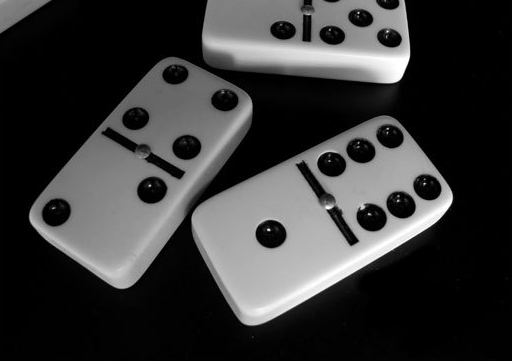
You might think I am referring to a locomotive that rattles noisily down steel tracks somewhere in Mexico. Well, I am not. I am talking about a popular board game using dominoes that I discovered through friends.

A year ago or so, when in Mexico, Tom and Dee Grant, along with another couple, Don and Leslie, introduced my wife, Barbara, and I to the game. I forgot about the fun event until our last visit to the Grant’s home. That evening we again played Mexican Train, but with another couple as Don and Leslie weren’t available.

During the game, funny little things occurred that brought chuckles. Soon the double entendres were flying. I laughed until my eyes were blurry. The game went on for five hours. Barbara won. She’s a games person.

Anyway, when we returned to our home in Oregon, I decided to buy the game. Fearlessly, I went online and found www.mexicantrainfun.com.

Wow! Check out the website and you will see why it nearly blew my mind. It’s not exactly the slickest website in the world, but boy is it ever filled with, well, content. I thought I’d find a simple game featured here — you know, a box full of dominoes,  the other necessary pieces, and some simple instructions. Wrong. Instead, I was faced with a a long list of choices.

First, which set did I want? here were five options: a Double 6 with threes and fives (the number of pips on a tile), the most popular size, along with a Double 9, a Double 12 with 91 dominoes with the tile pips ranging from blank (0) to 12, a Double 15 with 136 dominoes ranging from 0 to 15, and a Double 18 featuring 190 dominoes, with the tile numbers ranging from 0 to 18. This one allows you to play more complicated games.

The website features a video to help you see the games and the colors on the various sets. In addition to dominoes with pips, they’re also available  with numbers (makes ‘em easier to read). There are various racks and trays (wood or plastic), a rules and strategy book, tournaments to sign up for, and domino clubs to join. There’s even a blog site for players’ comments.

For example, a question was posed on the site about a player announcing that he wanted to “go out” on a double (a tile with the same number of pips on each half), but not having a tile to answer it. The rules were checked, and seeing a name of a recognized expert on the game they called her. Her response was that you must answer a double to go out. This changes the strategy of the game a great deal, since you should try to hold a tile that coordinates with a double, or be sure to play a double earlier if it doesn’t match anything in your hand so you can go out, or, if it is a low double, hang onto it to the end because it will be low points in your hand. Get it?!

You are wondering why I don’t explain the above in greater, more lucid detail, it’s because I really can’t, at least not yet. I am still a novice. Like I’ve said, I’ve only played the game twice. I’m not Barbara!

I have learned one important detail, however. It turns out that the owner of the premises where the game is being played is the final arbiter in all disputes. It might pay to host the game.

What’s available on the website doesn’t stop there. They sell train markers, a set of eight that come in solid colors or with glitter, or a Double 6 with black dots and brass spinners (don’t ask). You can buy a container (case) in vinyl, tin, wood, or aluminum, and carry it in a tote bag with a Mexican Train logo. Ot how about a yard sign for advertising that Mexican Train is being played at your place tonight?

They sell train hubs in clear plastic, or wood hubs for six or eight players. Some sets have train hubs that come with sounds. Even chicken sounds! And why not also get yourself a set of 10 colored chicken markers while you’re at it? Or there’s always the interactive yellow hub with chicken-foot and train graphics and sounds. Simply push “train sound” when you start a train, or “chicken crow” when you start a double (again, don’t ask!).

There are attractive red caboose pencil sharpeners, dominoes with jumbo sized pips or numbers, even a spiffy, four-fold domino tabletop. There are large train markers, the Mexican Train whistle key chain, and, best of all, a large glass train in a silver gift box. And of course you have to have scorecards, and an official train pen.

It’s apparently highly recommended that you cover your game table with felt. It makes for quieter play, and the tiles slide more easily. Also, since dominoes pick up dirt from table surfaces, people’s hands, food, and drink, over time they become dirty. You guessed it. The site offers cleaning remedy suggestions.

Being a party animal, I decided I wanted to be able to play with eight players, so I opted for the professional-sized Double 15. Hey, it was on sale, at a whopping 19% discount. I saved $16. Plus, bonus, it came with a faux cowhide Leatherette case with a snap closure. And the train hub is interactive. You know, with those funny chicken sounds.

I stopped short of purchasing the game night lawn sign. I like to think that shows a certain steely sort of masculine will and determination.

On the other hand, it could simply be because I don’t have a lawn.

The birth of cool

Legendary cool jazz trumpeter, Chet Baker

1958-1964 bore a different look, attitude and sound than anything that had come before. It was that brief, eventful era that bridged the gap between the old-school glamour of Hollywood’s Golden Age, and the, hipper, harder-edged times that would follow. It was during these years that rock and roll was born, and, while not marking the birth of the blues, was the period when this form of distinctly American music finally received broad public recognition. Blues had been around for decades, but mainstream America paid little attention, until it was discovered that the blues were the root of rock and roll.

A new generation began to emerge, embracing music and fashion that directly expressed the changing times. It was this sexy combination that soon inspired the rest of the world to get with the new program. Blues and rock and roll were this new wave’s musical meat, and folk music was their potato. Then punks came on the scene, along with rebels, hipsters, potheads, and loud ‘n fast guitars.

The times, they were a’changin’.

The atmosphere in the smoke-filled jazz clubs of that era was stifling. Windows and doors were opened to allow some “cool air” in from the outside, to help clear away the suffocating smoke. It was inevitable that the slow, smooth jazz style that was typical for that late-night scene came to be called “cool.”

Marlene Kim Connor connects cool and the post-war African-American experience in her book, What is Cool? Understanding Black Manhood in America. Connor writes that cool is the silent and knowing rejection of racist oppression, a self-dignified expression of masculinity developed by black men denied mainstream expressions of manhood. She argues that the mainstream perception of cool is narrow and distorted, that it is too often seen merely as a style or a sign of arrogance, rather than a way to achieve respect. Designer Christian Lacroix is onside with Connor, noting that, “…the history of cool in America is the history of African-American culture.”

While speaking of cool, anyone interested in this “new” jazz phenomenon is well advised to check out Ted Gioia’s excellent book, Cool Jazz and West Coast Jazz.

Postwar cool

World War II brought the people of Britain, Germany, and France into intimate contact with Americans and American culture. The war brought hundreds of thousands of GIs to these countries, men whose relaxed, easy-going manner was seen by young people of the time as the very embodiment of liberation. They brought with them came Lucky Strikes, nylons, swing, and jazz, in addition to this laid-back attitude—the new American Cool.

To be cool or “hip” at the time meant hanging out with buddies, pursuing sexual liaisons, displaying the appropriate attitude of narcissistic self-absorption, and generally expressing a desire to escape the mental straitjacket of “old-fashioned” ideologies. From the late 1940s onward, American popular culture influenced young people all over the world, to the great dismay of the paternalistic elites who still ruled the “official” culture.

The stage was set for one of the greatest eras of social unrest and upheaval in Western history.

The Polar Palace

The interior of the Polar Palace


Saturday mornings on occasion found me at the Polar Palace, a block south of Melrose Avenue at the corner of Van Ness Avenue and Clinton Street. I was a teenager, no longer riding the red car from the San Fernando Valley into Hollywood. When I was fourteen, Mother decided I was old enough to take care of myself while she was at work.

So the Polar Palace it was, with its painted mountain scenes on the end walls, a neat place to meet girls. It was the largest indoor ice surface in the world—110 by 230 feet. It cost 75 cents to enter, 25 cents as a spectator. A lady named Gracie sat at the cashier’s booth. She’d been a Mack Sennett bathing beauty years before.

One Saturday when I was there, the pretty blonde actress, Vera-Ellen, was skating at the rink. She was practicing for her upcoming film, White Christmas. She played the role of Judy Haynes. Rosemary Clooney played her sister, Betty. Bing Crosby as Bob, and Danny Kaye as Phil, pursued them.

In the finale, Bob and Betty declare their love, as do Phil and Judy. The background of the set is removed to show the snow falling in Pine Tree, Vermont. Everyone raises a glass, toasting, “May your days be merry and bright; and may all your Christmases be white.”

That reminds me. Christmastime found my mother meticulously decorating a silvertip pine with tons of tinsel. My wife, Barbara, says I inherited Mother’s idiosyncrasy. She laughs whenever I walk through the kitchen and can’t resist straightening items on the counter, or the times I walk through the garden and have to pull a weed or two.

Anyway, the Polar Palace with its hanging incandescent lights was a fun place, but it wasn’t insulated, so a sort of fog misted inside. I dressed for the cold conditions. Oftentimes, in the summer, as much as four inches of water accumulated on the surface. I recall little lumps of ice that formed from condensation caused by an overhead pipe that dripped rusty water. The pipes held the lights. At least the rust stains alerted skaters to the crusty deposits that were hazardous.

The Polar Palace, a huge wooden structure, burned down in 1963. The cause: faulty wiring in the coffee shop. After the fire, it was discovered that permafrost went as deep as forty feet into the ground. For many years the property was not suitable to build upon.

The coffee shop was where all the non-skating action occurred, where I flirted with the pretty girls. They made hot and cold sandwiches, including a great hot meatloaf sandwich, but my favorite was a bear-claw heated on the grill in sizzling butter.

What I called the professional skaters, paid 50 cents a month for personal lockers.

The guards, a guy named Dick and several others, resurfaced the ice (this was pre-Zamboni) with hand scrapers and a device that looked like a ten-gallon drum with a wide strip of chamois hanging from it. The drum contained water and fed the top of the chamois, which laid a smooth surface on the ice. The corners used to have a big buildup of ice from the hoses.

Cliff Oddson was manager of the skate shop, and was one of the best sharpeners in town. He’d skated in Sonja Henie’s shows and a couple of her movies. He had a great collection of antique skates which all went in the fire. A guy named Bob also worked there.

In 1954, the U.S. Nationals were held there. Tenley Albright was crowned national champion for her second women’s singles title.

I have wonderful memories from those Saturdays—the music, the smell, the cold, the sounds of skaters whizzing past me. The Polar Palace seemed so huge back then.