A pioneering public hospital checks out

(Excerpted from “L.A. Then and Now,”  by  Cecilia Rasmussen, Los Angeles Times Staff Writer, October 2, 2005)

Celebrities, mayors, judges, and fire and police chiefs drew their last breaths here, as did thousands of rich and poor Angelenos. Sen. Robert F. Kennedy received last rites here.

Now, this pioneering public hospital is receiving its last rites. It will be razed this week to make way for the Los Angeles Police Department’s new $29-million Rampart station.

For more than a century, the institution most recently known as Central Receiving Hospital provided emergency care and, later, paramedic services. Many a police officer and firefighter owed his life to this frontline first-aid station for those who needed to be stitched up and sent on to bigger hospitals.

The two-story, brick-faced structure at 6th Street and Loma Drive, just west f downtown, is the hospital’s fifth location. Built in 1957 for $1.5 million, it closed to the public in 1970. But as recently as August, it offered physical psychological exams to police officers and firefighters.

The city’s first receiving hospital of sorts opened in 1868 as a “pesthouse”—in effect, a hospice for victims of pestilence, especially smallpox. But soon the Chavez Ravine institution took in victims of other contagious diseases as well.

Its second incarnation began in the late 1880s as a two-room emergency first-aid unit in the back of the downtown Central Police Station. One police surgeon tended all comers: victims of shooting, rapes and assorted mayhem.

By the end of 1889, 562 patients had been treated there. A year later, the number had multiplied to 3,515 as the area’s population soared.

A few years later, in 1896, a new Central Police Station and Receiving Hospital opened on the south side of 1st Street, between Broadway and Hill streets. Horse-drawn ambulances rushed victims through the drive-up entrance.

It would take another dozen years before the city hired its first professional nurse, Charles Whitehead. In his 33 years of service, he treated victims of the 1910 Los Angeles times bombing and picked “scores of metal pieces” out of former LAPD detective turned private eye Harry Raymond, whose car was bombed in 1938 after he blew the whistle on corrupt cops.

Police Chief Charles Edward Sebastian worked there before becoming mayor in 1915. But he was forced to resign the next year when the Los Angeles Record published letters he had written to his mistress describing his wife as “the Old Haybag.”

He tried to return to the LAPD as a lieutenant, but the force refused to take him back. He got a job as a gas station attendant.

Despite his reduced circumstances, he put his son, Charles Francis Sebastian, through Stanford Medical School. The younger Sebastian returned to Los Angeles in 1922 to play a leading role at the hospital.

In 1927, the fourth incarnation of the hospital opened a few miles away, on the third floor of the Georgia Street Police Station. The first patient was “Baby Fauso Bustus, 3 years old, son of Mrs. F. Bustus, 1609 Redwood St.,” a Lost Angeles newspaper reported.

Georgia Street Receiving Hospital was among about a dozen hospitals in the city by then. For three decades it was also the poorest, with outdated tools and technology.

Satellite hospitals in Hollywood, Lincoln Heights and Van Nuys began opening in the late 1930s under the leadership of Dr. Sebastian. In 1949 he was promoted to superintendent in charge of all four city hospitals. Sebastian came up with a life-saving innovation that is ubiquitous today.

In 1952, ambulance attendant Jack Gilson died when he was thrown from the vehicle in a traffic accident. Sebastian had already watched two other ambulance attendants die that way and didn’t care to see a fourth. He devised a series of straps to hold passengers into their seats, according to Al Cowen, retired Los Angeles Fire Department chief paramedic who is chairman of the Department of Emergency Services for Valley College.

“This early form of seat belts was installed in all 13 of the city’s ambulances, commonly referred to as Brown Bombers,” which were tan station wagons “with red crosses painted on the side,” Cowen said.

For more than a decade, Sebastian had been begging the City Council to build a modern facility. At last he prevailed, and the Central Receiving Hospital opened in June 1957. It included 40 rooms: 20 on the first floor for civilians and 20 on the second floor for police officers and firefighters. Each room was equipped with “piped-in oxygen,” the Times reported, and the X-ray and surgical equipment was state of the art.

Georgia Street treated its last patient on June 27, 1957, according to hospital logbooks. The Police Department continued to use the building until the mid-1980s, when it was demolished to expand the Convention Center.

Sebastian directed the hospitals until his retirement in 1961.

Perhaps the most famous of Central Receiving’s patients arrived by ambulance in the early morning hours of June 5, 1968. Robert F. Kennedy had been shot at the nearby Ambassador Hotel after winning the California presidential primary.

News of the shooting traveled fast. By the time Kennedy’s ambulance arrived, more than 300 bystanders had gathered to keep vigil.

Father Thomas Peacha of St Basil’s Catholic Church was driving near the Ambassador Hotel when he heard the news on the radio. He headed for Central Receiving and made his way to the emergency room, where Kennedy was lying on the table. The senator’s wife, Ethel, was sitting nearby on a stool.

“I’m sure he wasn’t conscious,” Peacha said in an interview with The Times shortly afterward. Peacha administered last rites using a tiny piece of cotton soaked in blessed oil.

Kennedy was pronounced dead at 1:44 a.m. June 6 at Good Samaritan Hospital across the street, where he had been taken for surgery.

The City Council initially blamed Kennedy’s death on the small, ailing hospital and the ambulance drivers who had bypassed other facilities to take him there. Confidence in the hospital weakened, and the council implemented a policy permitting injured police officers and firefighters to receive emergency care at the nearest hospital.

But several investigations found that the battle to save Kennedy’s life had been lost the moment Sirhan Sirhan pulled the trigger. Hospital personnel had handled everything correctly, the probe found.

In 1969, the hospital came under fire again when LAPD Officer Robert J. Cote was shot as he tried to stop a robbery. Cote was transported four miles through heavy traffic to Central Receiving and pronounced dead more than an hour later.

Again, citizens were assured that it wouldn’t have mattered where he was taken.

“Even if cote had been shot in the lobby of the hospital, he could not have survived,” Central Receiving Hospital Supt. M.X. Anderson said.

Still, the Cote affair continued to be a festering source of community anger. The council pressed to shutter the hospital, and in 1970 it closed to the public. Paramedic services switched to the Fire Department—as Sebastian had suggested 11 years earlier.

As he walked through the old hospital recently, Cowen, the retired chief of paramedics, thought of all the lives that had been saved there.

“Charles Sebastian’s ghost is walking around here somewhere,” Cowen said. “And if he could, he’d embrace everyone, saying thank you.”

A POSTSCRIPT FROM JESS WAID

In August 1963, I was involved in a high-speed wobble on my Harley-Davidson police motorcycle while inbound on the Hollywood Freeway at Barham Boulevard. The bike was heading for the center divider, a chain link fence, so I made the instant decision to lay the bike down on its right side—not the way to do it as my right foot slipped off the brake and pulled me under the heavy motorcycle.

I slid 100 yards resulting in a vertical break of my right scapula, a nasty avulsion under my chin from the windshield, my right knee was torn open, and my right arm filled with roadside gravel accumulated along the center divider strip. Eighty percent of my ulnar nerve was destroyed.

I was rushed Code Three to Central Receiving Hospital, where Doctor Bob Morgan, saved my right arm and my life. I was on the table for six-plus hours. Doc performed three skin grafts to the avulsed areas: chin, right arm and right knee. Two weeks later I was discharged. Several subsequent operations with a plastic surgeion corrected most of the damage to my jaw and face.

So, although I am not a ghost, I am one of those who Cowen referred to who would embrace the CRH staff and Doctor Bob and say, “Thank you.”

From Deutschland with love

With the latest Bond flick now in the cinemas, it’s interesting to take a look at 007’s handgun of choice.

The Walther PP series pistols are blowback-operated semi-automatics. They feature an exposed hammer, a traditional double-action trigger mechanism, a single-column magazine, and a fixed barrel that also acts as the guide rod for the recoil spring. The series includes the Walther PP, PPK, PPK/S, and PPK/E. The various PP series are manufactured in either Germany or the United States. Since 2002, the PPK variant is solely manufactured by Smith & Wesson in Houlton, Maine, under license from Carl Walther GmbH Sportwaffen. In the past, this particular model was manufactured by Carl Walther in its own factory in Germany, as well as under license by Manurhin in Alsace, France, and by Interarms in Alexandria, Virginia.

Originally built in 1929, the Walther PPK remains a popular pistol, used today for concealed carry, V.I.P. protection, and Britain’s MI5, as well as by European and American police. It has also been a popular display pistol to give as a gift to American and British military officers.

The PP was first released in 1929, and the PPK in 1931; both were popular with European police and civilians, for being reliable and concealable. During World War II, they were issued to the German military and police, the Schutzstaffel, the Luftwaffe, and Nazi Party officials; Adolf Hitler shot and killed himself with his PPK (a 7.65mm/.32 ACP) in the Führerbunker in Berlin. More importantly(!), the Walther PPK (also a 7.65mm/.32 ACP) pistol is famous as James Bond’s signature gun in many of the Bond films, (including the latest, Skyfall), and novels. Ian Fleming’s choice of the Walther PPK directly influenced its popularity and its notoriety.

The most common variant is the Walther PPK, the Polizeipistole Kurz (Police Pistol Short), indicating it was more concealable than the original PP, and hence better suited for plainclothes and undercover work. Sometimes, the name Polizeipistole Kurz (Short Police Pistol) is used; however, the accuracy of that interpretation is unclear. The PPK is a smaller version of the PP (Polizeipistole) with a shorter grip and barrel and reduced magazine capacity.

The PP and the PPK were among the world’s first successful double action semi-automatic pistols that were widely copied, but still made by Walther. The design inspired other pistols, among them the Soviet Makarov, the Hungarian FEG PA-63, the Argentinian Bersa Thunder 380, the Spanish Astra Constable, and the Czech CZ50. Although it was an excellent semi-automatic pistol, it had competitors in its time.

Walther’s original factory was located in Zella-Mehlis in the state  of Thuringia. As that part of Germany was occupied by the Soviet Union following World War II, Walther was forced to flee to West Germany, where they established a new factory in Ulm. However, for several years following the war, the Allied powers forbade any manufacture of weapons in Germany. As a result, in 1952, Walther licensed production of the PP series pistols to a French company, Manufacture de Machines du Haut-Rhin, also known as Manurhin. The French company continued to manufacture the PP series until 1986. In fact, Manurhin manufactured all postwar European-made PP series pistols manufactured until 1986, even though the pistol slide may bear the markings of the Walther factory in Ulm.

In 1978, Ranger Manufacturing of Gadsden, Alabama was licensed to manufacture the PPK and PPK/S; this version was distributed by Interarms of Alexandria, Virginia. This license was eventually canceled. Starting in 2002, Smith & Wesson (S&W) began manufacturing the PPK and PPK/S under license.
Walther has indicated that, with the exception of the PP and the new PPK/E model, S&W is the current sole source for new PPK-type pistols.

The PPK/S was developed following the enactment of the Gun Control Act of 1968 (GCA68) in the United States, the pistol’s largest market. One of the provisions of GCA68 banned the importation of pistols and revolvers not meeting certain requirements of length, weight, and other “sporting” features into the U.S. The PPK failed the “Import Points” test of the GCA68 by a single point. Walther addressed this situation by combining the PP’s frame with the PPK’s barrel and slide to create a pistol that weighed slightly more than the PPK. The additional ounce or two of weight of the PPK/S compared to the PPK was sufficient to provide the extra needed import points.

Because U.S. law allowed domestic production (as opposed to importation) of the PPK, manufacture began under license in the U.S. in 1978; Interarms distributed this model. The version currently manufactured by Smith & Wesson has been modified by incorporating a longer grip tang, better protecting the shooter from slide bite, i.e. the rearward-traveling slide’s pinching the web between the index finger and thumb of the firing hand, which was a problem with the original design.

In the 1950s, Walther produced the PPK-L, a lightweight variant of the PPK. The PPK-L differed from the standard, all steel PPK in that it had an aluminium alloy frame. These were only chambered in 7.65mm Browning (.32 ACP) and .22 LR because of the increase in felt recoil from the lighter weight of the gun. All other features of the postwar production PPK/S (brown plastic grips with Walther banner, high polished blue finish, lanyard loop, loaded chamber indicator, 7+1 magazine capacity and overall length) were the same on the PPK-L.

In the 1960s, Walther began stamping “Made in West Germany” on the frame of the pistol right below the magazine release button. The 1950s production pistols had the date of manufacture, designated as ‘month/year’, stamped on the right side of the slide. Starting in the 1960s, the production date, designated by the last two digits of the year, was stamped on the exposed part of the barrel that could be seen in the ejection port.

Thoughts in rhyme and prose by Robert F. McMeekin

A 2009 photo of LAPD Chief Charlie Beck as he makes his way through rows of officers at the Devonshire Division police station in Northridge in 2009. (Andy Holzman/Staff Photographer, Los Angeles Daily News)

Robert F. McMeekin grew up in Brooklyn, New York and went on to attend Syracuse University and Cal State University, earning his bachelor’s and master’s degrees at Cal State. Now a retired Los Angeles Sergeant of Police, Mr. McMeekin is married with three grown children.


THOUGHTS IN RHYME

How proud I am, how proud I be

To be retired from the LAPD

I have fondest memories of the Academy

Most of my classmates still remember me

I learned my craft in a radio car

I thank my partners who took me this far

From a shy wiseass from the streets of Brooklyn

I learned to deal wit crime and sin

The men I worked with thru years of strife

Are now good friends for now and life

There is a terrific bond you do cultivate

From all your partners who shared your fate

For all who read these thoughts in rhyme

I think you’ll agree we had a hell of a thyme


A NICE WAY TO MEET

I woke up this morning and let my dog out the door

That’s when I saw a pretty lady leave apartment four

“Good morning” sez I, “Hello,” sez she

My dog then trotted over and jumped on her knee

“He thinks you brought him a treat”

“I have no treat, but it’s a nice way to meet”

The next morning I let my dog out at the same time

And there she was—so very pretty—it was a crime

As my dog jumped on her knee, she gave him a treat

“You’re gonna spoil him, now he’ll expect a treat whenever you meet”

“That’s okay,” sez she. “I’ll get even when you take me to dinner.”

“That’s fine with me—I can’t lose, so I’, the winner”

One year later she and my dog were friends for life,

Her and me were also friends but more importantly—man and wife


HOW PROUD I WAS

Back in the ’seventies, I was a sergeant of police assigned to Wilshire Division, working the night watch, PMs. One spring night, as a field supervisor, I was cruising along Olympic Boulevard just west of Western Avenue. A radio broadcast came out giving info on a 211 (robbery) that just occurred on Western, not too far away.

The broadcast gave descriptions of two male-black suspects, plus the make of their car and its license number.

As I approached Western Avenue, I turned north, reasoning that it was still early and the suspects would probably head towards Hollywood with their loot.

After about two blocks, I spotted the suspects in their car ahead of me.

I radioed my location with the request for backup, flipped on my overhead red lights and cut the suspects vehicle off at an angle. Using my car as a shield, weapon drawn, I ordered the suspects out of their car one at a time, driver’s side, hands up.

Both suspects complied when they saw me with my shotgun pointing at their heads. At this time, several police units arrived at the scene and took custody of both suspects. Policy dictated that supervisors turn over custody of arrestees to a field unit for arrest booking and reports.

I then continued on my shift as a field supervisor.

At end-of-watch, EOW, I drove to the station, gathered my gear, and headed to the watch commander’s office to go off duty. As I entered the w/c’s office, change of watch was taking place as the morning watch supervisors and w/c relieved the night watch supervisors and w/c.

There were six sergeants, two lieutenants, and several police officers in the office as I entered. Much to my surprise and delight my contemporaries and supervisors soundly applauded me!

I was officially relieved and was the man of the hour. To be truly recognized by my peers and supervisors was the proudest moment of my life.

I never forgot it.


LAPD authors…

I would like to plug my fellow retired LAPD authors, so I am listing their works below:

BOOKS, FICTION & NON-FICTION, BY FORMER LAPD OFFICERS

The Oasis Project by Art Adkins  (May 17, 2010)  $14.00

Power Grid by Art Adkins  (Sept 10, 2010) $14.99 – Kindle $2.99

A Dozen Deadly Roses by Kathy Bennett  (Jun 4, 2011) Kindle $2.99

A Deadly Blessing by Kathy Bennett  (Apr 8, 2012) Kindle $2.99

Sand Against Time by Paul Bishop (1990) Hardcover (used) $24.95

Chapel of the Ravens by Paul Bishop (Oct 1992) Hardcover $18.25 Paperback $4.87

Croaker: Grave Sins by Paul Bishop (Jun 28, 2011) – $2.99 Kindle

Bluff City Brawler (Fight Card) by Heath Lowrance, Jack Tunney, Mel Odom and Paul Bishop (Sep 1, 2012) – $2.99 Kindle

Felony Fists (Fight Card) by Jack Tunney, Mel Odom and Paul Bishop (Nov 11, 2011) – $0.00 Kindle

Get Hit, Hit Back (Fight Card) by Jack Tunney, John Kenyon, Paul Bishop and Mel Odom (May 26, 2013) – $2.99 Kindle

Hot Pursuit by Paul Bishop (Jun 19, 2011) – $2.99 Kindle

The Other Side of Truth by Paul Kimball and Greg Bishop (Apr 3, 2013) – $9.39 Kindle

The Cutman (Fight Card) by Jack Tunney, Mel Odom and Paul Bishop (Nov 11, 2011) – $0.99 Kindle

Deep Water by Paul Bishop (Jun 19, 2011) – $2.99 Kindle

Penalty Shot by Paul Bishop (Jun 23, 2011) – $2.99 Kindle

Welcome to the Octagon (Fight Card MMA) by Jack Tunney, Gerard Brennan, Paul Bishop and Mel Odom (Apr 17, 2013) – $0.99 Kindle

Fight Card: Against the Ropes by Jack Tunney, Terrence McCauley, Paul Bishop and Mel Odom (Feb 11, 2013) – $2.99 Kindle

The Knockout (Fight Card) by Jack Tunney, Paul Bishop, Mel Odom and Robert J. Randisi (Dec 1, 2012) – $0.99 Kindle

Golden Gate Gloves (Fight Card) by Jack Tunney, Robert Evans, Mel Odom and Paul Bishop (Oct 21, 2012) – $2.99 Kindle

The Centurions’ Shield by Keith and Jake Bushey

Uniform Decisions by John Caprarelli and Lee Mindham  (Dec 27, 20110 $11.80 – Kindle $7.99

Criminal Justice Administration by Clyde Cronkhite (Oct 15, 2007) $84.28

Law Enforcement and Justice Administration by Clyde Cronkhite (Jan 15, 2012) $126.95/$58.25pb

Fallen Angels by Connie Dial (Apr 20, 2012) $22.04 – Kindle $9.99

Internal Affairs by Connie Dial (Jun 1, 2009) $21.29 – Kindle $15.40

The Broken Blue Line by Connie Dial (Jun 1, 2010) $21.28 – Kindle $15.40

The Buffalo Rock by Bob Faulkner  (Aug 8, 2008) $30.00

The Warrior in Me by David E. Gray (Mar 9, 2010) $19.99 – Kindle $7.69

True to the Blue by David E. Gray

Eclipse of the Blue by David E. Gray (Oct 28, 2012) $29.99 – Kindle $3.99

Images of America – Los Angeles Police Department by Tom Hays and Art Sjoquist (Oct 10, 2005) $19.99

Black Dahlia Avenger by Steve Hodel (Apr 11, 2003) $11.18 – Kindle $0.99

Most Evil by Steve Hodel (Sep 22, 2009) $3.99 – Kindle $7.99

Black Dahlia Avenger II by Steve Hodel (Mar 13, 2012) $19.11 – Kindle $7.99

Thicker’n Thieves by Charles Stoker and Steve Hodel (Mar 13, 2012) $23.00 – Kindle $7.19

Islam and Barack Hussein Obama by Stephen M. Kirby, Ph.D. (Jul 20, 2010) $8.75

Letting Islam Be Islam by Stephen M. Kirby, Ph.D. (Oct 1, 2012) $18.18

Orphan’s Asylum by Mike Krecioch (Feb 20, 2008) $19.99 – Kindle $3.99

“G’d Up” 24/7 – The GHB Addiction Guide by Trinka Porrata (Jun 1, 2007) $34.99

War Stories Lived by a L.A. Cop by Robert E. Reynolds (Aug 1, 2012) $19.95 – Kindle  $19.95

Good Cop Dead Cop by Bob Ruchhoft and Phil Smith (Apr 4, 2011) $13.95 – Kindle $4.99

The BCMC – The Big City Motor Cop by Gary Smith (Jul 29, 2009) $19.99 – Kindle $9.99

Hide and Seek – The Warrant Game by Gary Smith (Apr 6, 2011) $19.99 – Kindle $9.99

Casey Teel by Dale Sprinkle (Sep 29, 2011) $28.95/$17.95pb – Kindle $3.99

The First Crime Scene by Frank Tomlinson  (Oct 17, 2009) $19.99

No One Escapes by Frank Tomlinson  (Nov 24.2011) $18.99

The SWAT Pioneers – A History of the LAPD’s SWAT Program 1965-1972 by Rik Violano (Jan 1, 2006) $30

To Ride a Hurricane by William L. Walker  (Mar 3, 2008) $28.80 – Kindle $15.95

To Ride a Hurricane II The Redemption by William L. Walker (Dec 6, 2011) $29.95 – Kindle $29.95

Gene Roddenberry’s “Earth Final Conflict” (Bk. 1) by Gene Roddenberry (Out of Print)Gene Roddenberry’s “Earth Final Conflict” (Bk. 2) by Gene Roddenberry (Out of Print)

THE MAKING OF STAR TREK : The Book on How to Write for TV! by Stephen E. Whitfield and Gene Roddenberry (Jul 1, 1970) (Currently unavailable)

Star Trek 5, The Rift, Chain of Attack, Star Trek: The Motion Picture, Deep Doma by Peter David, Gene DeWeese, Gene Roddenberry, David Dvorkin, Melinda James Blish (Jan 1, 1972) (Currently unavailable)

The Star Trek Reader I by James Blish and Gene Roddenberry (Sep 1976) Hardcover $30.48

Star Trek: The New Voyages by Sondra Marshak, Myrna Culbreath, Gene Roddenberry and Cast of Star Trek (1976) Paperback $39.99

The Star Trek Reader II by James Blish and Gene Roddenberry (Apr 1977) Hardcover $11.65

The Star Trek Reader III by James Blish and Gene Roddenberry (Aug 1977) Hardcover $12.99

The City on the Edge of Forever (Star Trek Fotonovel, No. 1) by Harlan Ellison and Gene Roddenberry (Nov 1977) Paperback $8.30

Where No Man Has Gone Before (Star Trek Fotonovel, No. 2) by Samuel A. Peeples and Gene Roddenberry (Nov 1977) Paperback $47.99

The Star Trek Reader IV by James Blish and Gene Roddenberry (Mar 1978) Hardcover $20.93

The Devil in the Dark (Star Trek Fotonovel, No. 9) by Gene L Coon and Gene Roddenberry (Jul 1978) Paperback $10.00

Day of the Dove (Star Trek Fotonovel No. 10) by Jerome Bixby and Gene Roddenberry (Aug 1978) Paperback $40.56

All Our Yesterdays (Star Trek Fotonovel #6) by Gene Roddenberry (Sep 29, 1978) Paperback $14.99

Amok Time (Star Trek Fotonovel, No. 12) by Theodore Sturgeon, Gene Roddenberry and DeForest Kelley (Oct 1978) Paperback $39.95

A Piece of the Action (Star Trek Fotonovel #8) by David P Harmon and Gene Roddenberry (Nov 24, 1978) Paperback $10.00

Star Wars The Motion Picture by Gene Roddenberry (1979) Hardcover (Used) $0.88

Star Trek the Motion Picture by Gene Roddenberry (1979) Paperback $13.46

Star Trek by Gene Roddenberry (Jan 1, 1980) Paperback(used) $1.21

The Making of Star Trek: The Motion Picture by Gene Roddenberry and Susan Sackett (Feb 29, 1980) Paperback $81.52

Star Trek: The Motion Picture by Gene Roddenberry (Mar 28, 1980) Paperback $15.85 Hardcover $84.40

The Making of Star Trek by Stephen E. Whitfield and Gene Roddenberry (1986) Paperback $19.99

Envoys of Mankind: A Declaration of First Principles for the Governance of Space Societies by George S. Robinson, Harold M. White and Gene Roddenberry (Nov 1986) Hardcover $17.00 (Collectible)

Star Trek Novel by Roddenberry (Apr 2, 1987) Paperback $15.85 – Hardcover $19.99

Star Trek: the Making of the TV Series by Gene Roddenberry (Sep 12, 1991) Paperback $66.64

GENE RODDENBERRY: The Myth and the Man Behind Star Trek by Gene Roddenberry). Engel, Joel (1994) Hardcover $44.95

GENE RODDENBERRY, THE LAST CONVERSATION by Gene RODDENBERRY (1994) Hardcover $50.00

Errand of Fury by Gene Roddenberry Kevin Ryan (2007) Paperback $4.98

Star Trek, the Next Generation: Before Dishonor by Gene Roddenberry Peter David (2007) Paperback $12.05

Star Trek Vol.1 (Graphic Novel) Gold Key (The Key Collection) by Gene Roddenberry (Jun 30, 2011) Kindle $6.99

Star Trek Vol.2 (The Key Collection) by Gene Roddenberry (Jun 30, 2011) Kindle $4.61

Star Trek Vol.3 (The Gold Key Collection) by Gene Roddenberry (Jul 14, 2011) Kindle $8.99

Star Trek Vol.4 (The Key Collection) by Gene Roddenberry (Jul 14, 2011) Kindle $8.99

Star Trek Vol.5 (The Gold Key Collection) by Gene Roddenberry (Jul 14, 2011) Kindle $8.99

Fame, Hollywood style


Along fifteen blocks of Hollywood Boulevard and three blocks of Vine Street in Hollywood, California, is the The Walk of Fame. It was established in 1958 and attracts more visitors,  about ten million annually—than other LA area attractions such as the Sunset Strip, Grauman’s Chinese Theater, the Queen Mary in Long Beach, and the Los Angeles County Museum of Art.

As of November 8, 2012, the Walk included 2,484 stars, spaced at 6-foot intervals. Each star consists of a coral-pink terrazzo with five-points, trimmed in brass (not bronze), inlaid into a charcoal-colored terrazzo background. In the upper portion of he pink star field, the name of the honoree is inlaid in brass block letters. Below the inscription, in the lower half of the star field, a round inlaid brass emblem indicates the category of the honoree’s contributions. The emblems symbolize five categories within the entertainment industry:

 
– Classic film camera, representing motion pictures;
– Television receiver, representing broadcast television;
– Phonograph record, representing audio recording or music;
– Radio microphone, representing broadcast radio;
– Comedy/tragedy masks, representing theater/live performance (added in 1984).

The Hollywood Chamber of Commerce maintains The Walk. They, or the Hollywood Historic Trust, grant “special stars” unique to the honoree. They are not part of the Walk of Fame; instead, they are located nearby on private property. These “Friends of the Walk of Fame” monuments vary from the trademark “star” shape, in that they are charcoal terrazzo squares, rimmed by miniature pink terrazzo stars displaying the five standard category emblems, along with the sponsor’s corporate logo, with the sponsor’s name and contribution in inlaid brass block lettering. Examples include the Los Angeles Police Department (LAPD) star emblem, a replica of a police badge indicating the LAPD’s Hollywood Division, and the Los Angeles Dodgers, displaying the team’s logo.

Then there are the uniquely shaped monument for the Apollo 11 mission to the Moon, consisting of four identical, circular “moons” bearing the names of the three astronauts (Neil Armstrong, Michael Collins, and Edwin E. “Buzz” Aldrin Jr.), the date of the first moon landing (“7/20/69”), and the words “Apollo XI” set in each of the four corners at the intersection of Hollywood and Vine. The “moons” are silver and dark gray terrazzo circles rimmed in brass on a square pink terrazzo background, with the television emblem inlaid at the “twelve o’clock” position on the circles.

The original selection committees chose to recognize some entertainers’ contributions in multiple categories with multiple stars. Gene Autry is the only honoree with stars in all five categories. Bob Hope, Mickey Rooney, Roy Rogers, and Tony Martin each have stars in four categories—Rooney has three of his own and a fourth with his wife, Jan, while Rogers also has three of his own, and a fourth with his band, The Sons of the Pioneers. Thirty-three people, including Frank Sinatra, Dinah Shore, Gale Storm, Danny Kaye, and Jack Benny, have stars in three categories.
Seven recording artists have two stars in the same category, for distinct achievements: Michael Jackson, as a soloist and as a member of The Jackson 5; Diana Ross, as a member of The Supremes and for her solo work; Smokey Robinson, as a solo artist and as a member of The Miracles; and John Lennon, Ringo Starr, George Harrison, and Paul McCartney as individual performers and as members of The Beatles. Cher forfeited her opportunity to join this exclusive club by declining to schedule the mandatory personal appearance when she was selected in 1983. She did, however, attend the unveiling of the Sonny & Cher star in 1998, as a tribute to her recently deceased ex-husband, Sonny Bono.
The only two fictional characters to have two stars are Kermit the Frog and Big Bird, each with an individual star and one with The Muppets.
George Eastman is the only honoree with two stars in the same category for the same achievement—the invention of roll film.

Thor

The ears may be embarrassing right now, but just wait ’til he’s the size of a small pony!

I pulled our old Silverado up to the closed chain ink gate in Camp Verde, Arizona and read the sign:

Don’t trespass unless you can outrun a dobie who will cover the distance from the house to here in 2.5 seconds.

OK, that’s not exactly what the sign said, but the message was clear. We had found the home of Thor, the Doberman Pinscher puppy we had purchased via the Internet. I gave him his name, and so far, it looks as though it fits.

I had previously owned an Akita, but she passed away after 13 years. We were moving to Mexico, so I decided I wanted a replacement, another large dog, primarily for protection but also as a companion on my walks along the malecon beside lovely Lake Chapala.

Searching the web for a suitable puppy, when I came upon http://www.bigdobies.com, I was intrigued, especially by the “big” part of their URL. I soon learned that Suzan and Paul Baker indeed bred large dobies, pups that would grow to 30 inches at the shoulder and weigh as much as 130 pounds. I was hooked.

All went well with the Bakers. We drove from our home on the Oregon coast to Arizona to pick Thor up, then headed south. To make certain he imprinted with me, I insisted that Barbara do the driving until we got to Rio Rico, a small town about 14 miles north of the Mexican border. This gave me some crucial hours in the car to make sure our new puppy knew who was boss.

The next day I took over the wheel, convinced Thor now knew who was in charge. For three days he was subjected to the sights, sounds, and sensations (including the ubiquitous topas, Mexican speed bumps) of a typical road trip south of the border. He had company in the car, as we also have two small papillons, a male, seven-pound Beau, and a female, 14-pound Teri, as well as a two-year-old, 16-pound male schnoodle, Chico. What can I say?

The long and short of it is we arrived safely at our new hacienda. We’re still adjusting to life below the Rio Grande.

Teri has always been tormented by Chico, who constantly bites and holds onto her long, feathery tail. There is justice in this world, however, as now Chico is having to contend with Thor, who delights in glomming onto his little pal’s tail and giving it a good tug.

It’s hilarious watching the already 20-pound, ungainly Thor, sliding along on the stone-tile floors, holding on for dear life as a seriously miffed Chico drags him all over the house in an exasperated attempt to break free.

Poor Thor.

I say this because of his trimmed ears. Originally, I had opted not to have them cut, but wanting to have him look the part of a protector, I changed my mind. To ensure the ears will stay erect takes at least two months, and involves keeping each ear taped to a round post made of foam, and then looping the tape around both to hold them steady. If puppies are capable of embarrassment, Thor’s in trouble.

Somehow, on our trip south, we lost the Elastikon bandage tape the Baker’s had provided, forcing us to find another brand of elastic-adhesive tape to replace it. Turns out there’s a reason Elastikon is what savvy dobie owners use. Our replacement tape has led to an ongoing ear-taping nightmare.

Instead of leaving the ears wrapped for five days, with a two-hour air-circulating reprieve sandwiched in, we have to re-tape the ears daily, because Thor scratches the bandages to the point they look like earring balls. I’m I worried we’ll get to the point where we feel so sorry for him (not to mention our own frustration), we’ll give up on the whole ear thing.

So if in future you happen to run into Thor, and notice his narrow, pointed (because of the cutting), limp ears you’ll know why he looks so pathetic.

But please don’t laugh or tease him about it. Remember, floppy ears or no, he’ll be the size of a small pony, and can cover 50 yards of ground in 2.5 seconds!

Kenpō (or Go-Shinjutsu)


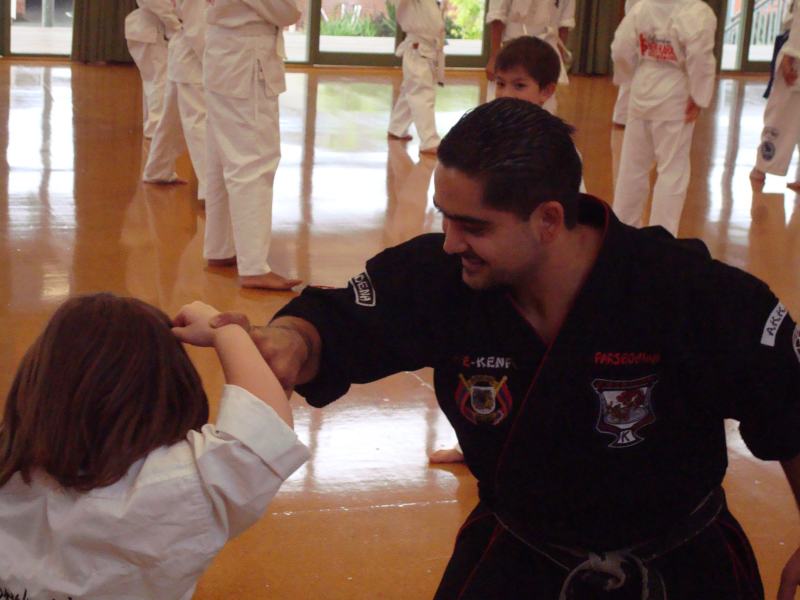
The Mike Montego series takes place in the early 1960s. Mike is a highly skilled kenpō martial artist. Not an unusual feat today, but a half-century ago, the cross-cultural (Ryukyuan, Chinese, and Japanese) self-defense system was relatively unheard of in the United States.

In the U.S., kenpō is often referred to as kenpo karate. The most widespread styles have their origins in the teachings of Great Grand Master James Mitose, who learned the kenpo art in Japan from his grandfather, Sakuhi Yoshida, and Professor William Kwai Sun Chow.

Professor “Willie” Chow trained in “kenpo jiu-jitsu” under Mitose. However, Chow called it Go-Shinjutsu, sometimes spelled Go-Shinjitsu.

The American east coast features a branch of kenpo created by Nick Cerio, and later built upon and redefined by Fredrick J. Villari. who brought the hybrid art of shaolin kempo karate to the general public through his nationwide network of “Villari’s Martial Arts Centers.” The Villari system integrated the strengths of American kenpo with the larger scope of movement and grappling available in shaolin kung fu and chin na, to create a highly unique American kenpo offshoot system.

Kenpo karate is, therefore, a distinct form of kenpo, although its techniques are virtually indistinguishable from Mitose’s kenpo jui-jitsu. The difference is mostly in the katas, or training routines. There were no katas in Chow’s kenpo karate, while kenpo jiu-jitsu has four katas: Nihanchi 1 and 2, the Bear Kata, and the Old Man Kata.

In the Montego series, Mike practices an Okinawan form of kenpō that focuses on empty handed/open-handed striking. His teacher, Yoshi Kono, a fictional Japanese master, learned the skill in his native Okinawa.

Mike Montego’s stories parallel the time when Edmund K. Parker, a student of Chow, was employing a blend of Chinese circular movements and hard linear movements to produce an effective self-defense system. He created techniques with names such as Thundering Hammers, Five Swords, Prance of the Tiger, and Flashing Mace to provide a memorization tool to his students.

Ed Parker, in early 1962, changed the style he had been teaching since 1956 in his “Kenpo Karate” studio in Pasadena, and renamed it “Chinese Kenpo,” dropping “karate” from the name of his system, even though he continued to issue belt certificates under the Kenpo Karate Association of America (KKAA), an organization he founded.

The practice by others of this distinct form of martial arts is not mentioned in the Mike Montego series for literary purposes.

For more information on kenpo, see Wikipedia, where one can find Will Tracy’s “The Origin of Kenpo Karate,” a fascinating history .

Run for it!

A participant in the LAPD’s Challenge Cup, Baker to Vegas Relay


NOTE FROM JESS WAID: Sergeant Alex Shearer, a good friend, now deceased, is the man the character Alex Strait is based on in my Mike Montego novels.

 Alex, who truly liked being called “Uncle Alex,” was a member of the LAPD’s long-distance running team that ran relays across the nation.

 In a letter to me dated March 22, 1994, Alex wrote the following:


It was early afternoon and I was getting ready for my leg when a squad car with three local deputies drove up. I soon learned that one of the deputies was going to “run a ways with me.”

         Now you know how I hate these unscheduled running partners, so I walked over to him. Bob Hickey was probably only 15 minutes away.

         The deputy was in full uniform, complete with Sam Brown and Smokey the Bear hat.

         I asked him, “You going to run with me?”

         “Yup.”

         “You going to wear that hat?”

         “Yup.”

         “What about the gun belt and gun?”

         “Yup.”

         My pissed-off point went up a notch or two.

         “You are going to change those cowboy boots, aren’t you?”

         “Nope.”

         That did it. This guy would rue the day he met me. He was about to undergo exquisite punishment.

         As Hickey and I made the baton exchange, I cranked along fast enough to let my fellow runner know that he had made a grievous error, but not fast enough to make him drop out.

         After a few hundred yards, my struggling companion removed his hat and threw it in the following squad car.

         I chuckled.

         A hundred yards farther on, off came the gun and gun belt.

         My floundering companion could not stop long enough to remove his cowboy boots. It must have been pure agony for him.

         I loved it!

         As we approached the town I decided the deputy had learned the folly of his ways and was ready to put it in gear and leave him to his blisters and misery.

         Starting to sprint off, I looked ahead and spied a fairly large number of the population had gathered along the street to watch. I figured they had come out to watch one of their locals run through town with a runner from the Big City.

         I don’t know whether it was because he was a fellow police officer, or I didn’t want to humiliate him in front of his fellow citizens, but I decided to drop back.

         We ran through the town together.

         Upon leaving the town folks behind us, he dropped off.

         I’ll never forget his last words, “Thanks for cutting me some slack.”

         I finished my leg with a good feeling. But I would probably have felt better if I had punished him a bit more.

         What nerve running with me in that outfit!


Played Misty for Me

This is a nicely done story, the real deal, by former LAPD cop and ex-sheriff of Jerome, Idaho, James D. Weaver. Enjoy!

West Los Angeles Division, Bel Air, 1980’s

I’ve just arrived for work when Officer Bob Stout, aka “Fatty,” the guy who coordinates all off duty cop jobs, approaches me. Bob tells me I am up for the next assignment. He maintains a list of officers who want to work off duty – the pay matches the LAPD’s hourly wage, and serves to keep the bill collectors off our backs. Having child support and numerous monthly payments to meet, thanks to my recent divorce, I gladly reply, “I’m your guy.”

“This job only became available because the vice guys are too busy,” Bob says.

He tells me I am to meet with the manager of a hotel who has a prostitution problem. Right there, Bob has gotten my attention. I’m used to high school dances, athletic events, and private parties, that sort of thing.

After filling out a Form 1.47 (Permit for Outside Employment), I call the hotel and am connected to a Mr. Checkers, the manager. I explain the reason for my call.

“I’d like to meet with you, ASAP,” Checkers says.

A short time later, I’m in his office. I sit on the opposite side of his fancy executive desk. As if I can’t tell already, he tells me that his hotel is high-end, very private, and extremely discreet. As part of their service, the concierge obliges those male guests who occasionally request a female companion to accompany them to business dinners, or simply to have a cocktail with.

Checkers says, “Jim let’s cut to the chase. Most of the ladies are high-class call girls.  You know—top of the line. We don’t get too bothered by it, as our policy is what happens here, stays here.”

He isn’t telling me anything I don’t already know. The hotel’s Bistro Lounge is home to the west-side “beautiful” people.

“Jim, one such lady, Misty, is stealing money, credit cards and jewelry from her ‘dates.’ Naturally, the guests she victimizes don’t want the police involved—the embarrassment, you know—and we prefer it that way, but she is posing a problem—risking the hotel’s reputation.”

Checkers leans forward, elbows on his desk.

“Bob Stout assured me he would send over someone like you, Jim, to work Misty—catch her with the goods, so to speak . . . and so, I went ahead and set up a date with her for next Friday night at 9 o’clock, here at the Bistro Lounge. I gave her the name Wally Woodstock. Misty told me she would be in a white dress, and would wear her red hair down over her shoulders. I told her which suite went along with the Woodstock name.”

Sitting back, he adds, “I’ve arranged to have a BMW in the garage for your disposal, should you need it, and I will provide you beforehand with $1,000 in marked bills—also, dinner reservations in the Lounge have been made under the name ‘Woodstock.’”

Checkers then says, “If you make the arrest, please be very discreet.”

“No problem, sir, but I will need a partner as a backup and witness.”

Checkers quickly agrees to pay for the second officer.

Later that day I meet with my long-time partner, Ron, and give him the scoop. He’s up for it, saying, “I’ve never been in the fancy joint.”

“Yeah right. OK, Ron, when I get the violation, I’ll say ‘fantastic,’” and then you bust on in. OK?”

He nods, his face forming a Cheshire cat grin. “I bet it will be, too.”

We review the legal elements needed for a violation of 647.B (Prostitution) in the California Penal Code—basically: naming the type of sex act, and hearing the offered price for said act.

Friday night, Ron and I arrive at the hotel, right on schedule. As expected, the suite is “top floor” quality. I hand Ron a key. Without having to say a word, I know he will watch my back and be ready for any problems. Even though he’s a carefree character, he knows how to take care of business.

We go down to the bar and take up our positions. The barroom is doing a good business, a place where guests relax while waiting for their table in the Lounge.

Around 9:15 pm, I spot the redhead, my date. Who wouldn’t? She jounces into the bar wearing a low-cut white dress, allowing her small breasts to rise visibly. Her hair hangs to the center of her back. Over her shoulders?

As she approaches the bar, several men’s eyes follow her sashaying hips.

I step up. “Misty?”

“Mr. Woodstock?”

“The one and only.”

I take her arm and lead her to my table. It’s set up for two. Candlelight flickers between us as our drinks are served. Soon, her leg is against mine. She also squeezes my hand.

“I’m sorry I’m late—you know how horrible LA traffic can be.” Her emerald-green eyes, twinkling from the golden flame, gaze at me longingly. “May I call you by your first name?”

“Sure . . . it’s Wally.”

“Wally . . . I like that. Well, Wally, I promise I will make it up to you.”

Casually, I scan the bar. Ron holds his favorite drink, a Glenlivet, neat. Typical Ron, he’s jawboning with a busty cocktail waitress.

After several vodka-and-Seven’s, the maitre d’ escorts Misty and me to our table in the dimly lit Bistro Lounge. I have to agree with what I’d heard: it is an ideal place for a rendezvous like the one we’re supposedly having.

Once seated, Misty again presses her leg next to mine. Her tongue peeks over her ruby lips, moistening them as she bends slightly toward me, enough to give me an eyeful of milky breasts, a smile on her made-up face.

She orders a lobster; I smile and do the same. I also order a bottle of Dom Pérignon.  We chat about what is going on in our lives over dinner. During dessert, Misty gets down to business.

“Wally . . . I think I’d like to have an after-dinner drink.” Her tone is questioning.

“I would like that,” I quickly say, admittedly feeling a rise in my groin.

“Wally . . . I like you. Would you mind if we had it in your room?”

As we walk out of the Lounge, I look for Ron. He’s nowhere in sight. I should be concerned, but I’m not. The drinks, the mood of the evening, and my groin have me feeling no pain. It’s about show time. I must focus on the bust—not hers, Jimbo! 

We enter the suite and I immediately ring room service for another bottle of Dom. Misty is sashaying in front of me, giving me a seductive stare. Thankfully, the bellhop soon knocks at the door. After he wheels in the cart with the bottle settled in a bucket of ice, I ask him to open the champagne. He does, and fills two glass flutes. I tip him and he departs.

Simultaneously, Misty throws her arms around me, blows in my ear, nibbles my earlobe, and kisses my neck. I’m getting tumescent.

Things are moving way too fast.

I quickly untangle myself. “Let me wash up, hon—enjoy your Dom.”

When I return she is on the sofa, down to her pink underwear and lying on her side. One of the best bodies I have ever seen.

“Come and get it cowboy,” she purrs then empties her stem glass.

Having no vice experience, I only know I need to get a violation. But she hasn’t even hinted about wanting money. I can’t expose myself, especially not with a hard-on—then she saves my ass.

“But first, cowboy, it’ll cost you $500 for a half-and-half (street vernacular for a blowjob and a straight lay.)

Sighing in relief, I say, “OK, lady—but first, let me see that fine body of yours.”

Misty eyes the swelling in my crotch, and quickly slips out of her bra and panties.

“Misty, you’re fantastic,” I say loudly with my head facing toward the hallway door.

I stand stupidly waiting for Ron to bust into the suite.

No Ron.

I repeat, even more loudly, “yeah, you’re really fantastic!”

I hear a scraping noise at the door, then a banging.

Misty sits up, obviously startled.

Ron staggers in and shouts, “Los Angeles Police, you’re unner arrest.” His words are slurred.

Misty immediately puts on the sob scene, like she’s been here before. “Can’t we work something out?”

I read Misty her legal rights.

“I got nothin’ to say to you fuckin’ assholes,” she spits out.

I landline Dispatch, and request a radio car to transport her to the West Los Angeles Station.

Later, while completing the necessary reports, Ron joins me.

“Misty just beat us back to the streets, pardner—she made bail.”

“Sorry I’m so slow.” Ron knows that report writing isn’t my favorite piece of police work.

“No problemo. I’m heading out, Jimbo—see you at Westside Frank’s for a nightcap.”

“OK, give me thirty.”

Arriving at Frank’s, a cop bar, I see Ron sitting with Fatty Bob. Feeling magnanimous, I announce, “I’m buying gents.”

I open my calfskin wallet to pay for the round.

“Oh shit!”

Mexican Train

Not this.


This.


Mexican Train.

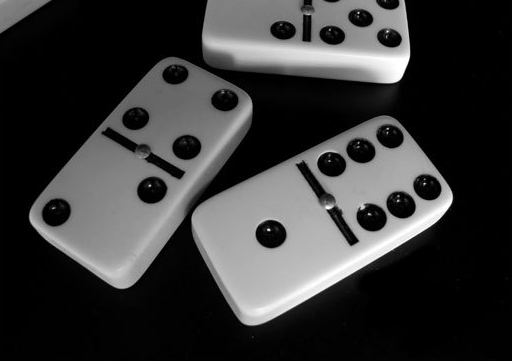
You might think I am referring to a locomotive that rattles noisily down steel tracks somewhere in Mexico. Well, I am not. I am talking about a popular board game using dominoes that I discovered through friends.

A year ago or so, when in Mexico, Tom and Dee Grant, along with another couple, Don and Leslie, introduced my wife, Barbara, and I to the game. I forgot about the fun event until our last visit to the Grant’s home. That evening we again played Mexican Train, but with another couple as Don and Leslie weren’t available.

During the game, funny little things occurred that brought chuckles. Soon the double entendres were flying. I laughed until my eyes were blurry. The game went on for five hours. Barbara won. She’s a games person.

Anyway, when we returned to our home in Oregon, I decided to buy the game. Fearlessly, I went online and found www.mexicantrainfun.com.

Wow! Check out the website and you will see why it nearly blew my mind. It’s not exactly the slickest website in the world, but boy is it ever filled with, well, content. I thought I’d find a simple game featured here — you know, a box full of dominoes,  the other necessary pieces, and some simple instructions. Wrong. Instead, I was faced with a a long list of choices.

First, which set did I want? here were five options: a Double 6 with threes and fives (the number of pips on a tile), the most popular size, along with a Double 9, a Double 12 with 91 dominoes with the tile pips ranging from blank (0) to 12, a Double 15 with 136 dominoes ranging from 0 to 15, and a Double 18 featuring 190 dominoes, with the tile numbers ranging from 0 to 18. This one allows you to play more complicated games.

The website features a video to help you see the games and the colors on the various sets. In addition to dominoes with pips, they’re also available  with numbers (makes ‘em easier to read). There are various racks and trays (wood or plastic), a rules and strategy book, tournaments to sign up for, and domino clubs to join. There’s even a blog site for players’ comments.

For example, a question was posed on the site about a player announcing that he wanted to “go out” on a double (a tile with the same number of pips on each half), but not having a tile to answer it. The rules were checked, and seeing a name of a recognized expert on the game they called her. Her response was that you must answer a double to go out. This changes the strategy of the game a great deal, since you should try to hold a tile that coordinates with a double, or be sure to play a double earlier if it doesn’t match anything in your hand so you can go out, or, if it is a low double, hang onto it to the end because it will be low points in your hand. Get it?!

You are wondering why I don’t explain the above in greater, more lucid detail, it’s because I really can’t, at least not yet. I am still a novice. Like I’ve said, I’ve only played the game twice. I’m not Barbara!

I have learned one important detail, however. It turns out that the owner of the premises where the game is being played is the final arbiter in all disputes. It might pay to host the game.

What’s available on the website doesn’t stop there. They sell train markers, a set of eight that come in solid colors or with glitter, or a Double 6 with black dots and brass spinners (don’t ask). You can buy a container (case) in vinyl, tin, wood, or aluminum, and carry it in a tote bag with a Mexican Train logo. Ot how about a yard sign for advertising that Mexican Train is being played at your place tonight?

They sell train hubs in clear plastic, or wood hubs for six or eight players. Some sets have train hubs that come with sounds. Even chicken sounds! And why not also get yourself a set of 10 colored chicken markers while you’re at it? Or there’s always the interactive yellow hub with chicken-foot and train graphics and sounds. Simply push “train sound” when you start a train, or “chicken crow” when you start a double (again, don’t ask!).

There are attractive red caboose pencil sharpeners, dominoes with jumbo sized pips or numbers, even a spiffy, four-fold domino tabletop. There are large train markers, the Mexican Train whistle key chain, and, best of all, a large glass train in a silver gift box. And of course you have to have scorecards, and an official train pen.

It’s apparently highly recommended that you cover your game table with felt. It makes for quieter play, and the tiles slide more easily. Also, since dominoes pick up dirt from table surfaces, people’s hands, food, and drink, over time they become dirty. You guessed it. The site offers cleaning remedy suggestions.

Being a party animal, I decided I wanted to be able to play with eight players, so I opted for the professional-sized Double 15. Hey, it was on sale, at a whopping 19% discount. I saved $16. Plus, bonus, it came with a faux cowhide Leatherette case with a snap closure. And the train hub is interactive. You know, with those funny chicken sounds.

I stopped short of purchasing the game night lawn sign. I like to think that shows a certain steely sort of masculine will and determination.

On the other hand, it could simply be because I don’t have a lawn.