It was a cold Saturday night in November, My partner Larry Gardner and I were enjoying a cup of coffee and donuts at “Arnie’s,” located at Santa Monica Boulevard and Bundy Drive. I was listening to “Walk of Life” coming from the vehicle parked next to us. The blonde driver was flirting with Larry; business as usual for him.
“Eight-Adam-three, thirteen, and twenty-one meet Eight-L-Twenty at Sunset and Bel Air Road, Code two.”
“Larry, listen up, we just got a call.”
We knew it must be serious as two other units were dispatched to Twenty’s location besides us. Without saying a word we emptied our coffees on the pavement.
Kicking over the V8, I accelerated out of the parking lot and sped to the meeting place. A few minutes later we pulled into the parking lot next to 8-L-20 Sergeant Jesse Escobar.
Escobar climbed out of his Black and White, as usual his hair was perfectly styled, his uniform looked like it’d just been pressed, his two-toned badge gleamed, and his black shoes shone like glass, even under the dim overhead light. I’d known Escobar for several years; he was known as a policeman’s sergeant. We were lucky to have him. as the three-striper was going up the LAPD ladder.
Shortly, we were joined by the two other assigned units.
“Guys we have a real situation. so pay attention.” The sergeant laid out a hand-drawn map of a residence located at 2 Benedict Canyon Drive.
“We recently received information that a possible shooting occurred at that location, we’ve got nothing more. So let’s get over there and have a look. We’ll park farther down the street and move in on foot. Turn your radios and headlights off before we get there. Any questions?”
As we followed Sergeant Escobar’s black-and-white station wagon, we were silent, lost in our own thoughts. I wondered what we would run into. I had a real uneasy feeling about this one.
When we parked in tandem and were on foot, Escobar once again pulled out the map. Using his flashlight, he ordered the others to the four corners of the house.
Why did he leave me out?
Escobar then focused on me. “You and I will take the house.”
After the other officers were in position, Escobar said in a low voice, “Let’s do it, Jim.”
We quietly moved to the rear of the house, where a light could be seen. A closer look determined it came from a laundry room hallway.
Sergeant Escobar tried the screen door. Unlocked.
I followed as he crept cautiously down the dimly lit hallway, past the laundry room and toward a room where the light was bright. It was the kitchen.
Escobar peered into the kitchen and then he looked back at me. He held up one finger and then pointed it down.
I knew that meant one down. Escobar stepped into the kitchen. I followed on his heels. I spotted the lifeles,s half-open eyes of a female staring up at me. The dead woman was lying in a huge pool of blood that almost covered the entire tile floor. I could clearly see powder burns on her bare breasts and stomach.
Quickly looking about, I could see blood all over the kitchen walls, ceiling, refrigerator, stove, and cabinets.
I stepped over her and felt my shoe soles picking up a sticky substance. Blood.
I spied Escobar in the living room hand motioning for me to go to the left as he was going to the right.
OK, I signaled back with a head nod.
He disappeared into the darkened next room.
I slowly moved down the partially lit hallway. Almost immediately, I spotted a body lying in the middle of the hallway ahead of me. As I approached I could now see it was another female. One half-open lifeless eye stared into space. A contact wound had blown out her left eye.
I stepped over her body, wondering what the hell was next?
Seeing a lighted room ahead, I crept forward and peeked around the open doorway. I saw a leatherette recliner chair with a human arm hanging over the side facing me.
I eased up to the chair and gave it a swift kick to surprise whoever was seated on it.
The chair swiveled to the left, and a male slumped forward and onto the floor. His clothed body ended up on his knees as if he was praying. A large collection of coagulated blood stained his back. It appeared to be an exit wound from a large caliber firearm.
I was startled when Escobar, in a calm voice said, “The rest of the house is clear. Looks like we will need the detectives for this one,” he continued.
He went outside and released the other two units.
My partner and I secured the scene. Several hours later the detectives arrived and began their investigation.
The coroner’s deputies later drove up. After they scanned the scene, they took the bodies and transported them downtown to the Coroner’s office. They would join other corpses awaiting autopsies.
Released from the scene I turned to Larry. “Hey pard, we still have time for Code Seven before EOW. (End-of-Watch.)”
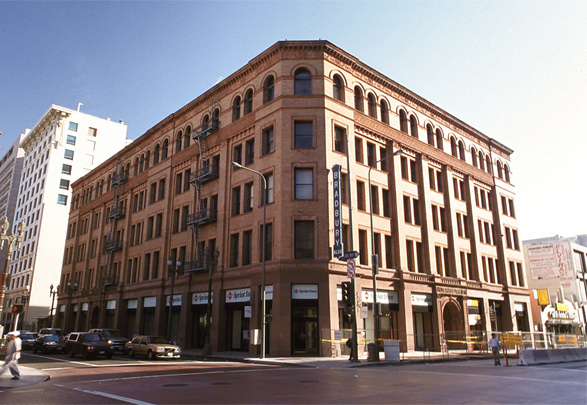
The Bradbury Building is an architectural landmark in downtown Los Angeles, California. Built in 1893, the building was commissioned by LA mining millionaire Lewis L. Bradbury and designed by local draftsman George Wyman.
It is located at 304 South Broadway and 3rd Street, and has been the site of many movie and television shoots, rock videos, and works of fiction. It’s the location of the office of Eagon Quinn, a character in my Mike Montego novels, set in 1960’s Los Angeles.
Lewis L. Bradbury (November 6, 1823–July 15, 1892) was a mining millionaire – he owned a mine named Tajo in Sinaloa, Mexico – who became a real estate developer in the latter part of his life. He planned in 1892 to construct a five story building at Broadway and Third Street in Los Angeles, close to the Bunker Hill neighborhood.
A local architect, Sumner Hunt, was first hired to complete a design for the building, but Bradbury dismissed Hunt’s plans as inadequate to the grandeur of his vision. He then hired George Wyman, one of Hunt’s draftsmen, to design the building.
Wyman at first refused the offer, but then supposedly had a ghostly talk with his brother Mark Wyman (who had died six years previously), while using a planchette board with his wife. The ghost’s message supposedly said “Mark Wyman / take the / Bradbury building / and you will be / successful” with the word “successful” written upside down. After the episode, Wyman took the job, and is now regarded as the architect of the Bradbury Building. Wyman’s grandson, the science fiction publisher Forrest J. Ackerman, owned the original document containing the message until his death. Coincidentally, Ackerman was a close friend of science fiction author Ray Bradbury.
Wyman was especially influenced in constructing the building by the 1887 science fiction book Looking Backward by Edward Bellamy, which described a utopian society in 2000.
In Bellamy’s book, the average commercial building was described as a “vast hall full of light, received not alone from the windows on all sides, but from the dome, the point of which was a hundred feet above … The walls and ceiling were frescoed in mellow tints, calculated to soften without absorbing the light which flooded the interior.” This description greatly influenced the Bradbury Building.
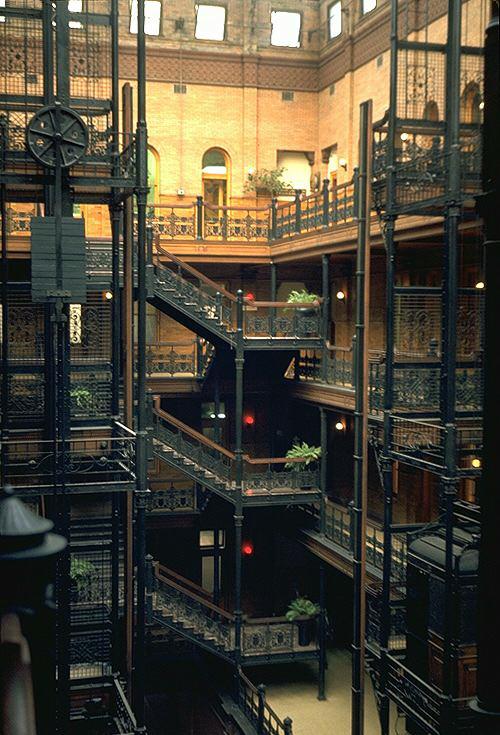
A Bradbury Building interior
A restoration and seismic retrofitting was undertaken by developer Ira Yellin and project architect Brenda Levin Associates in 1991. As part of the restoration, a storage area at the south end of the building was converted to a new rear entrance portico, connecting the building more directly to Biddy Mason Park and the adjacent Broadway Spring Center parking garage. The building’s lighting system was also redesigned, bringing in alabaster wall sconces from Spain.
The building features an Italian Renaissance Revival -style exterior façade of brown brick, sandstone and panels of terra cotta details, in the “commercial Romanesque Revival” that was the current idiom in East Coast American cities. But the magnificence of the building is the interior: reached through the entrance, with its low ceiling and minimal light, it opens into a bright naturally lit great center court.
Robert Forster, star of the TV series Banyon that used the building for his office, described it as “one of the great interiors of L.A. Outside it doesn’t look like much, but when you walk inside, suddenly you’re back a hundred and twenty years.”
The five-story central court features glazed brick, ornamental cast iron, tiling, rich marble, and polished wood, capped by a skylight that allows the court to be flooded with natural rather than artificial light, creating ever-changing shadows and accents during the day.
Cage elevators surrounded by wrought-iron grillwork go up to the fifth floor.
Geometric patterned staircases and wrought-iron railings are used abundantly throughout. The wrought iron was created in France and displayed at the Chicago World’s Fair before being installed in the building. Freestanding mail-chutes also feature ironwork.
The walls are made of pale glazed brick. The marble used in the staircase was imported from Belgium, and the floors are Mexican tiles.
During construction an active spring was found beneath the work-site, posing a threat to ongoing work on the building by weakening the foundation. However, Mr. Bradbury was very committed to the project, which he believed to be the greatest monument possible to his memory. Consequently, he imported massive steel rails from Europe to bolster the building and allow its construction to continue.
The initial estimate for the construction of the building was $175,000, but the final cost at completion was over $500,000—an extremely large amount for those times. Using the GDP Deflator method, this amount translates to more than $11 million in 2008 dollars.
Lewis Bradbury died months before the building opened in 1893, although it stands as a testament to his and George Wyman’s vision.
The building has operated as an office building for most of its history. It was purchased by Ira Yellin in the early 1980s, and remodeled in the 1990s. It was designated a National Historic Landmark in 1977.
The building has served as headquarters for the Los Angeles Police Department’s Internal Affairs division and currently is used by other government agencies. Several of the offices are rented out to private concerns, including Red Line Tours. The retail spaces on the first floor currently house Ross Cutlery (where O.J. Simpson purchased a stiletto that figured in his murder trial), a Subway sandwich restaurant, a Sprint cell phone store, and a real estate sales office for loft conversions in other nearby historic buildings.
The building is a popular tourist attraction. Visitors are welcome daily and greeted by a government worker who provides historical facts and information about the building. Visitors are allowed up to the first landing but not past it. Brochures and tours are also available. It is close to three other downtown Los Angeles Landmarks: the Grand Central Market and the Million Dollar Theater (across the street) and Angels Flight (two blocks away). The building is accessible from the Los Angeles MTA Red Line via the Civic Center exit three blocks distant.
The Bradbury Building is featured prominently as the setting in films, television, and literature – particularly in the science fiction genre. Most notably, the building is the setting for both the climactic rooftop scene of Blade Runner (1982), as well as the set of the character J. F. Sebastian’s apartment in which much of the film’s story unfolds.
The Bradbury Building appeared prominently in the noir films D.O.A.’(1950) and I, The Jury (1953). M (1951), a remake of the German film, contains a long search sequence filmed in the building, and a spectacular shot through the roof’s skylight. The five-story atrium also substituted for the interior of the seedy skid row hotel depicted in the climax of Good Neighbor Sam (1964), supposedly set in San Francisco but almost entirely shot in Los Angeles.
The Bradbury Building is also featured in The White Cliffs of Dover (1944), The Indestructible Man (1956), Caprice (1967), Marlowe (1969), the 1972 made-for-television movie The Night Strangler, Chinatown (1974), The Cheap Detective (1978), Avenging Angel (1985), Murphy’s Law (1986), The Dreamer of Oz (1990 TV movie), 1994’s Wolf and Disclosure, Lethal Weapon 4 (1998), Pay It Forward (2000), (500) Days of Summer (2009), and The Artist (2011).
Television series that featured the building include the 1964 The Outer Limits episode “Demon with a Glass Hand.” During the season six episodes (1963–64) of the series 77 Sunset Strip, the Stuart “Stu” Bailey character had his office in the Bradbury. In Quantum Leap the building is seen carrying the name “Gotham Towers” in Play It Again, Seymour, the last episode of the first season (1989). The building appeared in at least one episode of the television series Banyon (1972–73), City of Angels (1976) and Mission: Impossible (1966–73), as well as in the “Ned and Chuck’s Apartment” episode of Pushing Daisies, which debuted in 2007. The building was also the setting for a scene from the series FlashForward in the episode “Let No Man Put Asunder.” In 2010 the building was transplanted to New York City for a two-part episode of CSI NY. The Bradbury Building and a fake New York City subway entrance across the street were also used to represent the exterior of New York’s High School for the Performing Arts in the opening credits of the television series Fame.
The Bradbury appeared in music videos from the 1980s by Heart, Janet Jackson, Earth Wind and Fire and Genesis, and a Pontiac Pursuit commercial. Part of Janet Jackson’s 1989 film short Janet Jackson’s Rhythm Nation 1814 was filmed in the building as well. The interior appears in the music video for the Pointer Sisters’ 1980 song, “He’s So Shy.” The Bradbury Building was also used for Tony! Toni! Toné!’s “Let’s Get Down” music video.
The building was featured in the photography on the Microsoft Office SharePoint Portal Server 2003 box, while the personal computer game SimCity 3000 shows the building as one of many built in the so-called Medium Commercial zones.
The Bradbury has been frequently alluded to in popular literature. In Gravity’s Rainbow by Thomas Pynchon, the protagonist refers to Philip Marlowe, who would “feel homesick for the lacework balconies of the Bradbury Building.” In the Star Trek novel The Case of the Colonist’s Corpse: A Sam Cogley Mystery, the protagonist works from the Bradbury Building four hundred years in the future. Other allusions occur in The Man With The Golden Torc by Simon R. Green, and the science fiction multiple novel series The World Of Tiers by Philip Jose Farmer.
DC Comics and Marvel Comics – the latter of which has offices in the real Bradbury Building – both published comic book series based on characters that work in the historic landmark. The building serves as the headquarters for the Marvel Comics team The Order, and in the DC universe, the Human Target runs his private investigation agency from the building.
Located at 877 South Figuroa, the Pantry is a favorite eating spot for retired Homicide Detective, Eagon Quinn, who practices law out of the Bradbury Building on South Broadway, a character in my Mike Montego novels.
Hello folks. My nom de plume is Jess Waid. My hobby in retirement is novel writing. Currently, I am penning my fourth book, a police story. No, I am not a best seller, perhaps because I don’t have the gumption to go out and be a peddler. Did you know there are 22 million books being published each year? That’s a far cry from the 12,000 a decade ago. Of course, thanks to the Internet, most are Print-on-Demand, self-published works that shouldn’t see the light of day. Then there is the Fifty Shades of Grey exception. Whatever.
I mention this only because cheery Karen McConnaughey, apparently thinking I might be able to entertain you by describing my experience traveling from the southern coast of Oregon to Ajijic, Mexico, had no idea what she was unleashing. Actually, I think she expects what I have to say to be informative, perhaps helpful to future travelers. We shall see.
OK, here I go. Having reached my so-called “Golden Years” well ahead of my wife, Barbara, I commenced upon a search for a final place to retire. I sought a location somewhere on this planet that would be kinder to my aging joints than the blustery coast where I’d spent the past ten years. Before that, it was a dozen years on the shore of Lake Pend Oreille, in northern Idaho. Brrr.
When I discovered the Focus on Mexico website, I was intrigued. The year was 2009. That September, Barbara and I participated in their excellent eight-day seminar package, extending our stay several days because we liked the area so well. Soon, we decided that living lakeside in Ajijic was what we wanted to do. The temperate climate, the large lake, the terrain, and the warmth of the Mexican people convinced us.
The malecon, Lake Chapala, Ajijic
Like most reasonable people, we tried to plan for everything well ahead of our departure date. Before we left Ajijic on that first visit with Focus, we started the process for IMSS coverage, and eventually got our FM3s. Fortunately that occurred before the rules changed. Recently Julie Vargas, our pretty and capable facilitator, advised us that new regulations now require us to change to an FM2 status. But then you likely know that. Hey, this is Mexico.
Folks, I don’t handle major moves well. I believe it has to do with not having had a stable home life as a youngster. So be it. Still, I told myself to take on the transplanting process one final time. I’ve got to say it has been quite an adjustment; one I am still dealing with; one I do not expect to repeat.
OK, on to our move to Mexico.
While in Oregon, Barbara was tasked with getting our personal house in order: bank accounts, utility, telephone/TV service bills for the house, etc., and getting our bookkeeper set up to handle the payroll account for our Mexican restaurant business in Brookings, Oregon.
My assignment was to set about ensuring that our unsold beachfront house and restaurant would be properly maintained; also, that the house-sitter, Maryjane, a talented artist, was up to snuff on the little things that continuously happen to buildings on the coast, due to the salt-laden and blustery air.
FYI, when the house sells, we will have an estate sale, and the big items we wish to keep will be packed, hauled and stored by Strom-White Movers to our Ajijic home.
What vehicle to use for the trip? After much discussion, we decided to keep our 2001 Silverado 1500 model, with its enclosed camper shell. It only had 86,000 miles on it, and best of all, it allowed us to bring down our computers, printers, and sundry personal items. We couldn’t see subjecting a newer vehicle to the narrow cobblestone passages and topes of Ajijic. Nevertheless, for my tummy comfort, I purchased new black wheels (the latest fad) and new tires. I had the pickup gone through completely, fitting it with new spark plugs, ignition wires, hoses, brake assemblies, wiper blades, a thorough cleaning, and a rust-preventive painting of the undercarriage.
Not exactly our vehicle, but here’s a 2001 Silverado 1500
I should mention that earlier, in a Guadalajara paper, we noticed an advertisement for legalizing vehicles for Mexico. Deciding that was a good idea, I contacted Bella Flores Exports in Riverside, California. The owner, David Flores, assured me he could take care of our needs. As one might expect, we had some concerns and questions that, hopefully, his answers would satisfy. That meant a lot of phone tag during the subsequent weeks, a bit frustrating, especially the time when we were told he’d call us back the next day and no call came. We later learned that he was in France negotiating a deal with Fiat and Renault to import cars into Mexico, much cheaper than bringing them in from the States, he informed me.
Anyway, when Flores claimed he could legalize our truck for Mexico for $1100 as opposed to the $3,000 it would cost if we did it after arriving in Ajiic, we said OK. Then he explained that our Chevy pickup had to be empty. That meant unloading it at daughter DeDe’s hilltop home in Jamul, California, 128 mostly freeway miles south of Bella Flores. We had no choice but to do so.
Meanwhile, we sent him the original pink slip for the Silverado, along with copies of our Oregon insurance papers, our drivers’ licenses, and a utility bill from our future home in Ajijic proving our Mexican residence. This all occurred weeks in advance of our planned departure date. It was during this period that the phone tag took place.
Per Flores’ instructions, we delivered our empty truck to the Riverside address on a Wednesday afternoon, only to find his office closed. Numerous other businesses were located in the building, so I talked to the receptionist in the downstairs lobby, and she contacted him by phone. Fifteen or so minutes later, Flores’ assistant arrived. The man was pleasant but had no specific answers to my questions. So my daughter and I waited another ten minutes for his boss’ arrival.
When Flores showed up, he had his assistant examine our truck while Flores filled out some papers. He asked me what the amount of the fee was that he’d quoted to me on the phone. I told him $1,100. He gave me a look of doubt, and pulled out a sheet of paper with figures for different types of vehicles. The fee for my truck was $1,600. He apologized for any misunderstanding, and said he would waive the $150 he normally charged for his personal services, whatever that meant. I thanked him.
Already committed to the process, I signed the agreement. Then he told me how fortunate I was, as Mexican federal law required all vehicles to be “smog certified,” but that it was the individual Mexican state’s prerogative whether or not to require the certification. He said that Jalisco had decided to adopt the federal smog law on January 1st and that meant registered owners, many of whom he suggested would be caught unaware, would have to bring their vehicles up to standard at a cost of around $500. I thought the difference between $1,100 and 1,600 I was paying very interesting.
Next, he told me I could retrieve my Chevy pickup on Friday at 6 o’clock.
On that day, DeDe drove me to Riverside early to avoid the expected heavy traffic. We arrived in town at 3 o’clock. Thankfully, the weather was pleasant because we found ourselves waiting outside the Bella Flores office well into the dark hours, when my pickup was finally delivered. Flores had called earlier and said his hauler was delayed at the border. In a subsequent call around 7 o’clock, he said they were only 30 minutes away as they were in Colton, a nearby town. Actually, it was 90 minutes later.
Apparently, the actual reason for the delay was something else. In retrospect I think I know why, because later, Flores said the camper shell, considered an accessory, meant there would be duty fees attached. I remember when we dropped off the truck, the assistant checked it over for damages, et cetera. It is reasonable that he told Flores about the shell. So, did Flores, for whatever reason, wish to avoid the extra fee, and have the shell removed and stored in Colton before hauling it to the border for the legalizing process? I think so. Likely the delay was because they were remounting the shell.
At this point I must jump to the present. Several days ago we met with Julie Vargas at her “satellite office” at the Chapala de Real Hotel. The purpose was to ensure there would be no problem picking up our Jalisco license plates for the Chevy truck. Boy, was I glad we did. Julie said there were several steps that had to be gone through, including getting a letter from the police clearing our vehicle, and then going to Guadalajara at 5:30 a.m., likely standing in line indefinitely, and signing papers and paying a fee. Gloria is handling all of that for us. Yes, more pesos left my wallet, but soon we will have our truck properly legalized. I don’t know why David Flores didn’t advise us about the subsequent steps and fees that would be required.
OK, back to our move to Mexico.
Early Saturday morning found DeDe, Barbara and me loading the truck, getting all of our stuff stashed securely. It took us a good hour. Yes, the warm weather had me swiping at my wet forehead.
Guess what? When I tried to close the rear hatch, it wouldn’t seal. More sweat beads dripped from me when I discovered why.
The camper shell was skewed nearly two inches forward on the truck’s bedsides. Obviously, it had been reset on the bed in the nighttime hours, and likely in a hurry. To get to the mounting bolts meant unloading the bed. That wasn’t about to happen.
DeDe gave me three bungee cords to keep the shell’s rear lid shut while in transit.
Securing the lid was a security issue and a minor inconvenience on our nightly stops, when I had to unload dog crates and food bowls. Oh, guess I forgot to mention that we brought along our three small dogs: Beau, a 10 year-old six pound Papillon; Teri, a 10 year-old 14 pound Papillon mix; and, Chico, a two year-old 16 pound Schnoodle (papa a Poodle/,mama a Schnauzer).
A last comment about the truck situation: when we unloaded it in Ajijic, I discovered that the brake light wires to the shell had not been reconnected, so the added safety feature was missing during the drive. Not critical; we did have the regular taillights that worked.
Had Flores told me about the shell being lifted off, however, I would have checked to see that it was mounted properly. I’d gone through the process before we left Brookings when I’d removed the shell to repaint the truck bed. I knew it had to be squarely mounted to ensure the rear lid would seal. Ah well.
When we left Jamul, we headed for Camp Verde, Arizona to pick up our new pet, a nine-week-old Doberman Pinscher with ears freshly cropped. Ouch! I found Thor online when we decided, because of all the horror stories about bad guys in Mexico, that we should have a dog specially bred for protection. What attracted us to the Arizona breeder was the size of their dogs. Thor is expected to reach 30 inches at the shoulders and weigh close to 130 pounds. I recently invested in a grain shovel.
Our four-legged security system, Thor, at four weeks
We spent the next night, Sunday, our first with four dogs, in Rio Rico, a small town 14 miles north of the border. It was a lovely, pet friendly hotel. Barbara had spent much time searching out such inns along our planned route. What had made it difficult was her not knowing what nights we would be arriving where, due to the phone tags with Flores and being unable to learn the exact date for delivery/pick up of the truck until we were already heading south. It’s a two-day drive to Riverside from Oregon.
In fact, Barbara spent hours online searching pet-friendly websites, like bringfido.com, gringodogs.com, and others including hotels.com. What she found was all of them were out of date, and their website information inaccurate. For instance, when she contacted the listed hotels in Guaymas, she was told they didn’t accept pets.
Go figure.
Obviously, this entailed changing our planned itinerary once we crossed the border.
Our advice: contact the hotels directly to ensure accurate information if you intend to bring your pets. I suspect they have different rules for high and low seasons. Barbara finally called a number listed on a website for a hotel and got hotels.com. She had the representative actually call the hotels in Los Mochis and Mazatlan to make sure that they were in fact pet friendly. Our stays in both locations were as pleasant as one might expect, having four dogs to contend with, one a puppy that wasn’t about to be left alone.
Our biggest surprise, a pleasant one at that, was the actual crossing of the border. We had all our paperwork in hand ready to show to the authorities. As we wheeled up to the guard kiosks and observed the dark-clad troops with their automatic weapons slung from their shoulders, I prepared myself mentally for the unknown. I envisioned getting the scary red light, then unloading the truck, and showing proof of ownership papers for the dogs, their shot records indicating they’d been properly inoculated within the past ten days, and that nine-week old Thor was three months old (the information about dogs needing to be three months old was confusing. As a precaution, the “dobie” people had pre-dated Thor’s whelping date).
Perhaps it was the holographic decal in the upper right corner of the windshield or maybe our rather non-descript and tightly loaded truck, but they merely glanced at us as the green light flashed. Our travails with Bella Flores had been worthwhile.
We were waved through!
A, the charm of crossing the USA-Mexico border.
Not convinced of our good fortune, I drove several kilometers, continuously checking the side-view mirrors for the policia and the federales before I accepted reality and found my breathing returning to normal.
Because of the pet-friendly hotel fiasco (finding a place to stay), the day we drove to Los Mochis found us riding along for nine plus hours. I had planned to be on the road for a maximum five hours because of the dogs. Thankfully, our pets put up with the rather cramped space on a blanket laid over suitcases behind us. We kept the extended cab’s rear and side windows open along with the AC fan for the entire trip
We used only the toll roads when available—one glimpse of the free (libramiento) roads quickly had us shelling out the pesos at the tollbooths. The fees varied at each one, and I gave up trying to reason why. All of the attendants were pleasant.
The route south was easy to follow, until we left Mazatlan. Ongoing roadwork had me missing the dirt transition lane (poor signage, plus I was behind a dump truck and couldn’t see the road ahead very well) to the toll road. We ended up in Concordia about half a marathon’s distance east of Mazatlan. It was a fringe benefit for me, as the small town, noted for its furniture makers, many of them of French descent, is where my father was born in 1911.
A bit of traffic in Guadalajara
The downside of the scenic detour was it used up a critical hour, as I had planned to arrive in Guadalajara before the peak traffic hour. We hit it at five o’clock.
The Oldsmobile Starfire was an automobile produced by the Oldsmobile division of General Motors in two generations from 1961 to 1966, and 1975 to 1980. The Starfire nameplate was also used for the 1954–1956 Ninety- Eight series convertibles, and all 1957 Ninety-Eight series models. 1961 was the first year for the Starfire as a separate model, available in a single convertible body style. The Starfire competed in the growing personal-luxury car market as was typified by the 4-passenger Ford Thunderbird first introduced for the 1958 model year. However, the Starfire shared most of its sheet metal with other models, and was considered part of the full-sized Oldsmobile line. The Starfire Hardtop Coupe joined the convertible for the 1962 model year. The convertible was dropped for the final 1966 model year, moving to the Eighty-Eight model line. The Starfire returned as Oldsmobile’s first subcompact car for the 1975 model year, featuring a V6 engine supplied by Buick. The 1977 Starfire featured the first-ever Oldsmobile four-cylinder engine as standard equipment, with the V6, and a V8 engine optional.
A ’62 Starfire

The 1962 Starfire was distinguished from other Oldsmobile models by its unique aluminum trim, chrome engine dressing, and space age interior, featuring bucket seats, a center console, and a then-cutting edge console mounted shifter.
The Starfire was equipped with a 345 horsepower 394 cubic-inch V-8 and automatic transmission.
The Starfire name was first used by Oldsmobile on a one-of-a-kind dream car that was shown at the 1953 Motorama auto show. Named after a Lockheed jet fighter plane, namely the F-94, the original Starfire was a 5-passenger convertible that had a fiberglass body, a 200 hp (150 kW) Rocket V8 engine, and a wraparound windshield like that used on the top-of-the-line and limited-production 1953 Fiesta 98 convertible.
The name was then used for the 1954–1956 model years to designate the convertible models of the 98 line in much the same way that the Holiday name was used to designate hardtop body-styles. The 1954–1956 Oldsmobile 98 Starfire convertibles were the most expensive Oldsmobiles offered during those years. During the 1957 model year, all 98 models were referred to as being Starfire 98s. The name was dropped from the 98 series beginning with the 1958 model year.
From a 1961 Starfire brochure
Introduced in January 1961 as a convertible, the first Starfire shared its body and wheelbase with the Super 88 and the lower-priced Dynamic 88. It was loaded with standard equipment including leather bucket seats, center console with tachometer and floor shifter for the Hydra-matic transmission, and was the first U.S. full-sized production car to feature an automatic transmission with a console-mounted floor shifter, brushed aluminum side panels and power steering, brakes, windows and driver’s seat. With a base price of $4,647 in 1961, it was the most expensive Oldsmobile, even more than the larger Ninety-Eight models. The standard 394 cubic inch V-8 Skyrocket V8 engine – Oldsmobile’s most powerful in 1961 – used a 4-barrel Rochester carburetor and generated 330 hp (246 kW) at 4600 rpm. Sales of the 1961 model were 7,800.
For the 1962 model year, the convertible was joined by a two-door hardtop, which featured a new convertible roofline shared with other Olds 88 coupes. Horsepower was up to 345 hp (257 kW). 1962 was the best sales year for the first generation Starfire with sales of the hardtop coupe being 34,839 and sales of the convertible being 7,149.
Styling changes for the 1963 model year included a move away from the sculpted sides of the previous years model, to a flatter, more conventional look with an exclusive squared off roofline that included a concave rear window. Sales of the coupe were down to 21,489 and the convertible was down to 4,401, a drop of 38%, probably due to intense competition from Buick’s all-new Riviera, which was in the same price range as the Starfire but had its own unique body shell.
This is how I danced in the ’50s at Hollywood High. Josie Powell was my partner. Of course I wasn’t as smooth as this kid. Jeremy Webb is 17 & Kayla Henley’s only 15. But together, they won the 2012 Junior Division National Carolina SHAG Dancing Championships. The tune is Joe Turner’s “Flip, Flop and Fly.”
Wrigley Field was a ballpark in Los Angeles, California which served as host to minor league baseball teams in the region for over 30 years, and was the home park for the Los Angeles Angels of the Pacific Coast League as well as a current major league team, the later Los Angeles Angels, in their inaugural season, 1961. The ballpark was also used as the backdrop for several Hollywood films about baseball, as well as TV series such as Home Run Derby.
Wrigley Field was built in South Los Angeles in 1925 and was named after William Wrigley Jr., the chewing gum magnate who owned the first tenants, the original Los Angeles Angels Pacific Coast League team. In 1925, the Angels moved from their former home at Washington Park (Los Angeles), which was also known as Chutes Park. Wrigley also owned the Chicago Cubs, whose home (Wrigley Field) is also named after him.
William Wrigley Jr., the chewing gum magnate, had two ballparks named after him — the Chicago park was named for Wrigley over a year after the L.A. park’s opening
The Los Angeles Wrigley Field was built to resemble Spanish-style architecture and a somewhat scaled-down version of the Chicago ballpark (known then as Cubs Park) as it looked at the time. It was also the first of the two ballparks to bear Wrigley’s name, as the Chicago Park was named for Wrigley over a year after the L.A. Park’s opening. At the time, he owned Santa Catalina Island, and the Cubs were holding their spring training in that island’s city of Avalon (whose ball field was located on Avalon Canyon Road and also informally known as “Wrigley Field”).
Coincidentally, one of Wrigley Field’s boundary streets was Avalon Boulevard (east, behind right field and a small parking lot). The other boundaries of the block were 41st Street (north, behind left field), 42nd Place (south, behind first base), and San Pedro Street (west, behind third base and a larger parking lot). Not only did L.A. Wrigley get its name first, it had more on-site parking than the Chicago version did (or does now).
For 33 seasons, 1925 to 1957, the park was home to the Angels, and for 11 of those seasons, 1926 through 1935 and 1938, it had a second home team in the rival Hollywood Stars. The Stars eventually moved to their own new ballpark, Gilmore Field, just west of the Pan Pacific Auditorium.
With its location near Hollywood, Wrigley Field was a popular place to film baseball movies. The first film known to have used Wrigley as a shooting location was 1927’s Babe Comes Home, a silent film starring Babe Ruth. Some well known movies filmed there were The Pride of the Yankees and the movie version of the stage play Damn Yankees. The film noir classic Armored Car Robbery had its title heist set at Wrigley. It later found its way into television, serving as the backdrop for the Home Run Derby series in 1960, a popular show that featured one-on-one contests between baseball’s top home run hitters, which had a brief revival in the 1990s when it aired on ESPN Classic. Episodes of shows as diverse as The Twilight Zone (“The Mighty Casey,” 1960), Mannix (“To Catch a Rabbit,” 1969) and The Munsters were also filmed there. Some closeups were filmed there for insertion into the 1951 film Angels in the Outfield, a film otherwise set at Forbes Field in Pittsburgh.
Wrigley was used for other sports as well. Six world title boxing bouts were held there, including the 1939 Joe Louis-Jack Roper fight. On May 28, 1959, the park hosted the USA-England soccer friendly where England won 8-1 in front of 13,000.
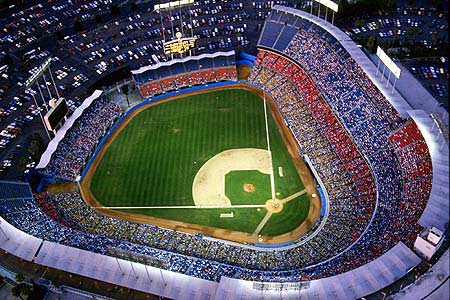
Dodger Stadium
L.A. Wrigley’s minor league baseball days ended when the Brooklyn Dodgers of the National League transferred to Los Angeles in 1958. The use of Wrigley was studied by the Dodgers, but they opted for seating capacity over suitability as a baseball field, and instead set up shop in the 93,000 seat Los Angeles Coliseum (which had a 251-foot foul line in left field) while awaiting construction of the baseball-only Dodger Stadium, which has a set capacity of 56,000.
In 1961, a new L.A. Angels club, named after the minor league team Los Angeles Angels (PCL), joined the American League as an expansion team, and took residence at Wrigley for just the one season. The team set a still-standing first-season expansion-team record with 71 wins. Thanks to its cozy power alleys, the park became the setting for a real-life version of Home Run Derby, setting another record by yielding 248 home runs. That 248 mark would stand for over 30 years. After the 1961 season, the team moved to Dodger Stadium (or Chavez Ravine, as it was known for Angels games), which was the Angels’ temporary home while Angel Stadium was being built. The new Dodger Stadium also “took over” for Wrigley Field, as the site of choice for Hollywood filming that required a ballpark setting.
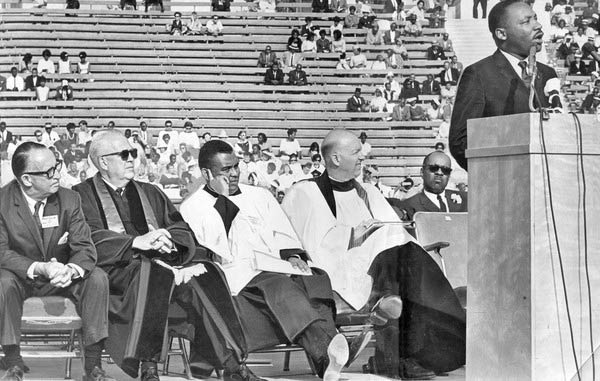
Martin Luther King spoke at Wrigley in 1963
There were no more regular tenants after 1961. By then the park was owned by the city, and various events were staged. On May 26, 1963, a large crowd attended a civil rights rally featuring Martin Luther King, Jr. By 1966 the park was being used for soccer matches and the like. Demolition began in March 1969, to make way for a new recreation facility called Gilbert Lindsay Park. The park has a ball field in the northwest corner of the property, which was once a parking area. The diamond is locally known as “Wrigley Field,” and is the home of Wrigley Little League baseball and softball. The original site of the Wrigley diamond and grandstand is occupied by the Kedren Community Mental Health Center and another parking lot.
The ballpark’s dimensions were cozy but symmetrical, giving a nearly equal chance to right and left-handed batters in the Home Run Derby series. The only difference was that the left field wall was 14.5 feet (4.4 m) high, whereas the right field fence was only 9 feet (2.7 m) high.
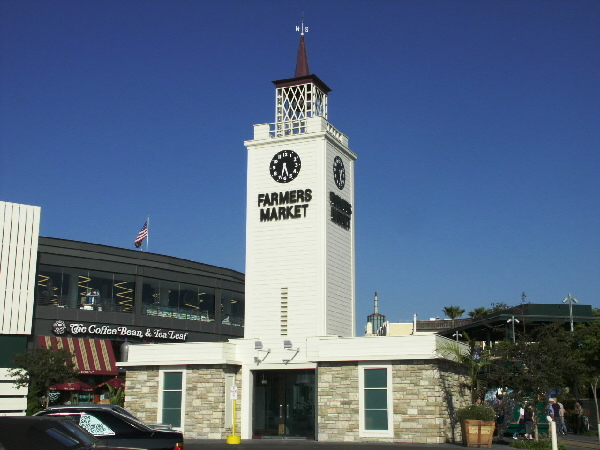
The Farmers Market is an area of food stalls, sit-down eateries, prepared food vendors, and produce markets in Los Angeles, USA. It also a historic Los Angeles landmark and tourist attraction, first opened in July 1934.
The Farmers Market features more than 100 restaurants, grocers and tourist shops, and is located just south of CBS Television City. Unlike most farmers’ markets, which are held only at intervals, the Farmers Market of Los Angeles is a permanent installation and is open seven days a week. The dozens of vendors serve many kinds of food—both American cuisine from local farmers and restaurants and Los Angeles’ variety of local ethnic foods from the many immigrant communities of Los Angeles, with many Latin American and Asian cuisines well represented.
Farmers Market is located at the corner of 3rd Street and Fairfax Avenue in the Fairfax District of Los Angeles, California, USA. It is adjacent to The Grove outdoor shopping mall; an electric-powered streetcar runs between the two sites.
The market is a destination for foodies in search of the market’s ethnic cuisines, as well as its specialty food markets and prepared food stalls. The front of Farmers Market displays a sign saying “Meet Me at Third and Fairfax.”
The market started when a dozen nearby farmers would park their trucks on a field to sell their fresh produce to local residents. The cost to rent the space was fifty cents per day.
In 1870, when they moved west from Illinois, Arthur Fremont (A.F.) Gilmore and his partner bought two sizable farms, one of which was the 256-acre (1.04 km2) dairy farm at this corner. Gilmore gained control when the partnership dissolved later.
Gilmore Oil Company replaced the dairy farm when oil was discovered under the land during drilling for water in 1905. Earl Bell (E.B.) Gilmore, son of A.F. Gilmore, took over the family business. The younger Gilmore started midget car racing and brought professional football to Los Angeles. He built Gilmore Field for the Hollywood Stars baseball team, which was owned by Bing Crosby, Barbara Stanwyck, and Cecil B. DeMille.
When CBS Television City opened next door in 1952, the Farmers Market provided those working or visiting that television studio a convenient place to shop or eat.
In the 1970s The Country Kitchen, a restaurant owned and operated by Jack and Eileen Smith (located next to the still-operating Du-par’s), was popular with stars and their fans alike. Mickey Rooney could sometimes be found working behind the counter. Other customers included Elvis Presley, Regis Philbin, Rip Taylor, Mae West, Johnny Carson, and even The Shah of Iran on his visit.
Koning Eizenberg Architecture, Inc. devised a major renovation, expansion, and master plan for the Market in the early 1990s. The project was initiated to provide new retail, office, and services spaces and reconfigure circulation and parking for the historic site.
In July 1934 a contingent of farmers pulled their trucks onto an expanse of empty land at the property known as Gilmore Island at the corner of Third and Fairfax in Los Angeles. They displayed their produce on the tailgates of their vehicles; to their delight customers quickly arrived and parked their cars on a hastily created dirt parking lot in spaces designated with chalk. They strolled among the trucks purchasing fruit, vegetables and flowers.
The atmosphere was casual, the open air commerce enticing, the goods fresh, and the result remarkable. Farmers Market became an instant institution.
With a partner, Arthur Fremont Gilmore purchased two ranches in the Los Angeles vicinity. The purchase inaugurated a string of serendipitous events that not even the far-sighted Gilmore could predict. When Gilmore and his partner elected to dissolve their arrangement, they drew straws—Gilmore’s straw secured 256 acres on which he created a successful dairy farm. A.F. Gilmore had no plans for a world-renowned institution when he moved to Los Angeles from Illinois in 1870. Rather, he was seeking a better life on the promising West Coast. When he married Mary Elizabeth Bell in 1882, the small adobe on the property became the new home for his family.
At the turn of the century, while drilling for water for his herd of dairy cows, A.F. Gilmore hit oil. By 1905, the dairy was gone and the Gilmore Oil Company born.
Earl Gilmore, son of Arthur F. Gilmore later developed Gilmore Field and the Pan-Pacific Auditorium on the site.
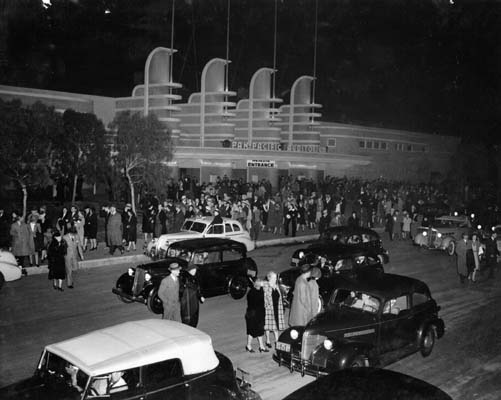
The Pan-Pacific Auditorium was a landmark structure in the Fairfax District of Los Angeles, California which once stood at 7600 West Beverly Boulevard near the site of Gilmore Field, an early Los Angeles baseball venue predating Dodger Stadium. It was located within sight of both CBS Television City on the southeast corner of Beverly and Fairfax Avenue and the Farmers Market on the northeast corner of Third Street and Fairfax. For over 35 years it was the premiere location for indoor public events in Los Angeles. The facility was closed in 1972, beginning 17 years of steady neglect and decay. In 1978 the Pan-Pacific Auditorium was included in the National Register of Historic Places but 11 years later the sprawling wooden structure was destroyed in a spectacular fire.

Designed by the Los Angeles architectural firm Wurdeman and Becket, which later designed the Music Center and the space-age “Theme Building” at Los Angeles International Airport, the Pan-Pacific Auditorium opened to a fanfare of Boy Scout bugles on May 18, 1935 for a 16-day model home exhibition. Noted as one of the finest examples of Streamline Moderne architecture in the United States, the green and white facade faced west, was 228 feet (69 m) long and had four stylized towers and flagpoles meant to evoke upswept aircraft fins. The widely known and much photographed facade belied a modest rectilinear wooden structure resembling an overgrown gymnasium inside and out. The auditorium sprawled across 100,000 square feet (9,300 m2) and had seating for up to 6,000.
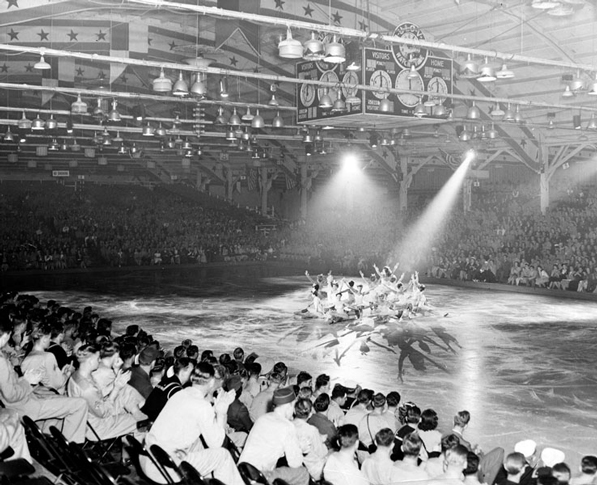
Throughout the following 30 years the Pan-Pacific would host the Ice Capades and the Harlem Globetrotters, serve as home to the Los Angeles Monarchs of the Pacific Coast Hockey League along with UCLA ice hockey, UCLA men’s basketball, USC men’s basketball, professional tennis, car shows, political rallies and circuses. During the 1940s it was used for audience-attended national radio broadcasts and in the 1950s for televised professional wrestling shows. At its height, most major indoor events in Los Angeles were held at the Pan-Pacific. Leopold Stokowski conducted there in 1936, 1950s actress Jeanne Crain was crowned “Miss Pan Pacific” there in the early 1940s, General Dwight D. Eisenhower spoke to a beyond-capacity crowd of 10,000 in 1952 a month before being elected President of the United States, Elvis Presley performed there in 1957 shortly before he was drafted into the Army and Vice President Richard Nixon addressed a national audience from the Pan-Pacific in November 1960. The building carried on as Los Angeles’ primary indoor venue until the 1972 opening of the much larger Los Angeles Convention Center, after which the Pan-Pacific Auditorium was closed.
In 1975, the Pan-Pacific made a brief appearance as the entrance to the NBC Studios in New York for the movie Funny Lady. Interest in the building was rekindled somewhat with its 1978 inclusion in the National Register of Historic Places. The 1980 release of the movie musical Xanadu brought renewed hopes the building might be saved when the auditorium’s facade was used to portray a dilapidated building which became a sparkling, brightly lit roller disco nightclub, but the movie was critically panned and not an economic success. The building made a brief, final appearance in the 1988 movie, Miracle Mile.
Black-and-white film footage of a man with a jet pack flying from left to right in front of the facade was used in the video for the 1981 Devo single, Beautiful World.
The auditorium continued to deteriorate throughout the 1980s, mostly owing to neglect. A large loading door on the southeast corner was often forced open, allowing free access to anyone. A fire in May 1983 damaged the northern end. On the evening of May 24, 1989 (six days after the 54th anniversary of its opening), the Pan-Pacific Auditorium was destroyed by a spectacular fire, the smoke from which was visible throughout the Los Angeles basin.
There were hopes throughout the surrounding Fairfax District towards refurbishing the Pan-Pacific, possibly as an ice rink or cultural center and the parking lot soon became a park. However, the building was neglected for many years and damaged by small fires accidentally started by transients.
A nearly full-scale, stylized replica of the facade opened as the main entrance to Disney’s Hollywood Studios theme park in Florida on May 1, 1989, just three weeks before the original was destroyed by fire.
Disney California Adventure Park, at the Disneyland Resort, opened new entrance gates in the style of the Pan-Pacific’s facade on July 15, 2011.
Pan Pacific Park, featuring a building echoing the original’s former glory, now sits on the site. There is a scaled-down replica of one of the famous towers.
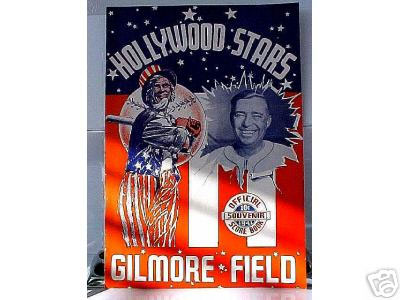
Gilmore Field is a former minor league baseball park that served as home to the Hollywood Stars of the Pacific Coast League from 1939-1957 when they, along with their intra-city rivals, the Los Angeles Angels, were displaced by the transplanted Brooklyn Dodgers of the National League.
Gilmore Field opened on May 2, 1939 and was the home of the Hollywood Stars of the Pacific Coast League until September 5, 1957. The stadium had a seating capacity of 12,987 people.
The ballpark was located on the south side of Beverly Boulevard between Genesee Avenue and The Grove Drive, just east of where CBS Television City is currently located. A couple hundred yards to the west was Gilmore Stadium, an oval-shaped venue built several years earlier, which was used for football games and midget auto racing. To the east was the famous Pan-Pacific Auditorium. Both facilities were built by Earl Gilmore, son of Arthur F. Gilmore and president of A. F. Gilmore Oil, a California-based petroleum company that was developed after Arthur struck oil on the family property. The area was rich in petroleum, which was the source of the “tar” in the nearby La Brea Tar Pits.
The field had intimate quarters from the spectator standpoint—first and third bases were 24 feet from the first row of seats. Home plate was 34 feet from the stands. The outfield gave the pitchers more of a break with foul lines 335 feet long, power alleys about 385, and 407 to center field. The power alleys were thus 40 feet deeper than in the cross-town counterpart, Wrigley Field.
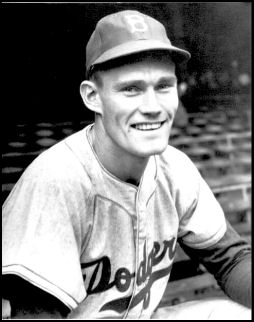
In 1938 Herbert Fleishaker, owner of the Mission Reds moved his team to Los Angeles, and took the name of the Hollywood Stars after the city’s previous PCL franchise. After but one season, the team was sold to new owners, among them Bob Cobb of Brown Derby Restaurant fame and the inventor of the California Cobb Salad. In their salad days, as it were, the Stars attracted glamorous actors and other celebrities or anyone else who wanted to be “seen,” much as Dodger Stadium would later. One of the L.A. Angels players, Chuck Connors, made a successful move from one side of the box seat railing to the other, becoming the star in “The Rifleman,” a popular 1950’s TV show. The Stars would play at Gilmore Field until 1957.
Chuck Connors went on to star in the popular TV series, The Rifleman
In 1948, Gilmore Field became the spring training location for the Pittsburgh Pirates.
Although L.A.’s Wrigley Field seemed to get the lions’ share of Hollywood screen time, Gilmore Field also had its moments on celluloid. It was featured in a 1949 movie called The Stratton Story, starring James Stewart and June Allyson, the true story of a promising pitcher (Monty Stratton) whose career was curtailed due to a hunting accident that left him with an artificial leg. Stratton’s major league baseball career was over, but he made a comeback at the minor league level. The scenes at the end of the movie were set elsewhere, but were filmed at Gilmore Field. The layout of the outfield, and especially the exceptionally high left and right field corners, help to identify it.
The ballpark site was abandoned after 1957. Gilmore Field was razed in 1958, and much of the site is now occupied by a parking lot at CBS Television City, near the Farmers Market. In September 1997, the Pacific Coast League Historical Society, CBS, and the A.F. Gilmore Company dedicated a bronze plaque in commemoration of Gilmore Field on a wall outside CBS Studio 46.
Gilmore Stadium was used for American football games at both the professional and collegiate level. The stadium was the home of the Los Angeles Bulldogs, the first professional football team in Los Angeles. The Bulldogs competed as an independent team before joining the second American Football League in 1937 and winning its championship with a perfect 8-0-0 record, the first professional football team to win its championship with an unblemished record. After the collapse of the league, the Bulldogs returned to being an independent team before joining the American Professional Football Association in 1939. The Bulldogs then became charter members of the Pacific Coast Professional Football League in 1940 and played in Gilmore Stadium until 1948, when the team moved to Long Beach, California, for its (and the league’s) final season. Gilmore Stadium was also the site of two 1940 National Football League (NFL) Pro Bowls.
On January 14, 1940, the 1939 NFL champion Green Bay Packers met an All-Star team consisting of players from the nine other NFL clubs in the second NFL All-Star game in history. The Packers won 16 to 7.
Extra seating was added to accommodate 21,000 fans for the Pro Bowl for the 1940 NFL season. The crowd set a record as the largest to view a Los Angeles pro game. The event was held on December 29, 1940. The game pitted the 1940 NFL Champion Chicago Bears against an All-Star team from the other NFL clubs in the third NFL All-Star game. The Bears won 28 to 14.
Midget car racing was invented at the track. The track hosted midget car racing from the track’s debut in May 1934 to 1950. The 1939 Turkey Night Grand Prix was held at the track.
Rodger Ward drove Vic Edelbrock’s midget car in a famous August 10, 1950 event at Gilmore Stadium. Ward shocked the racing world by breaking Offenhauser engine’s winning streak by sweeping the events at Gilmore Stadium that night.
Notable drivers that raced at the track include Danny Bakes, Bill Betteridge, Fred Friday, Walt Faulkner, Perry Grimm, Sam Hanks, Curly Mills, Danny Oakes, Roy Russing, Bob Swanson, Bill Vukovich, Rodger Ward, and Karl Young. Drivers that were killed at the track include Ed Haddad, Swede Lindskog, Speedy Lockwood, Frankie Lyons, and Chet Mortemore.
In the sixteen years of the stadium’s existence, over 5 million fans attended races at the track. The stadium drew crowds over 18,000 people each race. Attendance dropped to below 9,000 at normal weekly races by the late 1940s. The attendance drop and increased demand for property in West Hollywood led to the track’s sale in 1950. It was torn down in 1951. Some of its grandstand was installed at Saugus Speedway.
It also hosted donkey baseball, dog shows, rodeos, and at least one cricket match. Esther Williams performed in a diving and water ballet performance. A temporary above ground pool was constructed for the event. Several professional boxing title matches where held in the stadium. U.S. President Harry S. Truman delivered his “stiff upper lip” speech in the stadium.
Harry Truman speaks at Gilmore Stadium — Hollywood notables including Lauren Bacall, Humphrey Bogart… and Ronald Reagan were in attandenace.
Gilmore Stadium was featured in a 1934 Three Stooges short featuring a football game, and fittingly titled Three Little Pigskins. The scoreboard, with the name of the stadium, appears prominently in several shots, as does a billboard advertising Gilmore products. A sign for the nearby Fairfax Theater, across Beverly Boulevard at the north (open) end of the stadium, is also visible in the background a couple of times.
On May 19, 1947 Gilmore Stadium was packed with people waiting to hear a speech by Progressive Party candidate for President Henry A. Wallace. Wallace served as vice president under FDR and was also the Secretary of Agriculture (his specialty) and Secretary of Commerce. Also speaking at the event was actress Katharine Hepburn, whose speech stole the show.
The Hollywood Stars were a minor league baseball team that played in the Pacific Coast League during the early and mid 20th century. They were arch rivals of the other Los Angeles based PCL team, the Los Angeles Angels.
The first version of the Hollywood Stars began its existence in 1903 as the Sacramento Solons, a charter member of the PCL. The team moved to Tacoma in 1904, where it won the pennant as the Tacoma Tigers. During the 1905 season, the team returned to Sacramento to finish out the season, moved to Fresno in 1906 to finish last as the Fresno Raisin Eaters, then left the PCL altogether. The Sacramento Solons rejoined the PCL in 1909, and then moved to San Francisco during the 1914 season, finishing out the season as the San Francisco Missions. The team was sold to Utah businessman Bill “Hardpan” Lane and moved to Salt Lake City for the 1915 season. They played as the Salt Lake Bees for the next eleven seasons until Lane moved the team to Los Angeles for the 1926 season. Originally they were known as the Hollywood Bees, but soon changed their name to the Hollywood Stars.
The original Stars, though supposedly representing Hollywood, actually played their home games as tenants of the Los Angeles Angels at Wrigley Field in South Los Angeles. Though the Stars won pennants in 1929 and 1930, they never developed much of a fan base, playing their home games miles from the glamorous Hollywood district. They were merely a team to watch when the Angels were on the road. Attendance had been quite good (by standards of that era) during their inaugural year in 1926, but tapered off after that, exacerbated by the Great Depression.
When, after the 1935 season, the Angels doubled the Stars’ rent, Lane announced the Stars would move to San Diego for the 1936 season, to become the San Diego Padres. Los Angeles became a one-team city once more for the 1936 and 1937 seasons.
The second version of the Hollywood Stars joined the PCL in 1909 as the Vernon Tigers. As the Tigers, the team won two PCL pennants (and finished first in another only to lose the postseason series) before moving to San Francisco for the 1926 season. The transplanted Tigers, now known as the Mission Reds or usually just “the Missions,” foundered in San Francisco, failing to establish a rivalry with the existing San Francisco Seals.
In 1938 Missions’ owner Herbert Fleishaker moved his team back to Los Angeles, and took the name of the departed Stars. After but one season, the team was sold to new owners, among them Robert H. “Bob” Cobb, one of the owners of the Brown Derby restaurant and for whom the Cobb salad is named. The new ownership realized the team needed to represent Hollywood in order to succeed. They sold stock in the team to movie stars, movie moguls, and Hollywood civic leaders (“the Hollywood Stars owned by the Hollywood stars”). (One of these, Gene Autry, subsequently became owner of his own major league franchise, now the Los Angeles Angels of Anaheim.) Another major investor was William Frawley from TV’s I Love Lucy. Moreover, the team actually played in the Hollywood area, beginning in 1939 when 13,000-seat Gilmore Field was opened in the Fairfax District adjacent to Hollywood. (The club played part of the 1939 season in nearby Gilmore Stadium, after having played at Wrigley Field during 1938.)
The new Stars (or “Twinks”) caught on and became a very popular team, winning three pennants before 1958. They had successful affiliations with the Brooklyn Dodgers and Pittsburgh Pirates of Major League Baseball. In 1955, actress Jayne Mansfield was named Miss Hollywood Star. The Stars became genuine rivals of the Angels, and it was not uncommon for fights between the teams to break out during Angels-Stars games. In fact, on August 2, 1953, a brawl between the two teams lasted 30 minutes, broken up only when 50 riot police were sent to Gilmore Field by Chief of Police William Parker, who was at home watching the game on television when the fight started.
The Twinks were innovators. They began the custom of dragging the infield during the fifth inning, creating an artificial break in the action hoping fans would run to the concessions stands. The team began televising home games in 1939, and in later years televised every home game.
The Stars also had the dubious distinction of being the first team to replace the traditional bloused baseball trousers and stirrup socks with shorts and long socks in 1950. The theory was that players could run faster in this gear than in the baggy wool or cotton flannel uniforms of the day. The new uniforms resembling those worn by female softball players were “too Hollywood” even for Hollywood, as well as being very tough on the legs when sliding. They were soon replaced.
The Stars were immortalized on the 1957 jazz album Double Play! by Andre Previn and Russ Freeman. The baseball-themed album, with song titles like Called On Account Of Rain, Batter Up and In The Cellar Blues features a model on the cover wearing a Stars cap, in a rather suggestive pose by 1950s standards.
The Columbia Broadcasting System, owner of Gilmore Field, announced plans to raze the facility to build a new headquarters—CBS Television City, as it became known—in 1952. Before Stars’ owners could make contingency plans, however, the “other shoe dropped.” In October 1957, the Brooklyn Dodgers confirmed their long-rumored move to Los Angeles for the 1958 season, which forced the Stars and the Angels to relocate. The Angels, who had been purchased by Dodgers owner Walter O’Malley prior to the 1957 season, became the Spokane Indians in 1958.
Having no interest in operating the Twinks anywhere but in Los Angeles, the ownership group led by Frank J. Kanne, Jr. was compelled to sell the team, which it did, to a group based in Salt Lake City. The Stars, in a sense, “returned” to Salt Lake City (whence the original Stars had moved in 1926) in 1958, becoming the Salt Lake Bees once more.












 Jess Waid