All posts by jesswaid

Unknown's avatar

About jesswaid

Currently, I write police procedural novels with the stories taking place in Hollywood during the early 1960s; a period when I was a street cop there. I've moved to Mexico to be closer to my hobby of studying Mexican history. My friend and fellow author, Professor Michael Hogan, is my mentor. I am planning to write a three-part epic story that takes place in the mid-nineteenth century. What has inspired me was hearing about Los Ninos Heroes, martyrs of the Battle of Chapultepec. Also, my father was born in Concordia, Mexico and knowing his family history is an added incentive.

LAPD authors…

I would like to plug my fellow retired LAPD authors, so I am listing their works below:

BOOKS, FICTION & NON-FICTION, BY FORMER LAPD OFFICERS

The Oasis Project by Art Adkins  (May 17, 2010)  $14.00

Power Grid by Art Adkins  (Sept 10, 2010) $14.99 – Kindle $2.99

A Dozen Deadly Roses by Kathy Bennett  (Jun 4, 2011) Kindle $2.99

A Deadly Blessing by Kathy Bennett  (Apr 8, 2012) Kindle $2.99

Sand Against Time by Paul Bishop (1990) Hardcover (used) $24.95

Chapel of the Ravens by Paul Bishop (Oct 1992) Hardcover $18.25 Paperback $4.87

Croaker: Grave Sins by Paul Bishop (Jun 28, 2011) – $2.99 Kindle

Bluff City Brawler (Fight Card) by Heath Lowrance, Jack Tunney, Mel Odom and Paul Bishop (Sep 1, 2012) – $2.99 Kindle

Felony Fists (Fight Card) by Jack Tunney, Mel Odom and Paul Bishop (Nov 11, 2011) – $0.00 Kindle

Get Hit, Hit Back (Fight Card) by Jack Tunney, John Kenyon, Paul Bishop and Mel Odom (May 26, 2013) – $2.99 Kindle

Hot Pursuit by Paul Bishop (Jun 19, 2011) – $2.99 Kindle

The Other Side of Truth by Paul Kimball and Greg Bishop (Apr 3, 2013) – $9.39 Kindle

The Cutman (Fight Card) by Jack Tunney, Mel Odom and Paul Bishop (Nov 11, 2011) – $0.99 Kindle

Deep Water by Paul Bishop (Jun 19, 2011) – $2.99 Kindle

Penalty Shot by Paul Bishop (Jun 23, 2011) – $2.99 Kindle

Welcome to the Octagon (Fight Card MMA) by Jack Tunney, Gerard Brennan, Paul Bishop and Mel Odom (Apr 17, 2013) – $0.99 Kindle

Fight Card: Against the Ropes by Jack Tunney, Terrence McCauley, Paul Bishop and Mel Odom (Feb 11, 2013) – $2.99 Kindle

The Knockout (Fight Card) by Jack Tunney, Paul Bishop, Mel Odom and Robert J. Randisi (Dec 1, 2012) – $0.99 Kindle

Golden Gate Gloves (Fight Card) by Jack Tunney, Robert Evans, Mel Odom and Paul Bishop (Oct 21, 2012) – $2.99 Kindle

The Centurions’ Shield by Keith and Jake Bushey

Uniform Decisions by John Caprarelli and Lee Mindham  (Dec 27, 20110 $11.80 – Kindle $7.99

Criminal Justice Administration by Clyde Cronkhite (Oct 15, 2007) $84.28

Law Enforcement and Justice Administration by Clyde Cronkhite (Jan 15, 2012) $126.95/$58.25pb

Fallen Angels by Connie Dial (Apr 20, 2012) $22.04 – Kindle $9.99

Internal Affairs by Connie Dial (Jun 1, 2009) $21.29 – Kindle $15.40

The Broken Blue Line by Connie Dial (Jun 1, 2010) $21.28 – Kindle $15.40

The Buffalo Rock by Bob Faulkner  (Aug 8, 2008) $30.00

The Warrior in Me by David E. Gray (Mar 9, 2010) $19.99 – Kindle $7.69

True to the Blue by David E. Gray

Eclipse of the Blue by David E. Gray (Oct 28, 2012) $29.99 – Kindle $3.99

Images of America – Los Angeles Police Department by Tom Hays and Art Sjoquist (Oct 10, 2005) $19.99

Black Dahlia Avenger by Steve Hodel (Apr 11, 2003) $11.18 – Kindle $0.99

Most Evil by Steve Hodel (Sep 22, 2009) $3.99 – Kindle $7.99

Black Dahlia Avenger II by Steve Hodel (Mar 13, 2012) $19.11 – Kindle $7.99

Thicker’n Thieves by Charles Stoker and Steve Hodel (Mar 13, 2012) $23.00 – Kindle $7.19

Islam and Barack Hussein Obama by Stephen M. Kirby, Ph.D. (Jul 20, 2010) $8.75

Letting Islam Be Islam by Stephen M. Kirby, Ph.D. (Oct 1, 2012) $18.18

Orphan’s Asylum by Mike Krecioch (Feb 20, 2008) $19.99 – Kindle $3.99

“G’d Up” 24/7 – The GHB Addiction Guide by Trinka Porrata (Jun 1, 2007) $34.99

War Stories Lived by a L.A. Cop by Robert E. Reynolds (Aug 1, 2012) $19.95 – Kindle  $19.95

Good Cop Dead Cop by Bob Ruchhoft and Phil Smith (Apr 4, 2011) $13.95 – Kindle $4.99

The BCMC – The Big City Motor Cop by Gary Smith (Jul 29, 2009) $19.99 – Kindle $9.99

Hide and Seek – The Warrant Game by Gary Smith (Apr 6, 2011) $19.99 – Kindle $9.99

Casey Teel by Dale Sprinkle (Sep 29, 2011) $28.95/$17.95pb – Kindle $3.99

The First Crime Scene by Frank Tomlinson  (Oct 17, 2009) $19.99

No One Escapes by Frank Tomlinson  (Nov 24.2011) $18.99

The SWAT Pioneers – A History of the LAPD’s SWAT Program 1965-1972 by Rik Violano (Jan 1, 2006) $30

To Ride a Hurricane by William L. Walker  (Mar 3, 2008) $28.80 – Kindle $15.95

To Ride a Hurricane II The Redemption by William L. Walker (Dec 6, 2011) $29.95 – Kindle $29.95

Gene Roddenberry’s “Earth Final Conflict” (Bk. 1) by Gene Roddenberry (Out of Print)Gene Roddenberry’s “Earth Final Conflict” (Bk. 2) by Gene Roddenberry (Out of Print)

THE MAKING OF STAR TREK : The Book on How to Write for TV! by Stephen E. Whitfield and Gene Roddenberry (Jul 1, 1970) (Currently unavailable)

Star Trek 5, The Rift, Chain of Attack, Star Trek: The Motion Picture, Deep Doma by Peter David, Gene DeWeese, Gene Roddenberry, David Dvorkin, Melinda James Blish (Jan 1, 1972) (Currently unavailable)

The Star Trek Reader I by James Blish and Gene Roddenberry (Sep 1976) Hardcover $30.48

Star Trek: The New Voyages by Sondra Marshak, Myrna Culbreath, Gene Roddenberry and Cast of Star Trek (1976) Paperback $39.99

The Star Trek Reader II by James Blish and Gene Roddenberry (Apr 1977) Hardcover $11.65

The Star Trek Reader III by James Blish and Gene Roddenberry (Aug 1977) Hardcover $12.99

The City on the Edge of Forever (Star Trek Fotonovel, No. 1) by Harlan Ellison and Gene Roddenberry (Nov 1977) Paperback $8.30

Where No Man Has Gone Before (Star Trek Fotonovel, No. 2) by Samuel A. Peeples and Gene Roddenberry (Nov 1977) Paperback $47.99

The Star Trek Reader IV by James Blish and Gene Roddenberry (Mar 1978) Hardcover $20.93

The Devil in the Dark (Star Trek Fotonovel, No. 9) by Gene L Coon and Gene Roddenberry (Jul 1978) Paperback $10.00

Day of the Dove (Star Trek Fotonovel No. 10) by Jerome Bixby and Gene Roddenberry (Aug 1978) Paperback $40.56

All Our Yesterdays (Star Trek Fotonovel #6) by Gene Roddenberry (Sep 29, 1978) Paperback $14.99

Amok Time (Star Trek Fotonovel, No. 12) by Theodore Sturgeon, Gene Roddenberry and DeForest Kelley (Oct 1978) Paperback $39.95

A Piece of the Action (Star Trek Fotonovel #8) by David P Harmon and Gene Roddenberry (Nov 24, 1978) Paperback $10.00

Star Wars The Motion Picture by Gene Roddenberry (1979) Hardcover (Used) $0.88

Star Trek the Motion Picture by Gene Roddenberry (1979) Paperback $13.46

Star Trek by Gene Roddenberry (Jan 1, 1980) Paperback(used) $1.21

The Making of Star Trek: The Motion Picture by Gene Roddenberry and Susan Sackett (Feb 29, 1980) Paperback $81.52

Star Trek: The Motion Picture by Gene Roddenberry (Mar 28, 1980) Paperback $15.85 Hardcover $84.40

The Making of Star Trek by Stephen E. Whitfield and Gene Roddenberry (1986) Paperback $19.99

Envoys of Mankind: A Declaration of First Principles for the Governance of Space Societies by George S. Robinson, Harold M. White and Gene Roddenberry (Nov 1986) Hardcover $17.00 (Collectible)

Star Trek Novel by Roddenberry (Apr 2, 1987) Paperback $15.85 – Hardcover $19.99

Star Trek: the Making of the TV Series by Gene Roddenberry (Sep 12, 1991) Paperback $66.64

GENE RODDENBERRY: The Myth and the Man Behind Star Trek by Gene Roddenberry). Engel, Joel (1994) Hardcover $44.95

GENE RODDENBERRY, THE LAST CONVERSATION by Gene RODDENBERRY (1994) Hardcover $50.00

Errand of Fury by Gene Roddenberry Kevin Ryan (2007) Paperback $4.98

Star Trek, the Next Generation: Before Dishonor by Gene Roddenberry Peter David (2007) Paperback $12.05

Star Trek Vol.1 (Graphic Novel) Gold Key (The Key Collection) by Gene Roddenberry (Jun 30, 2011) Kindle $6.99

Star Trek Vol.2 (The Key Collection) by Gene Roddenberry (Jun 30, 2011) Kindle $4.61

Star Trek Vol.3 (The Gold Key Collection) by Gene Roddenberry (Jul 14, 2011) Kindle $8.99

Star Trek Vol.4 (The Key Collection) by Gene Roddenberry (Jul 14, 2011) Kindle $8.99

Star Trek Vol.5 (The Gold Key Collection) by Gene Roddenberry (Jul 14, 2011) Kindle $8.99

Fame, Hollywood style


Along fifteen blocks of Hollywood Boulevard and three blocks of Vine Street in Hollywood, California, is the The Walk of Fame. It was established in 1958 and attracts more visitors,  about ten million annually—than other LA area attractions such as the Sunset Strip, Grauman’s Chinese Theater, the Queen Mary in Long Beach, and the Los Angeles County Museum of Art.

As of November 8, 2012, the Walk included 2,484 stars, spaced at 6-foot intervals. Each star consists of a coral-pink terrazzo with five-points, trimmed in brass (not bronze), inlaid into a charcoal-colored terrazzo background. In the upper portion of he pink star field, the name of the honoree is inlaid in brass block letters. Below the inscription, in the lower half of the star field, a round inlaid brass emblem indicates the category of the honoree’s contributions. The emblems symbolize five categories within the entertainment industry:

 
– Classic film camera, representing motion pictures;
– Television receiver, representing broadcast television;
– Phonograph record, representing audio recording or music;
– Radio microphone, representing broadcast radio;
– Comedy/tragedy masks, representing theater/live performance (added in 1984).

The Hollywood Chamber of Commerce maintains The Walk. They, or the Hollywood Historic Trust, grant “special stars” unique to the honoree. They are not part of the Walk of Fame; instead, they are located nearby on private property. These “Friends of the Walk of Fame” monuments vary from the trademark “star” shape, in that they are charcoal terrazzo squares, rimmed by miniature pink terrazzo stars displaying the five standard category emblems, along with the sponsor’s corporate logo, with the sponsor’s name and contribution in inlaid brass block lettering. Examples include the Los Angeles Police Department (LAPD) star emblem, a replica of a police badge indicating the LAPD’s Hollywood Division, and the Los Angeles Dodgers, displaying the team’s logo.

Then there are the uniquely shaped monument for the Apollo 11 mission to the Moon, consisting of four identical, circular “moons” bearing the names of the three astronauts (Neil Armstrong, Michael Collins, and Edwin E. “Buzz” Aldrin Jr.), the date of the first moon landing (“7/20/69”), and the words “Apollo XI” set in each of the four corners at the intersection of Hollywood and Vine. The “moons” are silver and dark gray terrazzo circles rimmed in brass on a square pink terrazzo background, with the television emblem inlaid at the “twelve o’clock” position on the circles.

The original selection committees chose to recognize some entertainers’ contributions in multiple categories with multiple stars. Gene Autry is the only honoree with stars in all five categories. Bob Hope, Mickey Rooney, Roy Rogers, and Tony Martin each have stars in four categories—Rooney has three of his own and a fourth with his wife, Jan, while Rogers also has three of his own, and a fourth with his band, The Sons of the Pioneers. Thirty-three people, including Frank Sinatra, Dinah Shore, Gale Storm, Danny Kaye, and Jack Benny, have stars in three categories.
Seven recording artists have two stars in the same category, for distinct achievements: Michael Jackson, as a soloist and as a member of The Jackson 5; Diana Ross, as a member of The Supremes and for her solo work; Smokey Robinson, as a solo artist and as a member of The Miracles; and John Lennon, Ringo Starr, George Harrison, and Paul McCartney as individual performers and as members of The Beatles. Cher forfeited her opportunity to join this exclusive club by declining to schedule the mandatory personal appearance when she was selected in 1983. She did, however, attend the unveiling of the Sonny & Cher star in 1998, as a tribute to her recently deceased ex-husband, Sonny Bono.
The only two fictional characters to have two stars are Kermit the Frog and Big Bird, each with an individual star and one with The Muppets.
George Eastman is the only honoree with two stars in the same category for the same achievement—the invention of roll film.

Thor

The ears may be embarrassing right now, but just wait ’til he’s the size of a small pony!

I pulled our old Silverado up to the closed chain ink gate in Camp Verde, Arizona and read the sign:

Don’t trespass unless you can outrun a dobie who will cover the distance from the house to here in 2.5 seconds.

OK, that’s not exactly what the sign said, but the message was clear. We had found the home of Thor, the Doberman Pinscher puppy we had purchased via the Internet. I gave him his name, and so far, it looks as though it fits.

I had previously owned an Akita, but she passed away after 13 years. We were moving to Mexico, so I decided I wanted a replacement, another large dog, primarily for protection but also as a companion on my walks along the malecon beside lovely Lake Chapala.

Searching the web for a suitable puppy, when I came upon http://www.bigdobies.com, I was intrigued, especially by the “big” part of their URL. I soon learned that Suzan and Paul Baker indeed bred large dobies, pups that would grow to 30 inches at the shoulder and weigh as much as 130 pounds. I was hooked.

All went well with the Bakers. We drove from our home on the Oregon coast to Arizona to pick Thor up, then headed south. To make certain he imprinted with me, I insisted that Barbara do the driving until we got to Rio Rico, a small town about 14 miles north of the Mexican border. This gave me some crucial hours in the car to make sure our new puppy knew who was boss.

The next day I took over the wheel, convinced Thor now knew who was in charge. For three days he was subjected to the sights, sounds, and sensations (including the ubiquitous topas, Mexican speed bumps) of a typical road trip south of the border. He had company in the car, as we also have two small papillons, a male, seven-pound Beau, and a female, 14-pound Teri, as well as a two-year-old, 16-pound male schnoodle, Chico. What can I say?

The long and short of it is we arrived safely at our new hacienda. We’re still adjusting to life below the Rio Grande.

Teri has always been tormented by Chico, who constantly bites and holds onto her long, feathery tail. There is justice in this world, however, as now Chico is having to contend with Thor, who delights in glomming onto his little pal’s tail and giving it a good tug.

It’s hilarious watching the already 20-pound, ungainly Thor, sliding along on the stone-tile floors, holding on for dear life as a seriously miffed Chico drags him all over the house in an exasperated attempt to break free.

Poor Thor.

I say this because of his trimmed ears. Originally, I had opted not to have them cut, but wanting to have him look the part of a protector, I changed my mind. To ensure the ears will stay erect takes at least two months, and involves keeping each ear taped to a round post made of foam, and then looping the tape around both to hold them steady. If puppies are capable of embarrassment, Thor’s in trouble.

Somehow, on our trip south, we lost the Elastikon bandage tape the Baker’s had provided, forcing us to find another brand of elastic-adhesive tape to replace it. Turns out there’s a reason Elastikon is what savvy dobie owners use. Our replacement tape has led to an ongoing ear-taping nightmare.

Instead of leaving the ears wrapped for five days, with a two-hour air-circulating reprieve sandwiched in, we have to re-tape the ears daily, because Thor scratches the bandages to the point they look like earring balls. I’m I worried we’ll get to the point where we feel so sorry for him (not to mention our own frustration), we’ll give up on the whole ear thing.

So if in future you happen to run into Thor, and notice his narrow, pointed (because of the cutting), limp ears you’ll know why he looks so pathetic.

But please don’t laugh or tease him about it. Remember, floppy ears or no, he’ll be the size of a small pony, and can cover 50 yards of ground in 2.5 seconds!

Kenpō (or Go-Shinjutsu)


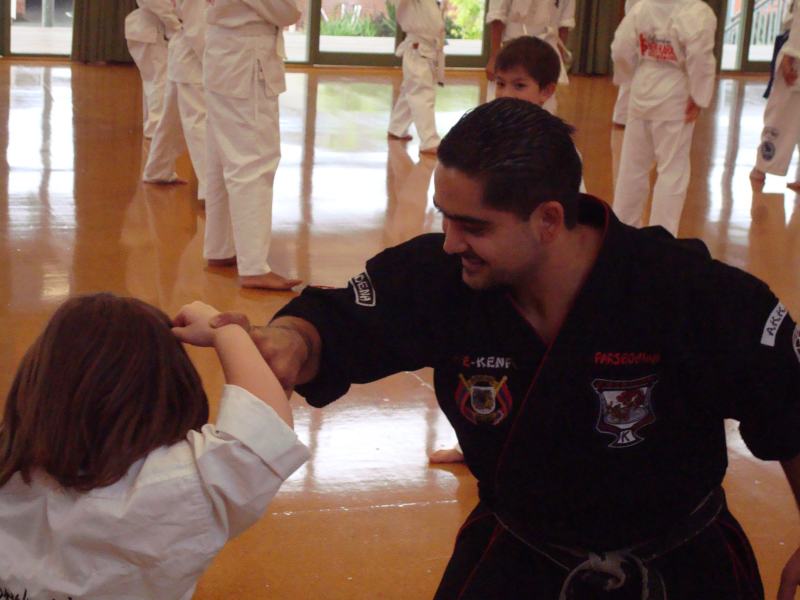
The Mike Montego series takes place in the early 1960s. Mike is a highly skilled kenpō martial artist. Not an unusual feat today, but a half-century ago, the cross-cultural (Ryukyuan, Chinese, and Japanese) self-defense system was relatively unheard of in the United States.

In the U.S., kenpō is often referred to as kenpo karate. The most widespread styles have their origins in the teachings of Great Grand Master James Mitose, who learned the kenpo art in Japan from his grandfather, Sakuhi Yoshida, and Professor William Kwai Sun Chow.

Professor “Willie” Chow trained in “kenpo jiu-jitsu” under Mitose. However, Chow called it Go-Shinjutsu, sometimes spelled Go-Shinjitsu.

The American east coast features a branch of kenpo created by Nick Cerio, and later built upon and redefined by Fredrick J. Villari. who brought the hybrid art of shaolin kempo karate to the general public through his nationwide network of “Villari’s Martial Arts Centers.” The Villari system integrated the strengths of American kenpo with the larger scope of movement and grappling available in shaolin kung fu and chin na, to create a highly unique American kenpo offshoot system.

Kenpo karate is, therefore, a distinct form of kenpo, although its techniques are virtually indistinguishable from Mitose’s kenpo jui-jitsu. The difference is mostly in the katas, or training routines. There were no katas in Chow’s kenpo karate, while kenpo jiu-jitsu has four katas: Nihanchi 1 and 2, the Bear Kata, and the Old Man Kata.

In the Montego series, Mike practices an Okinawan form of kenpō that focuses on empty handed/open-handed striking. His teacher, Yoshi Kono, a fictional Japanese master, learned the skill in his native Okinawa.

Mike Montego’s stories parallel the time when Edmund K. Parker, a student of Chow, was employing a blend of Chinese circular movements and hard linear movements to produce an effective self-defense system. He created techniques with names such as Thundering Hammers, Five Swords, Prance of the Tiger, and Flashing Mace to provide a memorization tool to his students.

Ed Parker, in early 1962, changed the style he had been teaching since 1956 in his “Kenpo Karate” studio in Pasadena, and renamed it “Chinese Kenpo,” dropping “karate” from the name of his system, even though he continued to issue belt certificates under the Kenpo Karate Association of America (KKAA), an organization he founded.

The practice by others of this distinct form of martial arts is not mentioned in the Mike Montego series for literary purposes.

For more information on kenpo, see Wikipedia, where one can find Will Tracy’s “The Origin of Kenpo Karate,” a fascinating history .

Run for it!

A participant in the LAPD’s Challenge Cup, Baker to Vegas Relay


NOTE FROM JESS WAID: Sergeant Alex Shearer, a good friend, now deceased, is the man the character Alex Strait is based on in my Mike Montego novels.

 Alex, who truly liked being called “Uncle Alex,” was a member of the LAPD’s long-distance running team that ran relays across the nation.

 In a letter to me dated March 22, 1994, Alex wrote the following:


It was early afternoon and I was getting ready for my leg when a squad car with three local deputies drove up. I soon learned that one of the deputies was going to “run a ways with me.”

         Now you know how I hate these unscheduled running partners, so I walked over to him. Bob Hickey was probably only 15 minutes away.

         The deputy was in full uniform, complete with Sam Brown and Smokey the Bear hat.

         I asked him, “You going to run with me?”

         “Yup.”

         “You going to wear that hat?”

         “Yup.”

         “What about the gun belt and gun?”

         “Yup.”

         My pissed-off point went up a notch or two.

         “You are going to change those cowboy boots, aren’t you?”

         “Nope.”

         That did it. This guy would rue the day he met me. He was about to undergo exquisite punishment.

         As Hickey and I made the baton exchange, I cranked along fast enough to let my fellow runner know that he had made a grievous error, but not fast enough to make him drop out.

         After a few hundred yards, my struggling companion removed his hat and threw it in the following squad car.

         I chuckled.

         A hundred yards farther on, off came the gun and gun belt.

         My floundering companion could not stop long enough to remove his cowboy boots. It must have been pure agony for him.

         I loved it!

         As we approached the town I decided the deputy had learned the folly of his ways and was ready to put it in gear and leave him to his blisters and misery.

         Starting to sprint off, I looked ahead and spied a fairly large number of the population had gathered along the street to watch. I figured they had come out to watch one of their locals run through town with a runner from the Big City.

         I don’t know whether it was because he was a fellow police officer, or I didn’t want to humiliate him in front of his fellow citizens, but I decided to drop back.

         We ran through the town together.

         Upon leaving the town folks behind us, he dropped off.

         I’ll never forget his last words, “Thanks for cutting me some slack.”

         I finished my leg with a good feeling. But I would probably have felt better if I had punished him a bit more.

         What nerve running with me in that outfit!


Played Misty for Me

This is a nicely done story, the real deal, by former LAPD cop and ex-sheriff of Jerome, Idaho, James D. Weaver. Enjoy!

West Los Angeles Division, Bel Air, 1980’s

I’ve just arrived for work when Officer Bob Stout, aka “Fatty,” the guy who coordinates all off duty cop jobs, approaches me. Bob tells me I am up for the next assignment. He maintains a list of officers who want to work off duty – the pay matches the LAPD’s hourly wage, and serves to keep the bill collectors off our backs. Having child support and numerous monthly payments to meet, thanks to my recent divorce, I gladly reply, “I’m your guy.”

“This job only became available because the vice guys are too busy,” Bob says.

He tells me I am to meet with the manager of a hotel who has a prostitution problem. Right there, Bob has gotten my attention. I’m used to high school dances, athletic events, and private parties, that sort of thing.

After filling out a Form 1.47 (Permit for Outside Employment), I call the hotel and am connected to a Mr. Checkers, the manager. I explain the reason for my call.

“I’d like to meet with you, ASAP,” Checkers says.

A short time later, I’m in his office. I sit on the opposite side of his fancy executive desk. As if I can’t tell already, he tells me that his hotel is high-end, very private, and extremely discreet. As part of their service, the concierge obliges those male guests who occasionally request a female companion to accompany them to business dinners, or simply to have a cocktail with.

Checkers says, “Jim let’s cut to the chase. Most of the ladies are high-class call girls.  You know—top of the line. We don’t get too bothered by it, as our policy is what happens here, stays here.”

He isn’t telling me anything I don’t already know. The hotel’s Bistro Lounge is home to the west-side “beautiful” people.

“Jim, one such lady, Misty, is stealing money, credit cards and jewelry from her ‘dates.’ Naturally, the guests she victimizes don’t want the police involved—the embarrassment, you know—and we prefer it that way, but she is posing a problem—risking the hotel’s reputation.”

Checkers leans forward, elbows on his desk.

“Bob Stout assured me he would send over someone like you, Jim, to work Misty—catch her with the goods, so to speak . . . and so, I went ahead and set up a date with her for next Friday night at 9 o’clock, here at the Bistro Lounge. I gave her the name Wally Woodstock. Misty told me she would be in a white dress, and would wear her red hair down over her shoulders. I told her which suite went along with the Woodstock name.”

Sitting back, he adds, “I’ve arranged to have a BMW in the garage for your disposal, should you need it, and I will provide you beforehand with $1,000 in marked bills—also, dinner reservations in the Lounge have been made under the name ‘Woodstock.’”

Checkers then says, “If you make the arrest, please be very discreet.”

“No problem, sir, but I will need a partner as a backup and witness.”

Checkers quickly agrees to pay for the second officer.

Later that day I meet with my long-time partner, Ron, and give him the scoop. He’s up for it, saying, “I’ve never been in the fancy joint.”

“Yeah right. OK, Ron, when I get the violation, I’ll say ‘fantastic,’” and then you bust on in. OK?”

He nods, his face forming a Cheshire cat grin. “I bet it will be, too.”

We review the legal elements needed for a violation of 647.B (Prostitution) in the California Penal Code—basically: naming the type of sex act, and hearing the offered price for said act.

Friday night, Ron and I arrive at the hotel, right on schedule. As expected, the suite is “top floor” quality. I hand Ron a key. Without having to say a word, I know he will watch my back and be ready for any problems. Even though he’s a carefree character, he knows how to take care of business.

We go down to the bar and take up our positions. The barroom is doing a good business, a place where guests relax while waiting for their table in the Lounge.

Around 9:15 pm, I spot the redhead, my date. Who wouldn’t? She jounces into the bar wearing a low-cut white dress, allowing her small breasts to rise visibly. Her hair hangs to the center of her back. Over her shoulders?

As she approaches the bar, several men’s eyes follow her sashaying hips.

I step up. “Misty?”

“Mr. Woodstock?”

“The one and only.”

I take her arm and lead her to my table. It’s set up for two. Candlelight flickers between us as our drinks are served. Soon, her leg is against mine. She also squeezes my hand.

“I’m sorry I’m late—you know how horrible LA traffic can be.” Her emerald-green eyes, twinkling from the golden flame, gaze at me longingly. “May I call you by your first name?”

“Sure . . . it’s Wally.”

“Wally . . . I like that. Well, Wally, I promise I will make it up to you.”

Casually, I scan the bar. Ron holds his favorite drink, a Glenlivet, neat. Typical Ron, he’s jawboning with a busty cocktail waitress.

After several vodka-and-Seven’s, the maitre d’ escorts Misty and me to our table in the dimly lit Bistro Lounge. I have to agree with what I’d heard: it is an ideal place for a rendezvous like the one we’re supposedly having.

Once seated, Misty again presses her leg next to mine. Her tongue peeks over her ruby lips, moistening them as she bends slightly toward me, enough to give me an eyeful of milky breasts, a smile on her made-up face.

She orders a lobster; I smile and do the same. I also order a bottle of Dom Pérignon.  We chat about what is going on in our lives over dinner. During dessert, Misty gets down to business.

“Wally . . . I think I’d like to have an after-dinner drink.” Her tone is questioning.

“I would like that,” I quickly say, admittedly feeling a rise in my groin.

“Wally . . . I like you. Would you mind if we had it in your room?”

As we walk out of the Lounge, I look for Ron. He’s nowhere in sight. I should be concerned, but I’m not. The drinks, the mood of the evening, and my groin have me feeling no pain. It’s about show time. I must focus on the bust—not hers, Jimbo! 

We enter the suite and I immediately ring room service for another bottle of Dom. Misty is sashaying in front of me, giving me a seductive stare. Thankfully, the bellhop soon knocks at the door. After he wheels in the cart with the bottle settled in a bucket of ice, I ask him to open the champagne. He does, and fills two glass flutes. I tip him and he departs.

Simultaneously, Misty throws her arms around me, blows in my ear, nibbles my earlobe, and kisses my neck. I’m getting tumescent.

Things are moving way too fast.

I quickly untangle myself. “Let me wash up, hon—enjoy your Dom.”

When I return she is on the sofa, down to her pink underwear and lying on her side. One of the best bodies I have ever seen.

“Come and get it cowboy,” she purrs then empties her stem glass.

Having no vice experience, I only know I need to get a violation. But she hasn’t even hinted about wanting money. I can’t expose myself, especially not with a hard-on—then she saves my ass.

“But first, cowboy, it’ll cost you $500 for a half-and-half (street vernacular for a blowjob and a straight lay.)

Sighing in relief, I say, “OK, lady—but first, let me see that fine body of yours.”

Misty eyes the swelling in my crotch, and quickly slips out of her bra and panties.

“Misty, you’re fantastic,” I say loudly with my head facing toward the hallway door.

I stand stupidly waiting for Ron to bust into the suite.

No Ron.

I repeat, even more loudly, “yeah, you’re really fantastic!”

I hear a scraping noise at the door, then a banging.

Misty sits up, obviously startled.

Ron staggers in and shouts, “Los Angeles Police, you’re unner arrest.” His words are slurred.

Misty immediately puts on the sob scene, like she’s been here before. “Can’t we work something out?”

I read Misty her legal rights.

“I got nothin’ to say to you fuckin’ assholes,” she spits out.

I landline Dispatch, and request a radio car to transport her to the West Los Angeles Station.

Later, while completing the necessary reports, Ron joins me.

“Misty just beat us back to the streets, pardner—she made bail.”

“Sorry I’m so slow.” Ron knows that report writing isn’t my favorite piece of police work.

“No problemo. I’m heading out, Jimbo—see you at Westside Frank’s for a nightcap.”

“OK, give me thirty.”

Arriving at Frank’s, a cop bar, I see Ron sitting with Fatty Bob. Feeling magnanimous, I announce, “I’m buying gents.”

I open my calfskin wallet to pay for the round.

“Oh shit!”

Mexican Train

Not this.


This.


Mexican Train.

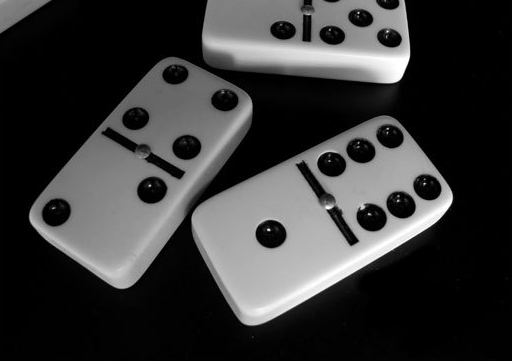
You might think I am referring to a locomotive that rattles noisily down steel tracks somewhere in Mexico. Well, I am not. I am talking about a popular board game using dominoes that I discovered through friends.

A year ago or so, when in Mexico, Tom and Dee Grant, along with another couple, Don and Leslie, introduced my wife, Barbara, and I to the game. I forgot about the fun event until our last visit to the Grant’s home. That evening we again played Mexican Train, but with another couple as Don and Leslie weren’t available.

During the game, funny little things occurred that brought chuckles. Soon the double entendres were flying. I laughed until my eyes were blurry. The game went on for five hours. Barbara won. She’s a games person.

Anyway, when we returned to our home in Oregon, I decided to buy the game. Fearlessly, I went online and found www.mexicantrainfun.com.

Wow! Check out the website and you will see why it nearly blew my mind. It’s not exactly the slickest website in the world, but boy is it ever filled with, well, content. I thought I’d find a simple game featured here — you know, a box full of dominoes,  the other necessary pieces, and some simple instructions. Wrong. Instead, I was faced with a a long list of choices.

First, which set did I want? here were five options: a Double 6 with threes and fives (the number of pips on a tile), the most popular size, along with a Double 9, a Double 12 with 91 dominoes with the tile pips ranging from blank (0) to 12, a Double 15 with 136 dominoes ranging from 0 to 15, and a Double 18 featuring 190 dominoes, with the tile numbers ranging from 0 to 18. This one allows you to play more complicated games.

The website features a video to help you see the games and the colors on the various sets. In addition to dominoes with pips, they’re also available  with numbers (makes ‘em easier to read). There are various racks and trays (wood or plastic), a rules and strategy book, tournaments to sign up for, and domino clubs to join. There’s even a blog site for players’ comments.

For example, a question was posed on the site about a player announcing that he wanted to “go out” on a double (a tile with the same number of pips on each half), but not having a tile to answer it. The rules were checked, and seeing a name of a recognized expert on the game they called her. Her response was that you must answer a double to go out. This changes the strategy of the game a great deal, since you should try to hold a tile that coordinates with a double, or be sure to play a double earlier if it doesn’t match anything in your hand so you can go out, or, if it is a low double, hang onto it to the end because it will be low points in your hand. Get it?!

You are wondering why I don’t explain the above in greater, more lucid detail, it’s because I really can’t, at least not yet. I am still a novice. Like I’ve said, I’ve only played the game twice. I’m not Barbara!

I have learned one important detail, however. It turns out that the owner of the premises where the game is being played is the final arbiter in all disputes. It might pay to host the game.

What’s available on the website doesn’t stop there. They sell train markers, a set of eight that come in solid colors or with glitter, or a Double 6 with black dots and brass spinners (don’t ask). You can buy a container (case) in vinyl, tin, wood, or aluminum, and carry it in a tote bag with a Mexican Train logo. Ot how about a yard sign for advertising that Mexican Train is being played at your place tonight?

They sell train hubs in clear plastic, or wood hubs for six or eight players. Some sets have train hubs that come with sounds. Even chicken sounds! And why not also get yourself a set of 10 colored chicken markers while you’re at it? Or there’s always the interactive yellow hub with chicken-foot and train graphics and sounds. Simply push “train sound” when you start a train, or “chicken crow” when you start a double (again, don’t ask!).

There are attractive red caboose pencil sharpeners, dominoes with jumbo sized pips or numbers, even a spiffy, four-fold domino tabletop. There are large train markers, the Mexican Train whistle key chain, and, best of all, a large glass train in a silver gift box. And of course you have to have scorecards, and an official train pen.

It’s apparently highly recommended that you cover your game table with felt. It makes for quieter play, and the tiles slide more easily. Also, since dominoes pick up dirt from table surfaces, people’s hands, food, and drink, over time they become dirty. You guessed it. The site offers cleaning remedy suggestions.

Being a party animal, I decided I wanted to be able to play with eight players, so I opted for the professional-sized Double 15. Hey, it was on sale, at a whopping 19% discount. I saved $16. Plus, bonus, it came with a faux cowhide Leatherette case with a snap closure. And the train hub is interactive. You know, with those funny chicken sounds.

I stopped short of purchasing the game night lawn sign. I like to think that shows a certain steely sort of masculine will and determination.

On the other hand, it could simply be because I don’t have a lawn.

Thor

Our four-legged security system, Thor, at four weeks

We’re moving to Mexico soon. While the area we’re moving to is far safer than many a neighborhood in the States, home security is still an issue.

Thus Thor.

This cute little denizen of Camp Verde, Arizona, will be picked up en route to our lovely new digs south of the border. Before you can say “Bob’s your uncle,” Thor will have grown a bit, ready and able to make unwelcome visitors to our hacienda nueva wish they’d dropped in somewhere else!

Who needs a .357 magnum?

So when you drop by for a visit, be sure to ring the doorbell, smile a lot — and bring a Milkbone or two!

The birth of cool

Legendary cool jazz trumpeter, Chet Baker

1958-1964 bore a different look, attitude and sound than anything that had come before. It was that brief, eventful era that bridged the gap between the old-school glamour of Hollywood’s Golden Age, and the, hipper, harder-edged times that would follow. It was during these years that rock and roll was born, and, while not marking the birth of the blues, was the period when this form of distinctly American music finally received broad public recognition. Blues had been around for decades, but mainstream America paid little attention, until it was discovered that the blues were the root of rock and roll.

A new generation began to emerge, embracing music and fashion that directly expressed the changing times. It was this sexy combination that soon inspired the rest of the world to get with the new program. Blues and rock and roll were this new wave’s musical meat, and folk music was their potato. Then punks came on the scene, along with rebels, hipsters, potheads, and loud ‘n fast guitars.

The times, they were a’changin’.

The atmosphere in the smoke-filled jazz clubs of that era was stifling. Windows and doors were opened to allow some “cool air” in from the outside, to help clear away the suffocating smoke. It was inevitable that the slow, smooth jazz style that was typical for that late-night scene came to be called “cool.”

Marlene Kim Connor connects cool and the post-war African-American experience in her book, What is Cool? Understanding Black Manhood in America. Connor writes that cool is the silent and knowing rejection of racist oppression, a self-dignified expression of masculinity developed by black men denied mainstream expressions of manhood. She argues that the mainstream perception of cool is narrow and distorted, that it is too often seen merely as a style or a sign of arrogance, rather than a way to achieve respect. Designer Christian Lacroix is onside with Connor, noting that, “…the history of cool in America is the history of African-American culture.”

While speaking of cool, anyone interested in this “new” jazz phenomenon is well advised to check out Ted Gioia’s excellent book, Cool Jazz and West Coast Jazz.

Postwar cool

World War II brought the people of Britain, Germany, and France into intimate contact with Americans and American culture. The war brought hundreds of thousands of GIs to these countries, men whose relaxed, easy-going manner was seen by young people of the time as the very embodiment of liberation. They brought with them came Lucky Strikes, nylons, swing, and jazz, in addition to this laid-back attitude—the new American Cool.

To be cool or “hip” at the time meant hanging out with buddies, pursuing sexual liaisons, displaying the appropriate attitude of narcissistic self-absorption, and generally expressing a desire to escape the mental straitjacket of “old-fashioned” ideologies. From the late 1940s onward, American popular culture influenced young people all over the world, to the great dismay of the paternalistic elites who still ruled the “official” culture.

The stage was set for one of the greatest eras of social unrest and upheaval in Western history.

Signs

I was born under the astrological sign of Aries, the ram. Two days later and it would have been Taurus, the bull. Mother, bless her heart, told me she really wanted her baby to be born on a Sunday. I don’t know why. I don’t think she thought about astrology. Well, ever the doting son, I arrived just after noon on a Sunday, as scheduled. I suspect I actually wanted to come days earlier. Maybe that explains why I tend to be impatient.

According to mythology, in Hellenistic astrology the sign of the ram was associated with the golden winged ram that rescued Phrixos and his sister Helle from the altar, where they were to be offered as a sacrifice to Zeus. The golden ram carried them to the land of Colchis, but on the way, Helle fell into the sea and drowned. When Phrixos arrived at Colchis he sacrificed the ram to Zeus and presented the Golden Fleece to his father-in-law, the King of Colchis. The fleece was then hung upon a sacred oak and guarded by a dragon, until rescued by Jason and the Argonauts. The myth recounts that Zeus was so moved by the ram’s fate that he gave it the greatest honor possible, that of being moved to the heavens.

Although the zodiac element of Aries is fire, I am not passionate about many things, but I’ve been known to blow up on occasion. Still, I don’t see myself as a fiery person.

Another Aries quality is cardinal. All I can say is that deep scarlet is my favorite color. Maybe reading about the zodiac sign has unduly influenced me, but I doubt it.

The ruler of the Aries sign is Mars, the Roman god of war. Mars represented military power as a way to secure peace; Mars had a love affair with Venus. I hesitate to comment on how that might affect me, however, considering that Venus is seen as a detriment in the Aries sign, I wonder. I’ve been wedded four times, although my last marriage, nearly 23 years ago to Barbara Kay, took. Perhaps, like John Gray’s book, Men are from Mars, Women Are from Venus: The Classic Guide to Understanding the Opposite Sex, suggests, my first three marriages were doomed — it was a Venus-Mars matter. No further comment.

Under Aries, the exaltation is the sun. All I can say is that I like being in a sunny clime. That’s why I’ve decided to settle in Mexico. Thankfully, Barbara loves the area we’re headed to, too.

Anyway, most of my life I paid little attention to the astrological sign I was born under. Yet, as I grew older and thought about events in my life, and my behavior generally through the years, I thought about Aries and the ram sign. I considered what I’d experienced in life, and compared those experiences with what people who specialize in horoscopes wrote, like the late Sydney Omarr.  I often found I could fit what astrologists stated to some small event that had happened to me on any given day. It was easy to read in what I wanted to see.

The bottom line is, while I’m unsure about a connection between the alignment of planets and my individual actions, I do feel we humans generate energy that can cause things to happen. I say “things,” because I can’t put a label to it. I’ll leave that to the specialists.

I recall seeing a large billboard on Cahuenga Boulevard, where the winding pass from the San Fernando Valley entered Hollywood, when I was a youngster. It displayed a couple with clasped hands, and the phrase, Prayer Changes Things. I wonder about the energy thing and the power of group prayer. I have read that when people concentrate in unison on one specific thing, positive results sometimes follow.

Anyway, I am fascinated by astrology and phenomena that can’t easily be explained; but, honestly, I rarely read books on the subject.

One other thing. For years, number 48 was my favorite. I was born in the fourth month, when there were 48 states, and World War II ended when I was eight. But the number has never been lucky for me. I have never won a thing by betting on it. I still like the number, though. A good reminder that winning isn’t everything!